Cappadocia Adventures
Cappadocia Adventures

Imagine standing on a quiet hillside in Cappadocia, surrounded by ancient rock-cut houses, abandoned chambers, and the distant silhouette of Mount Hasan.
In front of you stands an extraordinary stone church.
Its walls are decorated with elegant arches and red-brick patterns. Once, an impressive dome rose above its interior. Today, much of the building lies in ruins, but its surviving architecture still reveals the remarkable craftsmanship of medieval Byzantine builders.
Welcome to Çanlı Church (Çanlı Kilise), one of the most fascinating historical monuments near Aksaray.
Unlike Cappadocia's famous cave churches, Çanlı Church was constructed from carefully cut stone and decorative brickwork.
But what makes it truly extraordinary is the settlement surrounding it.
Archaeological research has revealed that this isolated-looking church once stood at the centre of a prosperous Byzantine community, complete with large residences, chapels, agricultural facilities, and underground shelters.
Çanlı Church is more than an ancient religious building. It is the surviving centrepiece of a medieval town that offers a remarkable glimpse into everyday life in Byzantine Cappadocia.
Let's discover its fascinating story.
During the Middle Byzantine period, Cappadocia became home to communities whose livelihoods combined agriculture, trade, military administration, and religious life.
Its volcanic landscape provided materials for constructing monumental stone buildings and excavating entire settlements directly into the rock.
Çanlı Church developed within this environment.
Located near Akhisar village, southeast of Aksaray, it stood within an extensive settlement overlooking the surrounding countryside.
The Turkish name Çanlı Kilise translates as Bell Church.
However, the church's original Byzantine name and religious dedication are unknown.
There is no surviving historical evidence securely identifying the saint or religious figure to whom the building was originally dedicated.
The familiar name belongs to the monument's later history.
One of the most important developments in understanding Çanlı Church came during archaeological investigations led by Professor Robert Ousterhout.
Beginning in 1994, an international research team documented the church and its surrounding settlement.
Their findings transformed how historians understood the site.
Earlier visitors had often interpreted the extensive rock-cut buildings as a large monastic establishment.
However, Ousterhout's investigations identified something far more complex.
The settlement contained substantial residences, smaller dwellings, storage facilities, stables, churches, and agricultural structures.
These discoveries suggested that Çanlı was not exclusively a monastery.
It was a functioning Byzantine community where people lived, worked, worshipped, and maintained their households.
Researchers have also suggested that the settlement may have been associated with the nearby fortress at Akhisar.
During the Byzantine period, fortified settlements played important roles in defending the region and organising local administration.
The impressive houses surrounding Çanlı Church may have belonged to wealthy landowners or families connected with military officials.
However, the identities of the original residents remain unknown.
The exact administrative relationship between the town and the fortress is also a scholarly interpretation rather than a documented certainty.
Çanlı Church is generally dated to the 11th century AD.
Architectural studies suggest that its principal construction may have taken place around 1050 AD, although no original inscription establishes an exact year.
Researchers have also proposed dates extending into the second half of the 10th century.
The church belongs to a period when Byzantine architecture was undergoing important developments.
Builders increasingly employed domed, cross-shaped churches with carefully organised interior spaces.
The most prominent examples were found in Constantinople, the Byzantine capital.
At Çanlı, architectural details demonstrate the influence of these metropolitan traditions.
The use of red bricks, carefully shaped stone blocks, and decorative arches is particularly significant.
The building did not necessarily acquire its surviving form during one construction campaign.
Architectural investigations identify three principal stages:
The original domed church.
The western entrance complex, or narthex.
A later chapel adjoining the northern side.
The addition of these spaces demonstrates that the church continued to develop after its original construction.
The surrounding settlement also experienced changes over time.
Official heritage records identify rock-cut buildings associated with occupation extending broadly from the 10th to 14th centuries.
The most reliable conclusion is that Çanlı Church was constructed during the Middle Byzantine period, probably in the 11th century, while the surrounding settlement remained in use through later medieval phases.
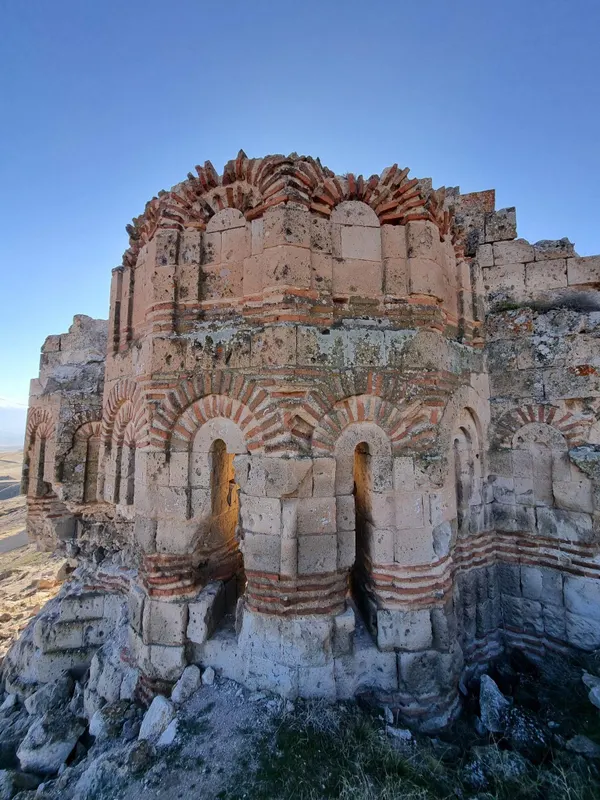
The architecture is undoubtedly Çanlı Church's most spectacular feature.
Unlike Göreme's rock-cut churches, Çanlı was built using a combination of carefully dressed stone and red brick.
Its design reflects both Cappadocian building traditions and architectural influences from Constantinople.
The original church followed a cross-in-square plan.
But what exactly does that mean?
Imagine a square building divided internally by four supporting columns or pillars.
The principal vaulted spaces form a cross, while smaller chambers occupy the corners.
Above the central area rises a dome.
This design became particularly important in Middle Byzantine church architecture.
At Çanlı, the original central space measured approximately nine metres by nine metres.
One of the church's most impressive original features was its central dome.
Historical architectural descriptions indicate that it rose to a considerable height above the main interior.
Its drum, the structure supporting the dome, was divided into twelve sides.
Narrow windows allowed daylight to enter the building.
Unfortunately, the dome no longer survives.
Historical photographs demonstrate that it remained standing during the early 20th century.
Research indicates that it collapsed during the 1950s, reportedly following an earthquake.
The surviving walls and supporting structures still reveal its original scale.
At the eastern end, the church contains three apses.
An apse is the rounded sanctuary space traditionally associated with a Christian altar.
The principal apse occupied the central position, with smaller apses on either side.
Their exterior walls were constructed with multiple angled surfaces, creating a distinctive appearance.
The apses are among the church's most recognisable surviving architectural features.
Now comes one of Çanlı's most extraordinary details.
The church's exterior contains elaborate patterns created using alternating stone and red brick.
Rows of recessed arches decorate the walls, particularly around the windows.
These patterns create a remarkable sense of depth and rhythm.
Such decorative brickwork was strongly associated with architectural traditions of Constantinople.
Some researchers suggest that the craftsmen may have been familiar with the capital's building techniques.
However, the bricks and decoration alone cannot prove that the builders personally came from Constantinople.
The western entrance area, known as the narthex, was developed into an unusual two-storey arrangement.
A narthex normally served as the entrance space separating the outside world from the church's principal worship area.
At Çanlı, its substantial construction demonstrates that the building became more architecturally complex over time.
A smaller chapel was added along the church's northern side.
Such secondary chapels are known as parekklesia.
They could serve additional liturgical, commemorative, or funerary functions.
However, the exact original use of Çanlı's northern chapel is not securely established.
Çanlı Church is remarkable because its builders combined monumental Byzantine masonry architecture with the distinctive volcanic landscape of Cappadocia.
Although Çanlı Church is famous primarily for its architecture, its interior was once decorated with important Byzantine paintings.
Unfortunately, much of the original decoration has disappeared.
Centuries of deterioration, structural collapse, and environmental exposure have left only fragments of the frescoes.
Nevertheless, historical documentation provides valuable evidence of their subjects.
According to the Turkish Ministry of Culture and Tourism, the church's interior contained paintings representing Jesus Christ and his apostles.
These figures were central to Byzantine religious decoration.
Christ represented divine authority and salvation.
The apostles symbolised the early Christian community and the spread of Christianity throughout the world.
Their images connected the sacred building with the traditions of the Christian Church.
Architectural research also records paintings associated with events and miracles from the life of Jesus Christ.
Such scenes were common in Byzantine churches.
They helped communicate religious teachings to worshippers through visual storytelling.
However, the surviving paintings at Çanlı are too fragmentary to confidently identify a complete biblical narrative.
It would be misleading to describe the church as preserving extensive, clearly visible paintings of every major event from Christ's life.
One of the most important artistic characteristics of Çanlı is its connection with Byzantine painting traditions associated with Constantinople.
Researchers have identified similarities in style, composition, and the materials used for the paintings.
These connections suggest that the church's patrons wanted a building reflecting the artistic prestige of the Byzantine capital.
The combination of elaborate architecture and high-quality decoration also suggests substantial financial support.
The surrounding settlement preserves another important religious painting.
In a separate rock-cut church identified by archaeologists as part of Area 17, a fresco depicts the Deesis.
The Deesis represents Jesus Christ accompanied by the Virgin Mary and John the Baptist.
Mary and John appear as intercessors, appealing to Christ for mercy on behalf of humanity.
This composition is significant because it preserves an important element of Byzantine religious belief.
It belongs to a separate church within the Çanlı settlement, not the principal stone-built Çanlı Church.
Another fascinating fresco was discovered in a rock-cut chapel in Area 12 of the settlement.
It represents the Three Hebrew Youths in the Fiery Furnace, a story from the Book of Daniel.
According to the biblical narrative, three young men refused to worship a golden image established by King Nebuchadnezzar.
They were thrown into a furnace but survived through divine protection.
At Çanlı, the composition also includes figures interpreted as the chapel's donors.
The painting is particularly interesting because the heavenly figure's protective wings extend over both the biblical youths and the patrons.
This connects the biblical story of divine protection with the religious hopes of the individuals who supported the chapel.
The fresco is generally associated with the 11th century.
Although the paintings inside the main church are now severely damaged, the wider settlement demonstrates the richness of Byzantine religious art.
Christ, the apostles, military saints, donors, and Old Testament figures all formed part of the area's visual traditions.
The frescoes of Çanlı reveal that this was not an isolated religious monument but a community where Christian artistic traditions flourished across several churches and chapels.
During the Byzantine period, Çanlı Church was an important religious building within a substantial community.
Its architecture, frescoes, and surrounding structures provide valuable evidence of medieval life.
The principal church was designed for Christian religious ceremonies.
Its sanctuary and altar were associated with the celebration of the Eucharist, also known as Holy Communion.
The paintings of Christ and the apostles reinforced the religious importance of the sacred interior.
The church's monumental scale suggests that its construction required significant resources.
Perhaps the most remarkable archaeological discovery concerns the everyday activities of the surrounding inhabitants.
Researchers documented a wide range of structures, including homes, storage rooms, stables, cisterns, and agricultural facilities.
Some residences contained impressive courtyards and elaborately decorated rooms.
Others were considerably smaller and simpler.
These differences suggest that the settlement contained households of varying social and economic status.
Among the surviving structures are rock-cut wine presses and storage areas.
The surrounding landscape was suitable for agricultural activities.
Residents also maintained facilities for keeping animals and storing supplies.
These features demonstrate that the community relied on practical economic activities as well as religious institutions.
Archaeological surveys identified underground chambers extending beneath parts of the settlement.
These spaces contained passages and rooms that could have offered refuge during periods of insecurity.
However, their precise functions may have changed over time.
It would be inaccurate to claim that every underground chamber was used exclusively to hide Christians from persecution.
One of the most unusual features of Çanlı is the discovery of mummified human remains.
According to official Turkish heritage documentation, archaeological work within the settlement recovered mummified remains, coins, jewellery, small lead containers, and other objects.
Some of the human remains have been dated broadly to the 10th–13th centuries.
Materials associated with Çanlı have been preserved in museums in Aksaray and Niğde.
These finds provide valuable evidence about the people who lived and died in the settlement.
However, they do not establish that everyone buried here was a monk or a member of the clergy.
Çanlı Church offers an extraordinary picture of Byzantine life because its surviving archaeology combines religious worship, agriculture, domestic architecture, burial traditions, and community organisation.
Çanlı Church is located near Akhisar village, approximately 17 kilometres from Aksaray city centre, Türkiye.
The monument stands about four kilometres northeast of Akhisar, on an elevated plateau overlooking the surrounding countryside.
Its location provides spectacular views towards Mount Hasan.
The Monumental Stone Façade
The surviving stone walls and red-brick decorations are among Çanlı's most impressive architectural features.
The Decorative Arches
The carefully arranged recessed arches around the windows demonstrate the influence of Byzantine metropolitan architecture.
The Three Apses
The eastern sanctuaries preserve some of the church's most distinctive masonry details.
The Remains of the Central Dome
Although the original dome has collapsed, the surviving supports reveal the scale of the church.
The Fragmentary Frescoes
Small traces of the original religious paintings survive inside the ruined structure.
The Rock-Cut Settlement
Numerous caves and chambers extend across the nearby hillside, preserving evidence of the former Byzantine town.
The Courtyard Residences
Some surviving complexes contain decorated entrances, large rooms, and other features associated with medieval domestic architecture.
The Panoramic Views
Mount Hasan and the surrounding landscape create one of the most memorable settings of any historical church near Aksaray.
The church can be reached from Aksaray via Akhisar village.
According to official visitor information, Akhisar can be reached by local transport, followed by a walk of approximately four kilometres.
Travelling by private vehicle is generally more convenient.
The final approach passes through rural terrain, and road conditions may vary.
Çanlı Church is an archaeological ruin rather than a fully restored museum church.
The dome and substantial portions of the original structure have collapsed.
Some surrounding caves and chambers may also be unstable.
Visitors should avoid climbing damaged walls, entering unsafe chambers, or approaching areas affected by rockfall.
Current access arrangements should be confirmed with local authorities before travelling.
Akhisar Fortress
A nearby fortified site that may have been associated with the medieval settlement at Çanlı.
Red Church (Kızıl Kilise)
A remarkable early Byzantine masonry church near Sivrihisar, famous for its reddish stone and surviving dome.
Güzelyurt Monastery Valley
A historic landscape containing numerous Byzantine rock-cut churches.
Saint Gregory Church
An important historic church in Güzelyurt, now known as Kilise Camii.
Ihlara Valley
One of Cappadocia's most spectacular natural and historical destinations.
Absolutely!
Çanlı Church is particularly rewarding for travellers interested in Byzantine architecture, archaeology, and Cappadocia's lesser-known historical landscapes.
Its impressive masonry demonstrates the skill of medieval builders.
Its surviving fresco fragments preserve evidence of religious artistic traditions.
Its nearby dwellings reveal how Byzantine communities organised their daily lives.
And its archaeological discoveries have transformed historians' understanding of Cappadocia.
For many years, rock-cut settlements like Çanlı were frequently described as isolated monastic communities.
But archaeological research revealed something far more interesting.
A town where wealthy families, ordinary households, farmers, religious communities, and possibly military officials lived together.
Today, the church stands in ruins.
Its dome has disappeared.
Its streets have become overgrown.
And the people who once inhabited the settlement are long gone.
Yet the surviving buildings continue to tell their story.
Çanlı Church is more than another ancient Byzantine monument in Cappadocia. It is an extraordinary reminder that the region's history was shaped not only by monks and churches but also by the everyday lives of its medieval inhabitants.
Photography credits:
Ingeborg Simon / Wikimedia Commons – Creative Commons Attribution-ShareAlike 3.0 Unported (CC BY-SA 3.0).
Historical photograph: Gertrude Bell, 1907 – Public Domain.
Historical architectural drawing: Hans Rott, 1906 – Public Domain.
No tours currently list Çanlı Church (Bell Church) – Aksaray, Cappadocia as a stop. Browse all day tours or plan a custom trip.
Browse all Cappadocia attractions