Cappadocia Adventures
Cappadocia Adventures

Think you've seen everything Cappadocia has to offer?
Well, not so fast!
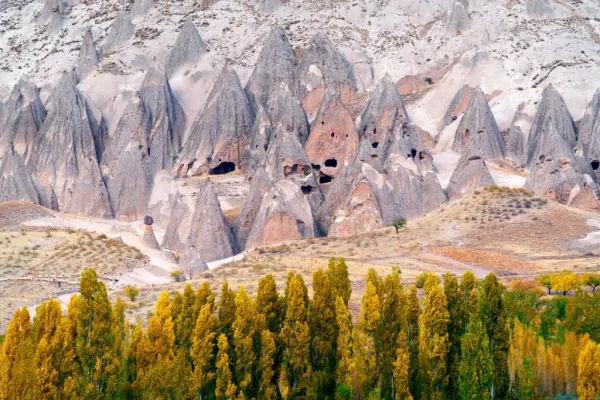
Yes, we know. You've seen the fairy chimneys, taken hundreds of photographs, and probably wondered how on earth people managed to live inside rocks.
But what if we told you that some of Cappadocia's most fascinating stories are hiding far beyond its famous valleys?
Welcome to the Blue Tour!
This journey takes you through centuries of Anatolian history, from the elegant stone mansions of a former Greek Orthodox settlement to ancient monasteries, remarkable Roman mosaics, and the extraordinary rock-cut churches of Soğanlı Valley.
And don't worry, we're not turning this into a boring history lecture!
Your journey begins with a warm meeting with your tour guide at your hotel before heading towards the southern countryside of Cappadocia.
Get comfortable, keep your camera ready, and prepare to discover a completely different side of this extraordinary region.
Four destinations. Thousands of years of history. And plenty of stories worth telling!
Mustafapaşa (Sinasos) VillageOne village, two names, and a history that might surprise you!
Our first destination takes us to Mustafapaşa, formerly known as Sinasos, a beautiful historic settlement located approximately 5 kilometres south of Ürgüp.
And believe us, this is not your ordinary Anatolian village!
As you wander through its charming streets, you'll notice magnificent stone mansions, beautifully carved doorways, historic churches, and buildings that seem to belong to a completely different century.
Well, many of them actually do!
During the Ottoman period, Sinasos was a prosperous settlement inhabited by both Greek Orthodox Christians and Muslim Turks.
Particularly during the 18th and 19th centuries, the village developed an impressive architectural identity, with elegant stone residences reflecting the wealth, craftsmanship, and cultural influences of its inhabitants.
Apparently, having a beautiful house was quite important back then, too!
But behind these beautiful buildings lies a fascinating, and rather emotional, chapter of history.
Following the population exchange agreement signed between Greece and Türkiye in 1923, the Greek Orthodox inhabitants of Sinasos were required to leave their homes. The exchange took place locally in 1924, when Muslim families arriving from Greece settled in the village.
Imagine leaving behind the house where your family had lived for generations, knowing that another family, experiencing a similar displacement, would soon call it home.
History is not always as beautiful as the buildings it leaves behind.
Today, the village preserves remarkable examples of this shared architectural and cultural heritage.
Among its important historic landmarks is the Church of Saints Constantine and Helena, originally constructed in 1729 and repaired in 1850.
And here's another interesting detail!
In 2021, Mustafapaşa was recognised as one of the world's Best Tourism Villages by the United Nations World Tourism Organization.
Not bad for a little village in Cappadocia, right?
After discovering its beautiful stone streets and fascinating history, we continue our journey towards a place where people once dedicated much of their lives to faith, work, and spiritual contemplation.
Next stop: Keşlik Monastery!
Keşlik MonasteryEver wondered what everyday life was like for monks in ancient Cappadocia?
Well, here's your chance to find out!
After departing from Mustafapaşa, our journey continues towards Keşlik Monastery, a fascinating Byzantine-era religious complex located near Cemil Village.
Surrounded by Cappadocia's extraordinary volcanic landscape, this historic monastery offers visitors a glimpse into the religious and communal life of the region.
But here's something interesting!
When we say monastery, you might imagine a little church, a few quiet monks, and someone praying in a dark corner.
Not exactly!
Keşlik was much more than just a place of worship.
The monastery complex contains two churches, kitchens, a dining hall, a school, meeting spaces, a winery, an oil-processing area, living quarters, and even a sacred water source known as an Ayazma.
Sounds more like a small community than a simple monastery, doesn't it?
That's because monastic life involved much more than prayer.
The people who lived here also needed to prepare food, maintain their living spaces, work, study, and organise their daily activities.
And unlike us, they didn't exactly have the luxury of ordering dinner through an application!
Among the monastery's most important religious structures are two churches dedicated to Archangel Michael and Saint Stephen.
Their rock-cut architecture and surviving religious artwork offer fascinating evidence of the Christian communities that once inhabited Cappadocia.
One particularly impressive feature is how the inhabitants made use of the region's volcanic rock.
Rather than constructing every room from individual stone blocks, they could carve spaces directly into the relatively workable rock.
Of course, that doesn't mean creating an entire monastery was easy!
Imagine preparing a kitchen, living quarters, meeting rooms, and places of worship by literally working your way into the landscape.
Suddenly, assembling furniture doesn't sound so difficult anymore!
As you explore this remarkable complex, your guide will explain the purposes of its different spaces and introduce you to the religious traditions that helped shape Cappadocia's history.
After discovering how these communities lived, worked, and worshipped, we leave the monastery behind and continue towards a place that reveals another fascinating chapter of Anatolia's past.
This time, we're going Roman!
Sobessos Ancient CityWho said Cappadocia was only about caves and churches?
The ancient Romans might have something to say about that!
Our next destination is Sobessos Ancient City, an archaeological site located near Şahinefendi Village in the Ürgüp district.
And here's a surprising fact!
Although the settlement dates back many centuries, its archaeological remains were only discovered in 2002.
Yes, you read that correctly!
A place with roots stretching back to the fourth century AD was brought to archaeological attention in the 21st century.
Pretty incredible, isn't it?
Archaeological investigations indicate that Sobessos was used as a small rural settlement during the Late Roman period, beginning around the fourth century AD.
As the settlement developed, it also became associated with the growing importance of Christianity in the region.
Excavations have revealed religious structures, residential buildings, workshops, streets, and other spaces that help us understand the daily lives of its former inhabitants.
But the real highlights?
The remarkable floor mosaics!
One of the important discoveries at Sobessos is a building that originally functioned as an elite residence before undergoing changes in its religious use.
Its floors were decorated with geometric mosaic patterns, demonstrating the decorative craftsmanship of the period.
And that is not all!
Archaeologists also uncovered a Late Roman bath complex, complete with rooms designed for different bathing temperatures.
The bathhouse included hot, warm, and cold sections, as well as changing and steam rooms.
Because apparently, even in ancient Cappadocia, people appreciated a proper bath!
And these Romans weren't satisfied with a simple bathroom floor, either.
Some of the bathhouse mosaics feature geometric patterns, plant designs, birds, and even a pair of sandals near one of the entrances.
A mosaic of sandals in a bathhouse? Now that's attention to detail!
While exploring the archaeological remains, you'll discover how sophisticated architectural planning, everyday comforts, and artistic decoration were already part of life in this region many centuries ago.
Sobessos also reminds us that Cappadocia was never simply a landscape of isolated caves.
It was home to settlements, trade, agriculture, organised communities, and changing religious traditions.
After exploring this fascinating archaeological site, our journey continues towards one of southern Cappadocia's most remarkable valleys.
And trust us, the final destination is worth the journey!
Welcome to Soğanlı Valley!
Soğanlı ValleyJust when you thought Cappadocia couldn't possibly surprise you anymore!
Our final destination brings us to Soğanlı Valley, a remarkable historical landscape located in the Yeşilhisar district of Kayseri Province.
Unlike the busier valleys around Göreme, Soğanlı introduces visitors to a quieter, more rural side of Cappadocia.
And this place has quite a story to tell!
Surrounded by dramatic volcanic formations, rocky slopes, ancient caves, and centuries-old religious buildings, the valley is an extraordinary combination of nature and human history.
But here's the interesting part!
People have been using this landscape since the Roman period.
Rock-cut spaces served different purposes over time, including burial places during the Roman era and religious buildings during the Byzantine period.
From the fourth century AD onwards, Soğanlı became an important centre of Christianity in Cappadocia, with its religious significance continuing through the following centuries.
And the people who lived here certainly knew how to work with stone!
Rather than simply building churches on the ground, they carved religious spaces directly into the volcanic rock.
Some of these churches contain beautiful frescoes depicting Jesus Christ, the apostles, and scenes from the Bible.
Many of the surviving wall paintings reflect artistic traditions of the 10th to 12th centuries.
Not exactly yesterday, right?
Among the important churches of Soğanlı are Karabaş Church, Kubbeli Church, Tahtalı (Saint Barbara) Church, Yılanlı Church, and Tokalı Church.
Each offers a different glimpse into the valley's extraordinary religious and artistic heritage.
One particularly interesting structure is Kubbeli Church, whose exterior was carved to resemble a domed building.
Imagine looking at a solid mass of rock and deciding to turn it into an architectural masterpiece!
Well, that's exactly the kind of creativity Cappadocia is famous for.
And churches aren't the only fascinating things you'll discover here.
The valley also contains numerous rock-cut shelters and pigeon houses, reminding us that people used this extraordinary landscape for everyday activities as well as religious purposes.
But before we leave, there's one more local tradition worth mentioning!
Meet the famous Soğanlı dolls!
These colourful handmade cloth dolls are produced by local women and have become one of the village's best-known traditional handicrafts.
If you come across the local artisans, their work offers a wonderful opportunity to appreciate a living tradition and support the community.
After exploring the valley's remarkable churches, historic rock-cut spaces, and extraordinary natural scenery, you'll probably realise something.
Cappadocia's beauty isn't limited to its famous fairy chimneys.
Sometimes, its most fascinating stories are waiting in the places you least expect.
And Soğanlı Valley is definitely one of them!
The End of Our Blue Tour!Well, what a journey that was!
We began by discovering the beautifully preserved streets of a former Greek Orthodox settlement, explored the daily lives of Byzantine monastic communities, travelled back to the Roman period, and finished among the extraordinary rock-cut churches of Soğanlı Valley.
Not bad for a single day, right?
After completing our exploration, we begin our return journey towards your hotel.
And while the adventure may be coming to an end, the stories certainly don't have to!
Because Cappadocia is much more than a beautiful landscape.
It's a place where civilizations have left their marks in stone, where cultures have met and changed, and where even the smallest village might have an extraordinary story to tell.
Now that you've discovered the other side of Cappadocia, which adventure will be next?
Görüşmek üzere!
1 guided tour includes a stop at Cappadocia Blue Tour | Ancient Churches & Historical Villages.
Browse all Cappadocia attractions