Cappadocia Adventures
Cappadocia Adventures

Imagine travelling through Cappadocia, surrounded by extraordinary volcanic cliffs, ancient cave dwellings, and valleys that have witnessed thousands of years of human history.
As you approach the historic village of Çavuşin, you notice something unusual.
High above the ground, carved directly into the rocky hillside, stands the entrance to an ancient church.
From the outside, it might look like another of Cappadocia's countless rock-cut monuments.
But behind those weathered stone walls lies a remarkable chapter of Byzantine history!
Welcome to Çavuşin Church (Çavuşin Kilisesi), one of Cappadocia's most historically significant rock-cut churches and an extraordinary example of 10th-century Byzantine religious art.
Located near the entrance to Çavuşin Village, approximately 2.5 kilometres from Göreme, this fascinating monument combines colourful biblical frescoes, unusual rock-cut architecture, and something rarely encountered in Cappadocia's churches.
Portraits of a real Byzantine emperor and his family!
Yes, you read that correctly.
Among the religious paintings decorating the church's interior are depictions of Byzantine Emperor Nikephoros II Phokas (963–969), his wife Empress Theophano, and members of the imperial family.
These portraits connect the church directly with the political and military history of the Byzantine Empire.
And that's only the beginning!
The walls and ceiling contain an extraordinary collection of religious paintings illustrating the birth, miracles, suffering, death, and Resurrection of Jesus Christ.
Elsewhere, visitors can discover portraits of Old Testament prophets, Christian saints, angels, military figures, and the Forty Martyrs of Sebaste.
But what makes Çavuşin Church particularly fascinating is the relationship between all these images.
Its paintings were not simply created to decorate an ordinary religious building.
They communicated Christian beliefs while also celebrating imperial authority, military victories, and the relationship between religion and political power in medieval Byzantium.
So, why was a Byzantine emperor painted inside a small cave church in Cappadocia?
What connects this remarkable monument with military campaigns against Arab-controlled territories?
And how did its extraordinary paintings survive for more than a thousand years?
Let's explore the fascinating history of Çavuşin Church, also known as the Church of Nikephoros Phokas or Büyük Güvercinlik Kilisesi (Great Pigeon House Church).
To understand Çavuşin Church, we need to travel back to the 10th century, when Cappadocia was an important region of the Byzantine Empire.
At that time, the Byzantine Empire controlled much of Anatolia, and Cappadocia occupied a strategically significant position between the imperial heartlands and the eastern frontier.
The region was not only important for agriculture and trade.
It also played a major role in military operations, religious life, and the careers of several influential Byzantine families.
One of those families was the powerful Phokas family, whose members became prominent military commanders and political figures.
And this is where our story begins.
The Rise of Emperor Nikephoros II Phokas
Nikephoros II Phokas was one of the Byzantine Empire's most famous military leaders.
Before becoming emperor in 963, he had earned an impressive reputation through successful military campaigns.
He was particularly associated with Byzantine efforts to recover territories from Muslim-ruled powers in the eastern Mediterranean.
His military achievements included the reconquest of Crete in 961 and subsequent campaigns in northern Syria and Cilicia.
When Nikephoros became emperor in 963, military expansion remained an important part of his reign.
During the following years, Byzantine forces advanced into Cilicia, a region along the Mediterranean coast of southeastern Anatolia.
The capture of Mopsuestia (modern Misis) and Tarsus in 965 represented an important achievement in these campaigns.
These victories strengthened Byzantine control over the region and were celebrated as significant military successes.
But what does all this have to do with a small church in Cappadocia?
Quite a lot, actually!
A Church Connected to Imperial Victories
Çavuşin Church was created during this period of military success.
Its decoration includes an extraordinary portrait of Emperor Nikephoros II Phokas, accompanied by members of his family.
Nearby, military figures appear on horseback, while the surrounding paintings combine biblical subjects with images of Christian saints and martyrs.
Researchers have interpreted this unusual combination as a visual celebration of Byzantine military victories and the emperor's religious authority.
The church may have been commissioned by influential local patrons who wished to honour the emperor and commemorate the military achievements associated with his reign.
Some historians have suggested that these patrons belonged to Cappadocia's powerful landowning and military families, possibly including people connected with the Phokas family.
However, the identities of the original commissioners have not been conclusively established.
What makes the church especially interesting is that it connects local religious life with events taking place across the wider Byzantine Empire.
The Imperial Family – A Remarkable Historical Portrait
Among the paintings in the northern apse is a group portrait associated with the imperial family.
The central figure is Emperor Nikephoros II Phokas.
He is accompanied by his wife, Empress Theophano, and other members of the family.
The portraits include figures identified as:
Bardas Phokas, the emperor's father and an important Byzantine military commander.
Leo Phokas, the emperor's brother and another influential military leader.
A further family member whose identity remains uncertain.
The figures are presented with ceremonial clothing and Christian symbols, emphasising both their political position and religious devotion.
A Greek inscription accompanies the portraits, asking God to protect the pious rulers Nikephoros and Theophano.
Imagine how extraordinary this would have appeared to people living in Cappadocia during the 10th century.
They were not simply looking at biblical figures or saints.
They were standing before painted representations of the people who ruled their empire.
The Mysterious Connection to John Tzimiskes
The church's history becomes even more intriguing when we consider another important Byzantine figure.
John I Tzimiskes was a successful military commander who eventually became Byzantine emperor in 969.
His rise to power followed the assassination of Nikephoros II Phokas, an event involving a conspiracy connected with the imperial court.
The story is particularly dramatic because Empress Theophano was implicated in the plot.
At Çavuşin Church, a mounted military figure has been associated with John Tzimiskes.
An inscription connected with this image appears to have been altered, possibly after Tzimiskes became emperor.
Scholars have interpreted this as evidence that the church's political imagery may have been updated in response to changes in imperial leadership.
However, the precise identification and history of the altered inscription remain subjects of academic interpretation.
Even with that uncertainty, the possibility is fascinating.
It suggests that the paintings were not simply religious decorations.
They also reflected the changing political world of the people who created and used the church.
So, when exactly was Çavuşin Church constructed?
Fortunately, this is one of the Cappadocian churches that can be dated with unusual precision.
According to the Republic of Türkiye's Ministry of Culture and Tourism, Çavuşin Church is dated to 964–965 AD, during the reign of Byzantine Emperor Nikephoros II Phokas.
But how do historians know?
The answer is hidden in the paintings themselves!
The Emperor Who Helped Date the Church
Nikephoros II Phokas ruled the Byzantine Empire from 963 until 969.
His image, together with that of Empress Theophano and other members of the imperial family, provides an important historical clue.
Because the paintings identify the emperor and his family, historians can connect the church's decoration with a relatively narrow period.
The military themes represented inside the church also relate to Byzantine campaigns in Cilicia during the 960s.
Together, these details have led researchers to associate the church with the years 964–965.
Although the precise year of its original excavation cannot be proven independently, the accepted dating places its principal decorative programme in the middle of the 10th century.
Why Is This Date So Important?
Many rock-cut churches in Cappadocia are difficult to date accurately.
Their builders often left no surviving construction records, and later modifications sometimes destroyed important archaeological evidence.
As a result, historians frequently rely on painting styles, architectural comparisons, and surviving inscriptions to estimate their age.
Çavuşin Church is different.
Its identifiable historical figures provide a much stronger connection with a particular period of Byzantine history.
This makes its paintings especially valuable for researchers studying the development of medieval Byzantine art.
In other words, Çavuşin Church is not merely an ancient monument. It is an important historical reference point for understanding Byzantine painting during the 10th century.
And more than a thousand years later, those paintings continue to tell their story.
One of the most remarkable things about Çavuşin Church is the way it was constructed.
Like many historic buildings in Cappadocia, the church was not assembled from individual blocks of stone.
Instead, it was excavated directly into the region's soft volcanic rock.
This material, known as tuff, was formed from volcanic deposits millions of years ago.
Its relatively soft texture allowed craftsmen to carve complex architectural spaces, including churches, monasteries, dwellings, and underground chambers.
At Çavuşin, these techniques produced an impressive religious building with several distinctive features.
A Two-Level Rock-Cut Complex
Çavuşin Church forms part of a rock-cut complex extending across two levels.
The lower level contains chambers traditionally described as monks' rooms.
Above them stands the principal church, where the religious ceremonies took place.
This arrangement has encouraged researchers to consider whether the complex was associated with a monastic community.
However, the presence of these rooms alone does not prove that the entire complex functioned as a formally organised monastery.
The original rock-cut stairway leading towards the upper church has collapsed.
In descriptions of the site's accessible period, visitors reached the church using a modern iron staircase.
The alteration of the original access route is a reminder of how much the rock-cut landscape has changed over the centuries.
The Single Nave – The Main Worship Area
Inside, the church follows a single-nave plan.
The nave is the principal interior space where worshippers gathered during religious ceremonies.
Unlike large basilicas with several aisles separated by columns, Çavuşin Church contains one main worship chamber.
Its general shape is close to a rectangle, with a relatively spacious interior and a high ceiling.
The impressive height makes the church feel larger than its external appearance might suggest.
The Barrel-Vaulted Ceiling
Look upward, and you'll notice another important architectural feature.
The ceiling follows a curved shape known as a barrel vault.
Imagine a long semicircular tunnel extending above the room.
That is essentially the form of a barrel vault.
This design was widely used in Roman and Byzantine architecture.
At Çavuşin Church, the curved ceiling also provided a large surface for religious decoration.
Numerous biblical scenes and portraits of Old Testament prophets were painted across its upper surfaces.
The result was a space where the architecture and paintings worked together to surround worshippers with Christian imagery.
The Three Apses – A Distinctive Architectural Feature
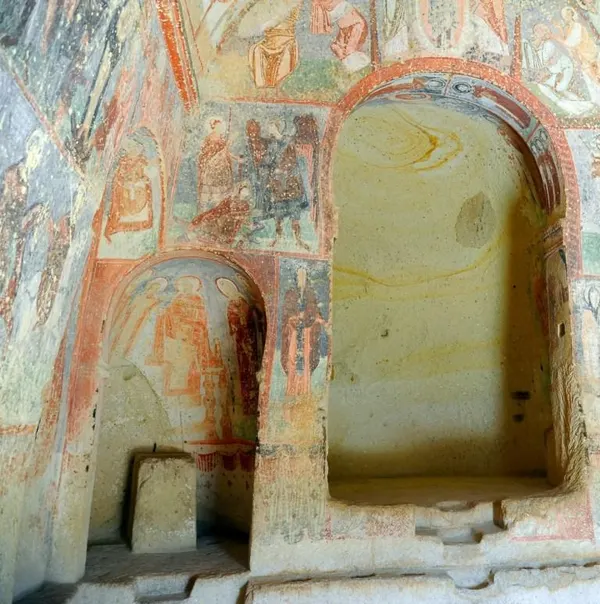
One of the most important architectural characteristics of Çavuşin Church is the presence of three apses at its eastern end.
An apse is a semicircular or rounded space associated with the sanctuary of a Christian church.
In Byzantine architecture, the central apse generally formed the principal liturgical area, while side apses could serve additional ceremonial functions.
At Çavuşin, the central apse is larger, deeper, and more elevated than the two side apses.
Steps lead towards the central sanctuary, separating it from the main floor of the nave.
The side apses contain carved seating arrangements and provide additional spaces for the church's religious decoration.
The northern apse is particularly important because it contains the imperial portraits of Nikephoros II Phokas and his family.
This arrangement demonstrates how the church's architecture was used to communicate religious and political messages.
The Narthex – A Lost Entrance Hall
Originally, the church also possessed an entrance area known as a narthex.
In Byzantine churches, the narthex functioned as a transitional space between the exterior and the main worship area.
At Çavuşin Church, much of this original entrance structure has collapsed.
The loss has significantly changed the building's appearance.
Nevertheless, surviving architectural and painted traces provide clues to its original arrangement.
Historical descriptions also identify images of archangels associated with the entrance area.
Windows, Niches, and Natural Light
Above the original entrance were two windows that allowed daylight to enter the interior.
Additional arched niches were carved into the walls.
These openings helped organise the religious space and provided surfaces for painted figures.
The natural light entering the church would have affected how visitors experienced the paintings.
Imagine standing beneath the high barrel vault while daylight illuminated the colourful scenes and imperial portraits.
Even without elaborate stone columns or monumental exterior façades, the builders created a remarkable interior.
Çavuşin Church demonstrates how Cappadocian craftsmen transformed relatively simple volcanic rock into a sophisticated environment for Byzantine worship.
Now we arrive at the most extraordinary part of Çavuşin Church.
Its frescoes!
The church contains one of the most historically significant painting programmes in Cappadocia, combining biblical narratives, imperial portraits, military figures, and Christian saints.
What makes this collection particularly interesting is its relationship with the political events of the 10th century.
While most of the paintings illustrate religious subjects, others connect the church directly with the Byzantine imperial family.
And together, they form an extraordinary visual story.
The Life of Jesus Christ – A Biblical Story Painted in Stone
The church's walls and ceiling contain an extensive sequence of scenes drawn from the Gospels and Christian tradition.
The paintings follow important events from the birth of Jesus Christ through his miracles, suffering, death, Resurrection, and Ascension.
Many of these scenes would have been familiar to Byzantine Christians through religious services and readings from scripture.
Let's take a closer look at some of the most important subjects.
The Annunciation
The Archangel Gabriel announces to the Virgin Mary that she will become the mother of Jesus Christ.
The event represents the beginning of the Incarnation, the Christian belief that God entered human history through Jesus.
The Nativity
The birth of Jesus is represented through scenes associated with Bethlehem.
These images introduce worshippers to the early life of Christ and the events surrounding his arrival.
The Adoration of the Magi
The Magi, traditionally described as wise men from the East, visit the infant Jesus.
Their journey symbolises the recognition of Christ beyond the Jewish community.
The Flight into Egypt
Joseph takes Mary and Jesus to Egypt to escape the danger presented by King Herod.
The painting communicates an important episode of protection and survival in the childhood of Christ.
The Massacre of the Innocents
This dramatic scene illustrates the killing of young children ordered by Herod, as described in the Gospel of Matthew.
It represents one of the tragic events surrounding the infancy narratives.
The Baptism of Jesus
Jesus is baptised by John the Baptist in the Jordan River.
The event marks an important moment in the beginning of his public ministry.
The Healing of the Blind Man
Jesus restores the sight of a blind man.
For Christian worshippers, the miracle demonstrated both compassion and divine power.
The Raising of Lazarus
One of the most remarkable biblical scenes in the church depicts Jesus raising Lazarus from the dead.
According to the Gospel of John, Lazarus had already been buried when Jesus arrived.
The miracle became an important symbol of Christ's power over death and the Christian hope of resurrection.
The Transfiguration
Jesus appears in radiant glory before three of his disciples.
The event reveals his divine nature and became an important subject in Byzantine religious art.
The Entry into Jerusalem
Jesus enters Jerusalem shortly before his arrest and Crucifixion.
The event is commemorated in Christianity as Palm Sunday.
The Last Supper
Jesus shares his final meal with his disciples.
The scene is particularly important because of its connection with the Eucharist, one of Christianity's central religious ceremonies.
The Betrayal of Judas
Judas identifies Jesus to those who have come to arrest him.
This event begins the sequence of events leading towards the Crucifixion.
Jesus Before Pontius Pilate
Jesus stands before the Roman governor Pontius Pilate.
The scene is associated with his trial and condemnation.
The Journey to Golgotha
Jesus is represented on the way to the site of his execution.
The image forms part of the church's sequence of scenes depicting Christ's suffering.
The Crucifixion
One of Christianity's most important events, the Crucifixion represents the death of Jesus upon the cross.
The Descent from the Cross
The body of Jesus is removed from the cross following his death.
This scene emphasises the sorrow surrounding the Crucifixion.
The Entombment
Jesus is placed in the tomb, completing the sequence of events associated with his death and burial.
The Anastasis – Christ's Victory Over Death
The Anastasis is a particularly important subject in Byzantine art.
It represents Christ's victory over death and his descent into the realm of the dead.
In traditional Byzantine compositions, Jesus is often shown raising Adam and Eve, symbolising the liberation of humanity.
The Empty Tomb
Women arrive at the tomb of Jesus and discover that his body is no longer there.
This scene is closely associated with the announcement of the Resurrection.
The Ascension
Jesus is depicted ascending into heaven following his Resurrection.
The scene completes the sequence of events associated with his earthly life.
Together, these paintings introduce the viewer to the essential narrative of Christianity.
But Çavuşin Church contains something that makes its decorative programme even more remarkable.
The Imperial Portraits of Nikephoros II Phokas and His Family
Among the most extraordinary frescoes are the portraits of the Byzantine imperial family.
Inside the northern apse, Emperor Nikephoros II Phokas appears with Empress Theophano and other members of his family.
Their elaborate clothing and carefully arranged positions reflect the ceremonial world of the Byzantine court.
Several figures hold small crosses, emphasising their religious identity.
An accompanying Greek inscription asks God to protect the emperor and empress.
This is especially important because it reveals how political authority and religious belief were connected in Byzantine society.
The emperor was not simply presented as a military ruler.
He was portrayed as a Christian sovereign whose position was associated with divine protection and religious legitimacy.
The small crosses may also have carried a wider symbolic connection with the imperial victories and sacred relics celebrated during Nikephoros' reign.
However, the exact meaning of these particular objects remains open to interpretation.
Constantine the Great and Saint Helena – A Powerful Political Message
Another important part of the church's painted decoration involves Constantine the Great and his mother, Saint Helena.
Constantine was the Roman emperor who supported Christianity and played a major role in its development within the Roman Empire.
Helena became especially associated with Christian pilgrimage and traditions concerning the discovery of the True Cross in Jerusalem.
Their presence at Çavuşin Church is not accidental.
Researchers have interpreted the relationship between Constantine and Nikephoros as an important element of the church's political message.
By associating Nikephoros with Constantine, the paintings could present the 10th-century ruler as a defender and protector of Christianity.
The symbolism would have been especially meaningful during a period of military campaigns against neighbouring powers.
In this interpretation, Nikephoros was being celebrated as a kind of New Constantine, a Christian ruler whose military authority was connected with religious devotion.
The Mounted Military Commanders
Another unusual feature of Çavuşin Church is the representation of military figures on horseback.
Two figures have been associated with General Melias and John Tzimiskes.
Melias was a senior military figure connected with Byzantine campaigns, while Tzimiskes later became emperor.
Their presence is especially remarkable because military commanders are not ordinarily the central figures of church decoration.
The images provide another connection between the church and the military history of the Byzantine Empire.
Some inscriptions associated with these portraits appear to have been modified during a later period, possibly reflecting the changing political circumstances following Nikephoros' death.
The paintings therefore preserve evidence of a time when military achievement, imperial leadership, and Christian devotion were closely connected.
The Forty Martyrs of Sebaste
Along the northern wall, beneath the scenes from the life of Jesus, are representations of the Forty Martyrs of Sebaste.
According to Christian tradition, these were forty Roman soldiers who suffered martyrdom because of their Christian beliefs during the early 4th century.
Their story became widely celebrated throughout Eastern Christianity.
The inclusion of the Forty Martyrs at Çavuşin is particularly interesting.
They were both soldiers and Christian martyrs.
Their appearance alongside imperial and military figures reinforces the church's unusual emphasis on the relationship between military service and religious faith.
The Archangels Michael, Gabriel, Raphael, and Uriel
Angels are another important part of the decorative programme.
Figures associated with Archangels Michael and Gabriel appear in the church's painted niches.
Michael was frequently represented in Byzantine Christianity as a protector and heavenly warrior.
Gabriel was especially associated with divine messages, including the Annunciation to the Virgin Mary.
Other angelic figures have been identified as Raphael and Uriel.
Their presence contributes to the spiritual character of the church.
For Byzantine worshippers, angels were not simply decorative figures.
They represented heavenly protection, divine communication, and the connection between earthly worship and the spiritual world.
The Old Testament Prophets
The church also contains portraits of four Old Testament prophets along the central area of the barrel vault.
These figures are identified as:
Jeremiah, Daniel, Habakkuk, and Amos.
Each played an important role in the religious literature of ancient Israel.
Within Byzantine Christianity, their writings were understood as part of the sacred history leading towards the coming of Jesus Christ.
By including these prophets, the painters connected the stories of the Old Testament with those of the New Testament.
The Church Fathers and Christian Saints
The sanctuary also contains depictions of important religious figures from the history of Christianity.
Among those identified in studies of the church are Saint Basil the Great, Saint Hypatius, Saint Epiphanius, Patriarch Germanus of Constantinople, and Patriarch Proclus.
These figures were associated with Christian teaching, theology, and ecclesiastical leadership.
Saint Basil is particularly significant because of his close connection with Cappadocia.
Born in Caesarea, modern Kayseri, Basil became one of the most influential theologians of the 4th century.
His teachings helped shape Eastern Christian monasticism and religious thought.
The presence of these saints reinforces the church's connection with the wider traditions of Byzantine Christianity.
The Donor Portraits – Who Paid for the Church?
Another fascinating detail appears near one of the angelic paintings.
Two small kneeling figures have been interpreted as donor portraits.
In Byzantine religious art, donors were people who contributed to the construction or decoration of a church.
They were sometimes represented in a humble position beneath holy figures, asking for divine protection or salvation.
Unfortunately, the paintings at Çavuşin are too damaged to establish the identities of these individuals.
Nevertheless, their presence suggests that members of the local community may have played an important role in supporting the church's creation.
And that adds another dimension to its history.
Behind the imperial portraits and extraordinary biblical paintings were real people who contributed to creating this sacred space more than a thousand years ago.
Today, we admire Çavuşin Church primarily as a historical monument.
But during the Byzantine period, its purpose was very different.
This was a place where people gathered to pray, listen to religious readings, participate in ceremonies, and express their Christian beliefs.
The paintings surrounding them were part of that religious experience.
And the unusual presence of the imperial family made Çavuşin particularly distinctive.
A Place of Byzantine Christian Worship
During the 10th century, Christianity played a central role in the religious and cultural identity of the Byzantine Empire.
Churches were places of prayer, worship, and community life.
The most important ceremonies included the Divine Liturgy, during which the Eucharist was celebrated.
The Eucharist commemorates the Last Supper of Jesus Christ and remains central to Eastern Orthodox Christianity.
At Çavuşin, the three-apse sanctuary provided the architectural setting for religious activity.
The paintings of Jesus Christ, prophets, saints, and angels surrounded the worshippers, communicating the relationship between earthly religious ceremonies and the heavenly kingdom.
Why Were So Many Religious Scenes Painted?
In the medieval world, illustrated religious manuscripts were expensive and not everyone could read.
Church paintings therefore offered an accessible way to encounter biblical stories.
The frescoes at Çavuşin presented major events from the life of Christ through a carefully organised sequence of images.
Worshippers could see the Annunciation, Nativity, miracles, Crucifixion, and Resurrection represented around them.
But the paintings served more than an educational purpose.
They also encouraged prayer, religious devotion, and reflection.
For the people who gathered here, these images made sacred stories part of the physical environment in which worship took place.
Religion and Imperial Power
One of the most fascinating aspects of Çavuşin Church is the relationship between religion and political authority.
By placing the imperial family within the religious decorative programme, the patrons connected the emperor's position with Christian ideas of divine protection.
The portraits of Nikephoros and Theophano invited prayers for the rulers.
The images of Constantine and Helena created a connection with the history of Christian imperial leadership.
Meanwhile, the mounted military commanders and Forty Martyrs reinforced the importance of military service and religious commitment.
Together, these paintings communicated a powerful message about Byzantine identity.
The emperor was represented not only as a political leader, but also as a protector of the Christian empire.
This relationship between faith and authority is one of the reasons Çavuşin Church is so important to Byzantine historians.
Was Çavuşin Church a Monastery?
The church forms part of a larger rock-cut complex containing chambers traditionally described as monks' rooms.
These spaces have encouraged researchers to suggest that the site may have had a monastic function.
In Byzantine Christianity, monastic communities consisted of people who dedicated their lives to prayer, religious discipline, and spiritual devotion.
Cappadocia became particularly well known for its monastic traditions.
Its valleys and volcanic cliffs provided suitable places for religious communities seeking relatively secluded environments.
However, the exact organisation of the community associated with Çavuşin Church is not firmly established.
Some researchers have considered the possibility of monastic use, while others have emphasised its relationship with local landowners, military families, and religious patronage.
The site may have fulfilled several functions during different periods.
Daily Life in Byzantine Çavuşin
Beyond the church walls, ordinary life continued throughout the surrounding settlement.
People cultivated crops, maintained their homes, cared for animals, and worked within the agricultural landscape.
Cappadocia's rock-cut architecture made it possible to create living quarters, storage spaces, and work areas directly inside the hillsides.
This environment helped shape the region's distinctive settlement patterns.
The people who worshipped at Çavuşin Church would have lived within a society where religious traditions were closely connected with family life, agriculture, and local community relationships.
The church's possible association with wealthy landowners also reminds us that religious buildings frequently depended on patrons who could provide financial support and resources.
And although the exact identities of those responsible for Çavuşin remain uncertain, their investment created one of the region's most important surviving examples of Byzantine art.
Çavuşin Church therefore preserves more than religious paintings. It reveals how Christianity, political power, military life, and local society came together in 10th-century Cappadocia.
So, what makes Çavuşin Church such an interesting place for travellers exploring Cappadocia?
The answer lies in its remarkable combination of architecture, religious art, and historical importance.
Located near the entrance to Çavuşin Village, approximately 2.5 kilometres from Göreme along the Göreme–Avanos road, the church is one of the region's most distinctive Byzantine monuments.
Its location makes it an important historical landmark within the wider Çavuşin area.
However, visitors should be aware that access arrangements can change as conservation work continues.
The Imperial Family Frescoes
The most historically distinctive feature is the painted representation of Emperor Nikephoros II Phokas and his family.
These portraits provide a rare opportunity to see identifiable figures from Byzantine political history represented inside a Cappadocian rock-cut church.
Their religious gestures, ceremonial clothing, and accompanying inscription reveal how imperial authority was presented within a Christian setting.
For history enthusiasts, this is undoubtedly one of the monument's greatest attractions.
The Biblical Frescoes
The church's extensive religious painting programme is another extraordinary feature.
The walls and vaulted ceiling contain scenes from the life of Jesus Christ, including his birth, miracles, suffering, death, and Resurrection.
Many of these paintings have survived for over a thousand years.
Although portions have suffered deterioration, the remaining artwork continues to demonstrate the skill and imagination of Byzantine painters.
The Mounted Military Figures
The portraits associated with Melias and John Tzimiskes are particularly interesting.
Their presence connects the church with Byzantine military history and the campaigns of the 10th century.
The possible alteration of an inscription also provides an intriguing glimpse into the political changes that followed the death of Nikephoros II Phokas.
The Forty Martyrs of Sebaste
The representations of the Forty Martyrs offer another opportunity to explore the relationship between Christian devotion and military identity.
Their presence is especially significant within a church associated with an emperor celebrated for his military achievements.
The Three-Apse Sanctuary
The architectural arrangement of the church is also worth studying.
Its three apses, elevated central sanctuary, carved seating arrangements, and high barrel-vaulted ceiling demonstrate how Cappadocian craftsmen adapted Byzantine church architecture to the volcanic landscape.
Even without the paintings, the interior would remain an impressive example of medieval rock-cut construction.
The Original Rock-Cut Complex
The surrounding chambers and surviving architectural features offer clues to the building's possible religious and residential functions.
The damaged entrance and collapsed original stairway also demonstrate the effects of time and natural erosion.
These features make the history of the building visible in the rock itself.
The Historical Village of Çavuşin
The church is situated within one of Cappadocia's most interesting historical settlement areas.
Çavuşin Village is famous for its rock-cut dwellings, dramatic volcanic cliffs, and centuries of settlement.
The wider area also contains other historically important Christian monuments, including the Church of St. John the Baptist.
These sites provide an opportunity to appreciate how different generations transformed Cappadocia's natural landscape into places of worship and everyday life.
Visiting Çavuşin Church – Important Information
Çavuşin Church is located in Çavuşin Village, in the Avanos district of Nevşehir Province, Türkiye.
The church has historically been reached from the Göreme–Avanos road.
Its original rock-cut staircase collapsed, and a later iron staircase was installed to provide access to the upper church.
However, as of November 2026, the official Turkish Museums website lists Çavuşin Church as closed for restoration.
Visitors should verify its reopening and current entrance arrangements through official museum information before planning an interior visit.
Even when interior access is restricted, Çavuşin Village and its wider historical landscape remain important destinations for travellers interested in Cappadocia's cultural heritage.
Is Çavuşin Church Worth Visiting?
For anyone interested in Byzantine history, ancient architecture, Christianity, or the hidden stories of Cappadocia, Çavuşin Church is undoubtedly an important monument.
Unlike many churches whose paintings illustrate only religious subjects, Çavuşin preserves an extraordinary relationship between biblical narratives and actual historical figures.
Its frescoes introduce us to the life of Jesus Christ.
Its portraits reveal the appearance and authority of a Byzantine imperial family.
Its military paintings connect the church with the campaigns that shaped the eastern Mediterranean during the 10th century.
And its architecture demonstrates the extraordinary ability of Cappadocian craftsmen to transform volcanic rock into meaningful religious spaces.
But perhaps the most fascinating thing about Çavuşin Church is the unusual connection between the sacred and political worlds.
More than a thousand years ago, people gathered here to pray beneath images of Jesus Christ, angels, prophets, and saints.
And among those sacred figures stood the painted image of the emperor who ruled their world.
Çavuşin Church is more than another ancient cave church in Cappadocia. It is a remarkable surviving record of an empire, its religious beliefs, its military ambitions, and the people who shaped its history.
Because in Cappadocia, history is not always written in books.
Sometimes, it's painted onto the walls of a mountain — and the faces looking back at us belong to the people who once ruled an empire.
Photo: Dosseman / Wikimedia Commons / CC BY-SA 4.0. Original: [individual photo URL]. Licence: https://creativecommons.org/licenses/by-sa/4.0/ . Changes: none.
No tours currently list Çavuşin Church Cappadocia – History & Byzantine Frescoes as a stop. Browse all day tours or plan a custom trip.
Browse all Cappadocia attractions