Cappadocia Adventures
Cappadocia Adventures

Imagine entering a small cave church in Cappadocia and discovering an enormous cross carved directly into the ceiling.
Now look ahead.
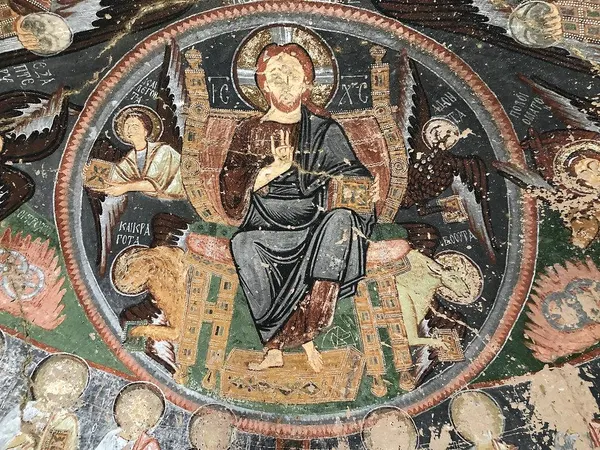
Jesus Christ sits upon a heavenly throne, surrounded by angels, mysterious creatures, and Christian saints.
Welcome to Cross Church (Haçlı Kilise), one of the most remarkable Byzantine rock-cut churches in Red Valley (Kızılçukur), near Göreme and Çavuşin.
Unlike Cappadocia's larger churches, Cross Church combines extraordinary stone carvings with a richly decorated sanctuary in a relatively small space.
But there's more!
The church also preserves ancient burial spaces, remarkable architectural furnishings, and evidence of its later transformation into a winepress and pigeon shelter.
Cross Church is an extraordinary example of how Byzantine craftsmen transformed volcanic rock into a place where architecture and religious art communicate a shared spiritual message.
During the Byzantine period, Cappadocia became an important centre of Eastern Christian religious life.
Its soft volcanic rock allowed communities to excavate churches, monasteries, and dwellings directly into the landscape.
Cross Church developed within this tradition, combining carefully carved architectural features with elaborate religious paintings.
The church appears to have experienced several phases of construction and decoration.
Its monumental ceiling cross may belong to an earlier phase, while the surviving paintings reflect later Byzantine artistic traditions.
Cross Church was originally designed for Christian worship.
However, following the decline of its religious function, parts of the building were adapted for agricultural activities.
A winepress was installed within the sanctuary, and small recesses were carved into the walls for keeping pigeons.
Greek graffiti, including inscriptions associated with 19th-century visitors, also survive.
These alterations demonstrate how Cappadocia's historic buildings continued to serve local communities long after their original purposes changed.
The exact construction date of Cross Church remains uncertain.
Some researchers associate its earliest excavation with the 6th–7th centuries AD.
Other architectural and artistic features suggest significant changes during the 9th–10th centuries, when much of the surviving painted decoration was probably created.
One of the church's most interesting historical questions concerns its monumental ceiling cross.
During the Byzantine Iconoclastic controversies, approximately 726/730–787 and 814–843 AD, the religious use of sacred images became a major political and theological issue.
Crosses remained important Christian symbols, leading some earlier researchers to associate cross-decorated churches with this period.
However, the presence of a monumental cross does not prove an Iconoclastic date.
Such decorations appeared before, during, and after Iconoclasm.
The surviving frescoes of Christ, angels, and saints also reflect later Byzantine religious painting traditions.
The most reliable conclusion is that Cross Church developed through several Byzantine phases, although its exact founding year and the date of the ceiling cross remain uncertain.
Although relatively small, Cross Church contains sophisticated architectural details.
Its principal worship space, known as the nave, measures approximately 5.5 × 5 metres.
Broad stone benches extend along the walls, while a flat ceiling contains its most extraordinary decoration.
Dominating the ceiling is an enormous Latin-style cross carved in relief directly from volcanic rock.
Instead of adding stone, Byzantine craftsmen removed the surrounding material, leaving the raised cross attached to the ceiling.
The composition includes an elaborate arch, decorative circles, and two diamond-shaped frames containing smaller Greek crosses.
Particularly interesting are thirteen circular ornaments along the upper arch.
One interpretation associates these with Jesus Christ and the Twelve Apostles.
However, no surviving inscription confirms this symbolic meaning.
Whatever its original purpose, the carving remains an impressive example of Byzantine craftsmanship.
The original entrance area, known as the narthex, has partially collapsed.
A surviving chamber contains three rock-cut floor graves, suggesting the importance of burial and religious remembrance.
An arched doorway once connected this entrance space with the principal worship area.
At the eastern end stands the church's horseshoe-shaped apse, measuring approximately 3 × 4 metres.
This was the sanctuary associated with the principal Christian ceremonies.
The space originally included a templon, a barrier separating the sanctuary from the congregation.
Along the curved rear wall stands a rock-cut synthronon, a seating arrangement used by clergy.
At its centre is a larger elevated seat with a carved backrest.
One particularly fascinating detail is that the central clerical seat stands beneath the painted image of Christ enthroned in heaven.
This arrangement creates a striking visual connection between religious worship on earth and divine authority above.
A painted band also overlaps an earlier carved cross motif, demonstrating how later decoration could reinterpret existing architectural features.
If the monumental ceiling cross is the church's greatest architectural feature, its Christ in Glory fresco is undoubtedly its artistic masterpiece.
The principal fresco dominates the upper curved section of the sanctuary.
Jesus Christ appears seated upon an elaborate throne, wearing reddish and blue garments.
He raises one hand in blessing while holding a Gospel book.
Surrounding him is a mandorla, a decorative field representing heavenly radiance and divine glory.
The composition presents Christ as the heavenly ruler of creation.
Four symbolic creatures surround Christ's throne.
Their imagery comes from biblical visions, particularly the books of Ezekiel and Revelation.
In Christian artistic tradition, they represent the Four Evangelists:
Matthew – Winged Man: Christ's human nature and ancestry.
Mark – Lion: Strength and royal authority.
Luke – Ox: Sacrifice and priestly worship.
John – Eagle: Divine revelation and spiritual vision.
These figures connect Christ's heavenly authority with the teachings of the Gospels.
Other heavenly beings surround the central composition.
Seraphim are six-winged beings associated with divine worship, particularly in the Book of Isaiah.
A tetramorph combines the characteristics of the four living creatures into one symbolic figure.
The Archangels Michael and Gabriel also appear, wearing elaborate garments inspired by Byzantine imperial traditions.
Michael is associated with heavenly protection, while Gabriel is remembered as the messenger who announced Christ's birth to the Virgin Mary.
Above them appears the Hand of God, symbolising divine presence and blessing.
Beneath Christ in Glory stands a carefully arranged group of saints.
The Virgin Mary raises her hands in prayer, while John the Baptist holds a scroll associated with John 1:29, identifying Christ as the Lamb of God.
Their arrangement recalls the Deesis, a Byzantine composition representing intercession before Christ.
Other figures include Peter, Paul, John, Matthew, Mark, Luke, and additional Christian saints.
Not all belong to the original Twelve Apostles.
Many faces have been scratched or damaged, but their garments and inscriptions remain important historical evidence.
The composition creates three symbolic levels:
Above: Christ and the heavenly court.
Below: The apostles, saints, Virgin Mary, and John the Baptist.
At the bottom: The carved seating used by clergy during worship.
This arrangement has been interpreted as a visual connection between heaven, the saints, and religious ceremonies on earth.
Circular medallions around the sanctuary arch contain figures identified as David, Solomon, Jeremiah, and Malachi, alongside other biblical prophets.
Their presence reflects Christian interpretations connecting Old Testament prophecy with the life of Jesus.
Another painting represents Saint Prokopios, associated with early Christian martyrdom.
The historian Eusebius recorded the martyrdom of a Procopius at Caesarea in Palestine in 303 AD, during the persecutions associated with Emperor Diocletian.
A small carved niche beneath the painted saint was associated with the storage or preparation of liturgical objects.
One of the church's most fascinating images depicts Saint Theodore riding a white horse and attacking a dragon with his spear.
In Byzantine Christian art, military saints frequently symbolised spiritual courage.
The dragon represented evil, making Theodore's victory an expression of the triumph of good over evil.
Together, these frescoes transform Cross Church into a remarkable visual representation of Christian history, biblical prophecy, and heavenly worship.
Cross Church was originally designed for Byzantine Eastern Christian worship.
Its sanctuary, carved furnishings, and elaborate paintings were closely connected with religious ceremonies.
The monumental ceiling cross represented one of Christianity's most important symbols.
It communicated ideas of sacrifice, salvation, and Christ's victory over death.
Its location above the congregation emphasised its religious significance.
The sanctuary's seating arrangement was positioned directly beneath the fresco of Christ in Glory.
This created an important relationship between the clergy performing religious ceremonies and the heavenly kingdom represented above them.
The three graves in the surviving narthex demonstrate that burial and remembrance formed part of the church's history.
However, the identities of those buried here remain unknown.
After its original religious use declined, the sanctuary was partially converted into a winepress.
A collection basin was carved into the existing stone furnishings, while other features were modified to accommodate grape processing.
Small recesses were also created for pigeons.
Pigeon droppings were traditionally collected as fertiliser for Cappadocia's vineyards and agricultural fields.
The church's Greek graffiti provides further evidence of later visitors and changing uses.
Cross Church demonstrates how Cappadocia's historic religious buildings could become part of everyday agricultural life while preserving traces of their Byzantine past.
Cross Church is located in Kızılçukur Valley (Red Valley), near Göreme and Çavuşin, Nevşehir Province, Türkiye.
Its elevated position among the reddish volcanic formations makes it a memorable destination for travellers exploring Cappadocia's valleys.
The Monumental Ceiling Cross
The church's most distinctive feature, carved directly from the volcanic rock and decorated with circles and smaller crosses.
Christ in Glory
The magnificent sanctuary fresco depicting Jesus enthroned among heavenly beings.
The Four Evangelist Symbols
The winged man, lion, ox, and eagle surrounding Christ.
The Archangels Michael and Gabriel
Two important heavenly figures wearing Byzantine ceremonial garments.
The Virgin Mary and John the Baptist
Figures associated with prayer, intercession, and the Deesis tradition.
The Carved Synthronon
An important example of Byzantine sanctuary furnishings used by clergy.
The Saints and Prophets
Paintings of biblical figures, Saint Prokopios, and Saint Theodore.
The Later Agricultural Features
The winepress, pigeon recesses, and historical Greek graffiti demonstrating the church's changing functions.
Cross Church lies within Red Valley, accessible through hiking routes connecting Göreme, Çavuşin, and the surrounding valleys.
Older descriptions mention a café beneath the church and a steep staircase leading towards its entrance.
Historically, access involved a high opening and rock-cut footholds.
Some researchers have suggested that this arrangement may have provided additional security, although its original purpose remains uncertain.
Visitors should confirm current access conditions and avoid unstable rock surfaces.
The Red and Rose Valley area contains several additional Byzantine monuments:
Three Crosses Church (Üç Haçlı Kilise)
Column Church (Direkli / Kolonlu Kilise)
Joachim and Anna Church
Üzümlü Church (Grape Church)
Cross Church should not be confused with Three Crosses Church, which is a separate monument in neighbouring Güllüdere Valley.
Absolutely!
Cross Church is particularly rewarding for travellers interested in Byzantine history, Christian symbolism, and Cappadocia's lesser-known religious monuments.
Its ceiling cross demonstrates extraordinary craftsmanship.
Its painted sanctuary reveals the theological imagination of Byzantine Christianity.
Its carved furnishings show how religious ceremonies were organised.
And its later agricultural adaptations tell the story of a building that continued to serve local communities for centuries.
But perhaps the most remarkable feature is the relationship between its two greatest masterpieces.
Above your head stands the monumental cross.
Before your eyes sits Christ upon his heavenly throne.
Together, they communicate the spiritual beliefs of the people who once worshipped here.
Cross Church is more than another ancient cave sanctuary. It is an extraordinary place where Byzantine architecture, religious symbolism, and centuries of Cappadocian history come together.
1 guided tour includes a stop at Cross Church Cappadocia – Haçlı Kilise History & Frescoes.
Browse all Cappadocia attractions