Cappadocia Adventures
Cappadocia Adventures

Located in Göreme, Nevşehir Province, in the heart of Cappadocia, El Nazar Church is one of the region's remarkable small yet sacred historical churches. It was carved directly into Cappadocia's extraordinary volcanic rock formations, formed from material known geologically as ignimbrite.
The church is situated in Zemi Valley, a beautiful natural area popular among travelers for hiking and exploring Cappadocia's unique landscapes.
El Nazar Church follows the Byzantine (Eastern Roman) Christian tradition, offering visitors a fascinating glimpse into the religious history and artistic heritage of the region.
However, what makes this church particularly remarkable is its unusual dome decoration, which differs from the traditional archaic style found in other early Cappadocian churches.
Let's take a closer look at the history, architecture, frescoes, and religious significance of El Nazar Church in Cappadocia.
El Nazar Church dates to the 10th-century Byzantine period, with its paintings commonly attributed to the latter part of the century.
The church was built by Byzantine Christians (Eastern Romans) and served the religious traditions of Eastern Christianity.
One of its most remarkable features is the depiction of the Ascension of Jesus Christ at the center of the dome.
Unlike the traditional archaic decoration found in some earlier Christian churches, this composition gives the central dome an especially important role in the church's religious and artistic program.
The scene represents Christ's Ascension into heaven and reflects the Byzantine tradition of organizing sacred images according to their theological significance.
El Nazar Church is a rock-cut Byzantine church, carved into the volcanic formations that make Cappadocia famous around the world.
The rock structure covering the church has largely collapsed on the outside. However, despite the damaged exterior, its interior still offers a delightful glimpse into Byzantine (Eastern Roman) history and daily Orthodox Christian life.
The church features a free-cross architectural plan, a central dome, and three apses, reflecting traditional Byzantine church design.
The church underwent restoration and conservation work associated with UNESCO and ICCROM. The first known conservation efforts mentioned in the restoration history date to 1976, followed by further interventions in 1989 and 1999.
These efforts aimed to protect the surviving historical structure and its remarkable religious artwork.
Once we look at the frescoes, paintings, and religious symbols of El Nazar Church, it is difficult not to be amazed.
For such a small place, the amount of religious imagery, inscriptions, and history preserved on its walls is extraordinary.
Considering the conditions and artistic techniques available during the Byzantine period, the detail of these paintings remains impressive even by today's standards.
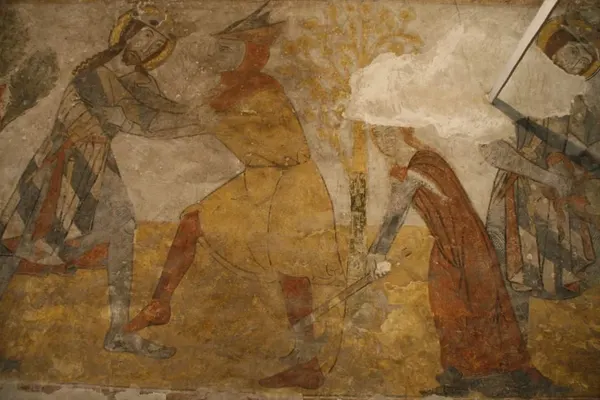
The frescoes and wall paintings mainly illustrate the life of Jesus Christ, the Virgin Mary, and Christian saints.
Let's take a closer look at the stories represented throughout the church.
Nativity (Birth of Jesus):
The Nativity scene is among the compositions arranged opposite one another in the southern and northern arms of the church.
Presentation of Jesus at the Temple:
This scene is located above the southern apse.
Because of its symbolic significance, it was placed in a particularly important and privileged position within the church.
Baptism of Jesus:
The Baptism scene is located in the western section of the church.
Transfiguration:
This scene depicts the revelation of Jesus' divine glory.
It occupies the western wall, opposite the apse, and holds an important position within the church's decorative program.
Passion and Crucifixion:
Scenes depicting the suffering and Crucifixion of Jesus are found particularly on the southern wall and in the opposing arms of the church.
Resurrection and Anastasis:
Scenes associated with the Resurrection of Jesus, including the Anastasis (Descent into Hades), are located in the northern arm.
Ascension of Jesus Christ:
The Ascension scene is depicted in the central dome of El Nazar Church.
The representation of Jesus follows the traditional conventions of Byzantine religious art established after the Iconoclastic Period.
This particular scene is one of the church's most distinctive artistic features.
The wall paintings in the main apse have suffered extensive damage over time, and only parts of the original compositions have survived.
The semi-dome of the main apse illustrates the Theotokos (Mother of God, the Virgin Mary) with the Christ Child.
Mary is seated on a throne resembling the shape of a lyre, a musical instrument from the harp family, with two curved arms extending from its body and an upper bar connecting them. The lyre is known from as early as the 9th century BCE.
The throne is decorated with precious pearls and semi-precious stones, while the Virgin Mary holds the Christ Child before her.
The composition also depicts the Virgin Mary with a scroll resting on her left knee, while she is shown blessing Jesus.
In the upper part of the main apse composition, the Hand of God is represented blessing the Virgin Mary and the Christ Child.
An especially interesting detail comes from historical photographs taken by Guillaume de Jerphanion (born in 1877), an epigrapher and Jesuit priest who studied the churches of Cappadocia.
In his photographs, two small trees can be seen, one on either side of the throne.
Unfortunately, these details have not survived to the present day.
On either side of the Virgin Mary stand two large angels depicted in profile.
The inscriptions identifying them are no longer visible, but they are believed to represent the Archangels Gabriel and Michael.
Both angels are depicted wearing royal garments, emphasizing the majesty and significance of the Theotokos.
The composition is completed by two saints positioned on either side of the Virgin Mary.
However, their identities have not been confirmed with certainty.
The figure on the northern side is believed to be a prophet.
The beardless figure on the southern side has been interpreted differently by researchers:
According to Guillaume de Jerphanion, the figure represents Ephrem (Saint Ephrem the Syrian, 306–373), described as a dispenser of grace.
According to G. P. Shimenen, the figure represents Etienne (Saint Stephen), traditionally recognized as the first Christian martyr, whose death is commonly placed around AD 34–36.
The narrow stole hanging down from the figure's neck resembles the garments worn by bishops in early religious paintings.
Clergymen depicted as dispensers of grace are generally represented holding a book and making a gesture of blessing with their right hand.
However, these characteristics are not particularly clear in this figure.
The depictions of the Theotokos and the saints in the main apse are dated to the 10th century.
Numerous depictions of saints, bishops, prophets, and martyrs can be found throughout the walls and domes of El Nazar Church.
Some saints are represented inside medallions, showing only the upper portions of their bodies, from the waist or chest upward.
Figures of bishops appear on the pendentives and on the arches beneath the inner sections of the dome.
Prophets and martyrs are depicted on the northern wall and in the remaining sections of the domes.
Along the inner arch of the apse, 11 medallions depicting saints are arranged in a continuous sequence.
A cross is positioned above them.
Two of the figures appear to be wearing royal garments, with crowns that are difficult to distinguish clearly.
The bearded figure on the southern side is believed to represent King David (around 1000 BCE), while the beardless figure on the northern side may represent King Solomon (traditionally dated to around 970–931 BCE).
On the southern side of the church, one figure is particularly well preserved.
Nearby inscriptions contain the names Isaac, Ezekiel, and Jonah.
In the western arm of the church, depictions of Emperor Constantine (306–337 CE) and Helena (246/248–330 CE) appear along the lower sections of the walls.
These representations complete the rich decorative program of the church and reflect the importance of saints, biblical figures, and historical Christian personalities in Byzantine religious art.
The paintings in the southern apse are heavily fragmented and damaged.
In this section, Jesus is depicted seated on a throne between two angels.
Among the surviving fragments are portions of a cruciform halo, figures wearing ancient-style garments, and traces of angels bending forward in reverence.
The composition reflects the divine authority of Jesus and the respect shown to him by the angels.
Although much of the original painting has disappeared, the surviving details still provide a glimpse into the artistic and religious traditions of Byzantine Cappadocia.
There are plenty of interesting things that can be said about the religious significance of El Nazar Church and the daily life of the communities that once lived around it.
Let's break them down.
Byzantine Orthodox Religious Use
The church was built during the 10th-century Byzantine Era, making it likely that it was intended for Byzantine Orthodox Christian worship.
Its architectural characteristics and religious paintings strongly reflect Eastern Christian traditions.
The Surrounding Landscape and Possible Settlements
According to official records, the surrounding area of the church is located within a floodbed.
Although the historical period cannot be confirmed, there is a strong possibility that a river or stream once passed close to the church.
This raises the possibility that the surrounding neighborhood may once have contained a settlement.
The Religious Heritage of Göreme
To better understand the religious life of El Nazar Church, we should also look at the other churches in the region.
Göreme is reported to have 127 rock-cut churches, including both surviving and collapsed structures.
The majority were built within the Byzantine Orthodox Christian tradition.
Some are associated with the early centuries of Christianity, including the broader historical period of the first four Ecumenical Councils of Christianity.
Was El Nazar Church a Monastery or a Parish Church?
Considering the church's architectural style and measurements, it differs from a large monastery or cathedral.
Its construction more closely resembles a monk's chapel, a traditional Cappadocian house-style structure, or a relatively small parish church.
A Local Belief About the Church's Origins
There is also a popular belief that the church might have been built by a monk or priest who grew up in the area now known as the Göreme Open-Air Museum.
According to this belief, the monk or priest later moved to the surrounding neighborhood to help local residents practice their prayers and religious traditions.
However, there is no historical evidence confirming this story.
Following the partial reconstruction and conservation work, efforts were made to preserve the church's original historical fabric.
Today, El Nazar Church in Göreme still offers visitors the charm of Anatolian Orthodox Christian history, with surviving Byzantine frescoes, religious paintings, and remarkable rock-cut architectural techniques.
Although the exterior has suffered considerable damage, the interior continues to reflect the artistic and religious heritage of Byzantine Cappadocia.
Visitors can explore the church on foot while traveling toward the Göreme Open-Air Museum.
From the center of Göreme, the walk takes approximately 20–30 minutes, depending on your route and walking speed.
The visiting hours listed for the church are:
Opening Time: 08:00
Closing Time: 17:00
Box Office Closing Time: 16:15
Visitors should confirm the current opening hours before traveling, as access and schedules may change.
The best time to visit El Nazar Church in Cappadocia is generally between April and mid-October, when the weather is more comfortable for walking, sightseeing, and exploring the surrounding valleys.
For visitors interested in Byzantine history, Cappadocian rock-cut churches, religious art, and nature, El Nazar Church offers an opportunity to discover one of Göreme's smaller historical treasures.
And while you're there, don't forget to combine your visit with a hike through Zemi Valley!
No tours currently list El Nazar Church. Charm Of Zemi in Cappadocia/Goreme as a stop. Browse all day tours or plan a custom trip.
Browse all Cappadocia attractions