Cappadocia Adventures
Cappadocia Adventures

Imagine entering a small church carved into Cappadocia's volcanic rock, only to discover nine domes, beautiful Byzantine frescoes, and religious stories painted nearly a thousand years ago.
Welcome to Elmalı Church (Elmalı Kilise), also known as Apple Church, one of the remarkable monuments inside Göreme Open-Air Museum.
But why is it called Apple Church?
Some explanations connect the name to an apple tree, while others suggest that a circular object depicted in the paintings was mistaken for an apple. Its true origin remains uncertain.
What makes this church especially interesting is its extraordinary interior. With nine domed sections, four columns, and three apses, Elmalı Church contains paintings of Jesus Christ, the Virgin Mary, Christian saints, prophets, angels, and important biblical events.
And these paintings aren't simply arranged to tell a story from beginning to end.
Instead, Old and New Testament scenes appear in carefully chosen positions, creating connections between Christian prophecies, miracles, and religious beliefs.
Let's discover what makes this little church such an important part of Cappadocia's Byzantine heritage.
Elmalı Church belongs to the Middle Byzantine period, when Cappadocia was an important centre of Christian worship, religious art, and rock-cut architecture.
Rather than constructing conventional stone buildings, local craftsmen excavated churches, chapels, monasteries, and living spaces directly into the region's soft volcanic rock.
Elmalı represents a particularly sophisticated example of this tradition.
Two Different Decorative Periods
One of the church's most interesting features is the presence of two decorative layers.
The earlier phase consisted of relatively simple red crosses, geometric patterns, and ornamental designs, some painted directly onto the rock.
These decorations have sometimes been discussed in connection with Byzantine Iconoclasm, a period when the use of religious images became controversial. However, crosses and geometric patterns were also used at other times, so their presence does not establish an exact date.
During a later phase, the interior received the colourful biblical frescoes that visitors recognise today.
As sections of these paintings deteriorated, portions of the earlier red decoration became visible again.
The Column Churches of Göreme
Elmalı Church is closely associated with Karanlık Church (Dark Church) and Çarıklı Church (Sandal Church).
Together, these monuments are commonly known as the Column Churches, sharing similar four-column architectural plans and important characteristics in their painted decoration.
Researchers have suggested possible connections between their artists and workshops, although their exact relationships remain uncertain.
Centuries of Change
Erosion eventually damaged parts of Elmalı Church's original exterior and entrance.
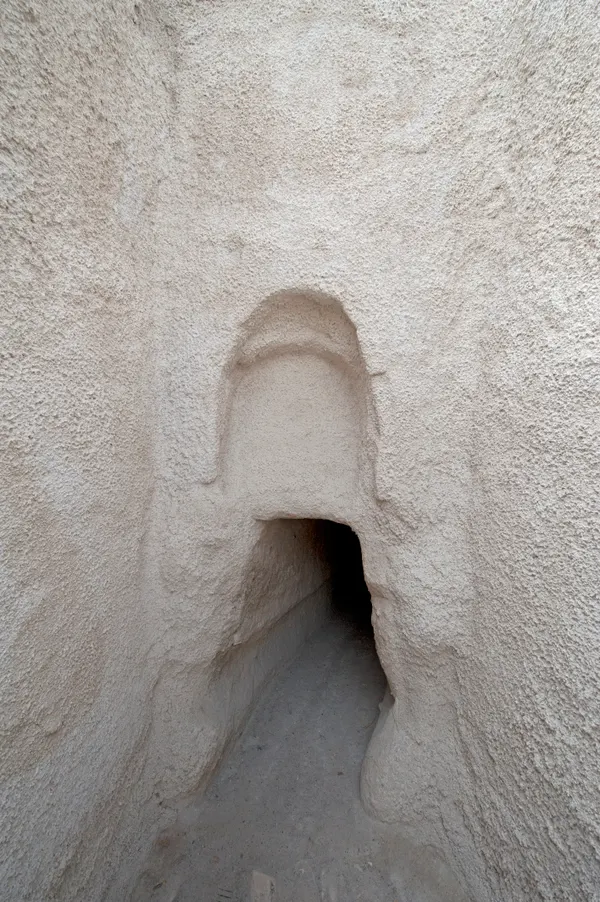
The original southern entrance was affected, and a narrow northern passage was later created to provide access. A possible former narthex, or entrance hall, has not survived intact.
Modern conservation efforts have focused on protecting the rock structure and its fragile paintings. Important restoration work was completed by 2003, and protective measures were introduced to reduce damage from visitors.
Today, Elmalı Church survives as part of the historic religious landscape of Göreme.
According to Türkiye's Ministry of Culture and Tourism, Elmalı Church is generally dated between the middle of the 11th century and the beginning of the 12th century.
However, its precise construction date remains uncertain.
Some researchers favour the 11th century, while other proposed dates extend further into the 12th century or even the beginning of the 13th.
Why the disagreement?
Because the church does not preserve a securely established construction inscription identifying its exact completion date.
Instead, historians examine its architecture, decorative layers, fresco styles, and similarities with neighbouring monuments.
Its cross-in-square layout and elaborate dome arrangement belong to important Middle Byzantine architectural traditions.
The paintings also provide valuable chronological clues, particularly when compared with those of Dark Church and Sandal Church.
However, neither the architectural similarities nor the earlier red decorations establish an exact construction year.
The most reliable conclusion is that Elmalı Church is a Middle Byzantine monument, generally associated with the 11th and early 12th centuries, with several stages of decoration.
That means many of its surviving paintings are approximately nine hundred to one thousand years old.
Elmalı Church may appear modest from outside, but its interior demonstrates the remarkable skills of Byzantine rock-cut craftsmen.
The church follows a cross-in-square plan, a design organised around a central space with sections extending outward in the shape of a cross.
Its principal architectural features include:
The Nine Domes
The interior is divided into nine domed sections, with the central dome occupying the most important position.
In Byzantine religious architecture, domes often symbolised heaven.
At Elmalı, the central dome features Christ Pantocrator, while other domed spaces contain angels and religious imagery, creating a symbolic connection between the earthly congregation and the heavenly world.
The Four Columns
Four rock-cut columns originally defined the central space and supported the architectural arrangement.
Historical documentation identifies three surviving original columns, while parts of the structure have required repair or reconstruction.
Unlike conventional masonry columns, these supports were created by carefully excavating the surrounding volcanic tuff and leaving the intended shapes standing.
The Three Apses
At the eastern end are three apses, the curved sanctuary spaces associated with Byzantine worship.
The central apse contains a Deesis composition showing Christ between the Virgin Mary and John the Baptist.
The northern apse features the Virgin Mary holding the infant Jesus, while the southern apse contains Archangel Michael.
The sanctuary probably also included a separating screen, or templon, although the original arrangement has not survived intact.
Entrances and Surrounding Structures
The original entrance was located to the south, but erosion damaged the surrounding rock.
A narrow northern passage was subsequently opened, changing the way visitors entered the church.
Elmalı also occupies the same broader rock formation as Saint Barbara Church, with nearby burial spaces and structures excavated at different levels.
Together, these features demonstrate how Byzantine craftsmen transformed Cappadocia's volcanic landscape into an elaborate religious complex.
Now comes the most fascinating part of Elmalı Church: its extraordinary collection of Byzantine frescoes.
The paintings use reds, blues, yellows, browns, and whites to depict biblical stories, heavenly figures, Christian saints, and religious symbols.
Their arrangement is particularly interesting because some scenes connect events from the Old Testament with those of the New Testament.
Christ Pantocrator
The central dome features Christ Pantocrator, meaning Almighty or Ruler of All.
Jesus is depicted as the heavenly ruler, holding the Gospel and offering a blessing.
His position above the congregation symbolises divine authority over creation.
The Deesis and the Church Fathers
The central apse contains the Deesis, representing Christ enthroned between the Virgin Mary and John the Baptist.
Mary and John appear as intercessors appealing to Christ for mercy on behalf of humanity.
Below them are five important Church Fathers:
Gregory of Nazianzus, Basil of Caesarea, John Chrysostom, Nicholas, and Blaise.
Basil and Gregory are particularly significant because of their historical connections with Cappadocia and the development of early Christian theology.
The Virgin Mary and Archangel Michael
The northern apse contains a representation of the Virgin Mary holding the infant Jesus, associated with the Hodegetria tradition, meaning She Who Shows the Way.
The southern apse features Archangel Michael, an important heavenly protector in Byzantine Christianity.
The prominence of angelic imagery has encouraged suggestions that the church may once have been dedicated to the archangels, but this remains unconfirmed.
Scenes from the Life of Jesus
Elmalı Church contains an extensive painted programme illustrating important events from the life of Christ:
Nativity: The birth of Jesus, representing the Christian belief in the Incarnation.
Adoration of the Magi: The visit of the wise men who honour the infant Christ.
Baptism: Jesus being baptised by John the Baptist in the Jordan River.
Transfiguration: Christ appearing in divine glory before his disciples, alongside Moses and Elijah.
Raising of Lazarus: Jesus restoring Lazarus to life, symbolising his power over death.
Entry into Jerusalem: Christ's arrival in Jerusalem before his Passion.
Last Supper: The final meal with his disciples, associated with the Eucharist. A fish depicted in the composition adds another layer of Christian symbolism.
Betrayal of Judas: Judas identifying Jesus to those who have come to arrest him.
Journey to Golgotha: Jesus being led towards the place of his Crucifixion.
Entombment: The burial of Christ following the Crucifixion.
Anastasis: Christ's victory over death, traditionally represented through his descent into Hades and the raising of Adam and Eve.
Women at the Empty Tomb: The discovery of Christ's empty tomb and the announcement of the Resurrection.
Ascension: Christ rising into heaven, surrounded by angels, with the Virgin Mary and apostles below.
The Ascension is especially impressive because its composition extends across several architectural surfaces. Christ appears within a mandorla, an almond-shaped field of light symbolising divine glory.
The Crucifixion – One of the Church's Most Remarkable Paintings
The Crucifixion on the southern wall deserves particular attention.
Jesus appears on the cross, accompanied by the Virgin Mary, John the Evangelist, and other figures.
Several symbolic elements make this composition especially interesting.
A skull beneath the cross refers to the Christian tradition connecting Golgotha with Adam, representing humanity's fallen condition and the hope of salvation through Christ.
The sun and moon emphasise the cosmic significance attributed to the Crucifixion.
Above the scene, heavenly angels and a Greek inscription create a dramatic relationship between Christ's suffering on earth and the response of heaven.
These details transformed the painting into much more than a representation of a biblical event.
Old Testament Stories
Elmalı Church also includes important scenes from the Hebrew Bible.
The Hospitality of Abraham depicts Abraham welcoming three mysterious visitors, traditionally represented as angels and later associated with Christian interpretations of the Trinity.
The Three Hebrew Youths in the Fiery Furnace represents three men miraculously surviving a burning furnace through divine protection.
Their placement near New Testament scenes creates meaningful theological connections.
For example, the Fiery Furnace and the Raising of Lazarus both emphasise deliverance from death, while the Hospitality of Abraham and the Nativity can be understood in relation to divine promises and their fulfilment.
The Eight Old Testament Prophets
Figures identified in studies of the church include:
Solomon, David, Jonah, Habakkuk, Daniel, Isaiah, Moses, and Elijah.
They appear holding scrolls and represent the prophetic traditions that Byzantine Christians connected with the life of Jesus.
Their positions help establish relationships between Old Testament writings and New Testament events.
The Five Martyrs of Sebaste
Another important group represents five Christian martyrs:
Eustratius, Auxentius, Mardarius, Eugenius, and Orestes.
Their portraits commemorate Christian martyrdom and the religious traditions of Anatolia.
Artistic Style and Decoration
The painters adapted their compositions to the church's curved domes, arches, columns, and irregular rock-cut surfaces.
Some figures extend beyond the boundaries of individual architectural sections.
Floral motifs, geometric patterns, decorative borders, and religious inscriptions complete the interior.
Together, these elements make Elmalı Church a remarkable example of Byzantine storytelling through architecture and painting.
During the Byzantine period, Elmalı Church was not simply a place to admire beautiful paintings.
It was a sacred environment intended for Christian worship, prayer, religious ceremonies, and the celebration of important feast days.
The central sanctuary was associated with liturgical ceremonies, including the Eucharist.
The Deesis represented divine mercy and intercession, while Christ Pantocrator in the dome symbolised heavenly authority.
The portraits of Church Fathers reinforced the importance of religious teaching and tradition.
Why Were the Paintings Arranged This Way?
Unlike a continuous illustrated story, the frescoes were distributed across the church according to architectural space and religious meaning.
The Baptism and Transfiguration both emphasise Christ's divine identity.
The Hospitality of Abraham and the Nativity connect divine promises with the birth of Jesus.
The Fiery Furnace and Raising of Lazarus illustrate miraculous deliverance and victory over death.
These relationships allowed worshippers to understand connections between different parts of Christian scripture.
Religious Celebrations
Many of Elmalı's paintings correspond to important occasions in the Eastern Christian calendar, including the Nativity, Baptism, Transfiguration, Crucifixion, Resurrection, and Ascension.
The images would have reinforced stories remembered through prayers, hymns, scripture readings, and religious celebrations.
Was Elmalı Part of a Monastery?
The surrounding Göreme landscape contains numerous rock-cut churches, burial spaces, and structures associated with Christian communities.
A connection with a larger monastic complex is possible, but erosion has destroyed parts of the surrounding architecture.
Consequently, the original organisation of the community that used Elmalı Church cannot be established with certainty.
Beyond the churches, people continued their everyday activities throughout Cappadocia, including agriculture, animal husbandry, and maintaining their rock-cut homes.
Elmalı Church therefore belonged to a wider environment where religious practice and ordinary life existed side by side.
Elmalı Church is located inside Göreme Open-Air Museum, approximately two kilometres east of Göreme town in Nevşehir Province, Türkiye.
The museum is part of the Göreme National Park and the Rock Sites of Cappadocia UNESCO World Heritage property, inscribed in 1985.
Although relatively small, Elmalı is one of the museum's most interesting monuments for visitors who appreciate Byzantine architecture and religious painting.
What Should You Look For?
Begin with the church's nine domes and four-column arrangement, which demonstrate the sophistication of its rock-cut construction.
Look upward towards Christ Pantocrator in the central dome.
In the main sanctuary, observe the Deesis, with Christ between the Virgin Mary and John the Baptist, and the Church Fathers below.
Don't miss the Crucifixion, particularly the skull beneath the cross, the sun and moon, and the angels above the scene.
The Ascension, Virgin Mary and Child, Old Testament prophets, Five Martyrs of Sebaste, and the church's earlier red geometric decorations are also worth examining.
Notice how some scenes are positioned close to paintings with related religious meanings.
These connections are among the most distinctive features of Elmalı's decoration.
Nearby Churches
For an interesting comparison, visit Karanlık Church (Dark Church) and Çarıklı Church (Sandal Church), which share architectural and artistic characteristics with Elmalı.
Other important monuments within or near Göreme Open-Air Museum include:
Saint Barbara Church
Yılanlı Church (Snake Church)
Tokalı Church (Buckle Church)
Each offers a different perspective on Cappadocia's Byzantine Christian heritage.
Visiting Information
Elmalı Church can be explored as part of a visit to Göreme Open-Air Museum, subject to current conservation and access restrictions.
Because its frescoes are fragile, visitors should avoid touching painted surfaces and follow the museum's photography regulations.
Opening hours, ticket conditions, and accessibility arrangements should be confirmed through official museum information before visiting.
Is Elmalı Church Worth Visiting?
Absolutely!
Its nine domes, layered decorations, detailed frescoes, and carefully arranged biblical scenes make it one of Göreme's most rewarding churches to explore.
Nearly a thousand years after the paintings were created, they continue to communicate the beliefs, artistic traditions, and religious stories of Byzantine Cappadocia.
And all of this survives inside a little rock-cut church with one of the most unexpected names in the region.
Apple Church.
Photo Credits & Copyright Information
The photographs featured in this article are sourced from Wikimedia Commons and are credited to their original photographers:
Rigorius & Dosseman — CC BY-SA 4.0
Wolfgang Sauber & Antoine Taveneaux — CC BY-SA 3.0
Jose Huwaidi — CC BY 4.0
Sonse — CC BY 2.0
We gratefully acknowledge these photographers for documenting and sharing the historical and artistic heritage of Elmalı Church in Cappadocia.
All photographs are used under their respective Creative Commons licences, which permit reuse with appropriate attribution. Copyright remains with the original creators.
No tours currently list Elmalı (Apple) Church Partially Collapsed, But Still Alive! as a stop. Browse all day tours or plan a custom trip.
Browse all Cappadocia attractions