Cappadocia Adventures
Cappadocia Adventures

Imagine discovering an enormous monastery carved into volcanic rock, where ancient passageways lead to hidden chambers, underground tunnels, and a church filled with magnificent Byzantine paintings.
And somewhere inside this extraordinary complex, a mysterious woman has been smiling at visitors for centuries.
Or has she?
Welcome to Gümüşler Monastery (Gümüşler Manastırı), one of Cappadocia's most remarkable surviving Byzantine religious complexes.
Located near Niğde, this ancient monastery is famous for its enormous rock-cut courtyard, underground chambers, and exceptionally well-preserved frescoes.
But its greatest attraction is undoubtedly the painting known as the Smiling Virgin Mary (Gülen Meryem Ana).
Unlike the solemn expressions typically associated with Byzantine religious paintings, Mary appears to have a gentle smile while holding the infant Jesus.
Whether this expression was part of the original artwork or influenced by later restoration remains a fascinating mystery.
And there's much more to discover!
Inside the monastery are ancient burial chambers, monks' living quarters, and elaborate paintings of Jesus Christ, the apostles, and important Christian saints.
Gümüşler Monastery is more than another ancient cave church. It offers an extraordinary journey into Byzantine art, medieval religious life, and one of Cappadocia's most intriguing artistic mysteries.
Let's discover its remarkable history!
During the Byzantine period, Cappadocia became an important centre of Christian religious and monastic life.
Communities established churches, monasteries, and settlements throughout the region's volcanic landscape.
The relatively soft volcanic rock allowed builders to excavate entire complexes directly into hillsides.
Gümüşler Monastery developed within this architectural tradition.
The monastery was established within a large volcanic rock formation near present-day Niğde.
Its historical name is not securely established. Today, it is known as Gümüşler, meaning Silvers, a name associated with the area's mining history.
The complex contains a spacious courtyard surrounded by chambers, a large church, burial areas, and underground spaces.
Its architecture suggests that the site developed over an extended period rather than being completed in one construction campaign.
The monastery was also located relatively close to important historical routes connecting Central Anatolia with southern regions.
Although known to local residents, Gümüşler attracted renewed archaeological attention during the 20th century.
British archaeologist Michael Gough conducted important research and conservation work at the monastery during the 1960s.
His team documented the architecture and carefully cleaned and conserved the surviving frescoes.
Their work was particularly important because parts of the paintings had become darkened by smoke, dirt, and centuries of use.
In 1973, Gümüşler was officially designated as an archaeological site.
Today, it is protected as one of Niğde's most important cultural heritage monuments.
The exact construction date of Gümüşler Monastery remains uncertain.
No securely established original inscription records the year the complex was founded.
Some archaeological studies suggest that the earliest structures may date to the 7th or 8th century.
Official Turkish museum information describes a broader development period extending between the 8th and 12th centuries.
The church's surviving frescoes are generally associated with the 11th and 12th centuries, although some academic interpretations favour an earlier painting phase.
Monasteries were not always created at once.
An initial group of chambers could gradually develop into a larger religious settlement.
Churches might be excavated during one period and decorated generations later.
At Gümüşler, researchers therefore examine the architecture, fresco styles, and similarities with other Byzantine monuments.
The most reliable conclusion is that Gümüşler Monastery developed during the medieval Byzantine period, with its important surviving church paintings generally dated to the 11th–12th centuries.
Regardless of its precise origins, the monument preserves approximately a thousand years of Christian architectural and artistic history.
One of the most extraordinary features of Gümüşler Monastery is its impressive architectural design.
Unlike small churches hidden within individual fairy chimneys, Gümüşler forms a large complex organised around a central open courtyard.
The monastery's central courtyard was excavated directly into a massive volcanic rock formation.
Its steep walls reach approximately 14 metres in height.
Imagine standing at the bottom of this enormous space, surrounded by carved entrances, windows, chambers, and architectural details.
The courtyard provided access to different parts of the monastery.
Burial areas and storage spaces are also associated with this central section.
The principal church follows a cross-in-square plan, one of the most important architectural arrangements in Byzantine Christianity.
But what exactly does that mean?
Imagine a square interior containing four supporting pillars.
Between the pillars, the principal spaces form the shape of a cross.
At Gümüşler, these pillars were carved directly from the volcanic rock.
They were plastered and decorated with geometric and rosette motifs.
The sanctuary contains apses, rounded spaces traditionally associated with Christian altars.
Another fascinating feature is the complex's underground section.
Rock-cut passages connect rooms at different levels.
Some areas have been described as a two-storey underground settlement, containing chambers and passages associated with practical activities.
Ventilation openings and communication features have also been identified.
Although these structures may have provided protected spaces during difficult periods, their exact historical functions cannot all be established.
The monastery includes graves carved into the rock, burial niches, and additional rooms traditionally associated with its residents.
Other spaces have been interpreted as kitchens, storage facilities, and communal areas.
These features demonstrate the complexity of the settlement.
Gümüşler Monastery was not simply a church surrounded by empty caves. It was an extensive architectural complex designed to accommodate religious and everyday activities.
Now comes the most fascinating part of Gümüşler Monastery.
Its extraordinary Byzantine frescoes!
The paintings are among the best-preserved examples of medieval Christian art in the Niğde region.
Their rich colours, carefully arranged compositions, and expressive faces demonstrate the skills of the artists who worked here.
Researchers believe that at least three different painters contributed to the church's decoration, based on differences in artistic style.
And one painting has become particularly famous.
The monastery's most celebrated fresco depicts the Virgin Mary holding the infant Jesus.
She is accompanied by the Archangels Michael and Gabriel.
But look carefully at her face.
Unlike the serious expressions commonly found in Byzantine religious art, Mary appears to be smiling.
This unusual expression gave the painting its popular name, the Smiling Virgin Mary.
The fresco is often described in tourism materials as an exceptionally rare representation of a smiling Madonna.
However, there's an important historical question.
Was Mary originally painted with a smile?
Some researchers have suggested that the expression may have changed during the conservation work carried out in the 1960s.
Others regard the painting as an unusual example of Byzantine artistic expression.
Without conclusive evidence establishing its original appearance, neither explanation can be considered certain.
Regardless, the fresco remains one of Gümüşler Monastery's most recognisable treasures.
One of the church's principal paintings appears in the main apse.
Jesus Christ is represented enthroned, accompanied by heavenly figures.
The composition communicates the Christian belief in Christ's divine authority.
Symbols associated with the Four Evangelists also appear within the decorative programme.
These represent Matthew, Mark, Luke, and John, the traditional authors of the four canonical Gospels.
The church's apse paintings also include the Deesis.
In Byzantine art, the Deesis represents Christ with holy figures who appeal to him on behalf of humanity.
The composition traditionally includes the Virgin Mary and John the Baptist.
Its meaning is associated with divine mercy, intercession, and salvation.
For medieval worshippers, such imagery reinforced the religious importance of the sanctuary.
Another particularly important group of frescoes depicts three influential Christian theologians:
Saint Basil the Great, Bishop of Caesarea, present-day Kayseri.
Saint Gregory of Nyssa, an important theologian and brother of Basil.
Saint Gregory of Nazianzus, another influential figure in early Christian theology.
Together, they are remembered as the Cappadocian Fathers.
Their writings helped shape Eastern Christian teachings, particularly those concerning the Holy Trinity.
Their presence at Gümüşler is especially meaningful because all three were closely associated with the region's early Christian heritage.
The church also preserves scenes from the early life of Jesus Christ.
The Annunciation represents the Archangel Gabriel announcing to the Virgin Mary that she will give birth to Jesus.
The Nativity depicts Christ's birth.
Both scenes are central to Christian beliefs concerning the Incarnation.
Another painting represents the Presentation of Jesus Christ in the Temple.
According to the Gospel of Luke, Mary and Joseph brought the infant Jesus to the Temple in Jerusalem.
There, the elderly Simeon recognised him as the promised Messiah.
The event became an important subject within Byzantine religious art.
Additional portraits depict John the Baptist and Saint Stephen.
John the Baptist is remembered for baptising Jesus in the Jordan River.
Saint Stephen is traditionally honoured as Christianity's first martyr.
Both figures held important positions within Byzantine religious traditions.
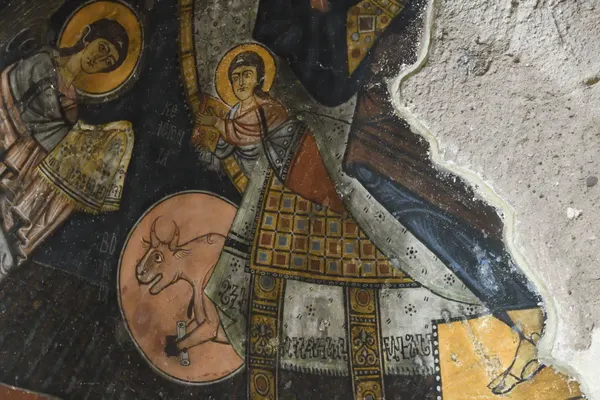
One of the monastery's most unusual artistic features is located in a room above the entrance area.
Unlike the biblical paintings inside the main church, this chamber contains representations of hunting scenes and various animals.
These images are especially interesting because they are uncommon within Cappadocian monastery decoration.
Their exact meaning remains uncertain.
They may reflect artistic traditions extending beyond the usual Christian biblical subjects.
Gümüşler Monastery is remarkable not only for its religious frescoes but also for the unusual combination of sacred paintings, animal imagery, and distinctive artistic styles.
During the Byzantine period, Gümüşler Monastery was an important place of Christian religious activity.
Its churches, chambers, and practical facilities provide valuable evidence of the relationship between worship and everyday life.
The principal church was designed for religious ceremonies.
Its sanctuary and altar were associated with the celebration of the Eucharist, also known as Holy Communion.
The paintings of Christ, the Virgin Mary, the apostles, and the Church Fathers reinforced the religious significance of the space.
They helped connect worshippers with important Christian traditions.
Monastic communities generally organised their lives around prayer, work, and spiritual discipline.
At Gümüşler, the numerous chambers suggest that residents used different spaces for sleeping, food preparation, storage, and other responsibilities.
However, the exact daily routine of the monastery's original occupants is not documented.
The monastery's practical rooms demonstrate that religious communities also required supplies and infrastructure.
Historical descriptions identify storage containers, kitchen areas, and underground chambers.
These spaces would have supported the ordinary needs of the people who lived or worked within the complex.
The courtyard and surrounding chambers contain several burial areas.
In Byzantine Christianity, burial near religious spaces was associated with prayers for the deceased and the hope of resurrection.
The surviving graves demonstrate the importance of remembrance within the monastery.
The paintings of Basil the Great, Gregory of Nyssa, and Gregory of Nazianzus are particularly significant.
These three theologians were among the most influential figures in Cappadocia's Christian history.
Their presence connected the monastery's religious community with the region's theological heritage.
Gümüşler Monastery preserves an extraordinary picture of medieval Christian life, where architecture, religious art, burial traditions, and practical activities existed together.
Gümüşler Monastery is located in Gümüşler town, approximately eight kilometres from Niğde city centre, Türkiye.
Although outside the most famous tourist routes of Göreme and Ürgüp, it belongs to the wider historical and cultural region of Cappadocia.
Its well-preserved architecture and colourful paintings make it one of Niğde's most rewarding Byzantine monuments.
The Smiling Virgin Mary
The monastery's most famous painting depicts Mary holding the infant Jesus, accompanied by the Archangels Michael and Gabriel.
The Enormous Courtyard
The deeply excavated courtyard, surrounded by towering rock walls, is one of the site's most impressive architectural features.
The Cross-Shaped Church
Notice the four carved pillars and the way the interior spaces form a traditional Byzantine cross-in-square arrangement.
The Cappadocian Fathers
Look for the religious portraits of Basil the Great, Gregory of Nyssa, and Gregory of Nazianzus.
The Biblical Frescoes
The church preserves important paintings illustrating Christ, the Virgin Mary, the Annunciation, Nativity, and other Christian subjects.
The Hunting Scenes
The unusual animal and hunting paintings provide another fascinating perspective on the monastery's artistic decoration.
The Underground Chambers
The rock-cut passages and connected rooms demonstrate the complexity of the wider settlement. Access to particular areas may be restricted.
The Burial Spaces
Graves and funerary chambers reveal the importance of Christian burial traditions.
The monastery is located in Gümüşler town, a short drive from Niğde.
It can be reached by car from the Niğde–Kayseri road, following signs towards Gümüşler.
Visitors travelling from central Cappadocia can include the monastery in a longer excursion exploring Niğde's Byzantine and archaeological heritage.
Approximately 30–45 minutes is a reasonable amount of time to explore the principal accessible areas and admire the paintings.
Visitors particularly interested in Byzantine art and architecture may wish to spend longer.
Niğde Museum
An important archaeological museum containing objects from the prehistoric, ancient, and Byzantine periods.
Constantine and Helena Church (Andaval)
An important early Byzantine church associated with the historical settlement of Andabilis.
Tyana Ancient City
A major Roman and Byzantine settlement near Kemerhisar, famous for its surviving aqueducts and archaeological history.
Niğde Castle
A historic landmark overlooking the city and its surrounding landscape.
Gümüşler Monastery is an officially protected archaeological site managed within Türkiye's museum system.
It is open to visitors under museum arrangements, although opening hours, admission prices, and access to specific chambers may change.
Visitors should consult official Turkish Museums information before travelling.
Because the frescoes are fragile, touching the painted surfaces and entering restricted areas should be avoided.
Absolutely!
Gümüşler Monastery is one of Cappadocia's most fascinating lesser-known historical destinations.
Its enormous courtyard demonstrates the creativity of Byzantine builders.
Its underground chambers reveal the complexity of medieval life.
Its paintings preserve important stories from Christianity.
And its famous Smiling Virgin Mary remains one of the most intriguing religious artworks in the region.
But perhaps the most remarkable thing is how much has survived.
Nearly a thousand years after the church was decorated, visitors can still admire its colourful frescoes, explore its ancient chambers, and discover the religious traditions of the people who once lived here.
Gümüşler Monastery is more than another Byzantine cave complex in Cappadocia. It is an extraordinary surviving record of medieval religious life, rock-cut architecture, and some of the region's most remarkable Christian art.
And behind its most famous painting, one question remains unanswered.
Was the Virgin Mary really smiling a thousand years ago?
Photography: Dosseman (Dick Osseman) / Wikimedia Commons – Creative Commons Attribution-ShareAlike 4.0 International (CC BY-SA 4.0).
No tours currently list Gümüşler Monastery – Smiling Virgin Mary & Byzantine History In Cappadocia as a stop. Browse all day tours or plan a custom trip.
Browse all Cappadocia attractions