Cappadocia Adventures
Cappadocia Adventures

Imagine travelling through Cappadocia's peaceful countryside when you notice something extraordinary rising above the surrounding plains.
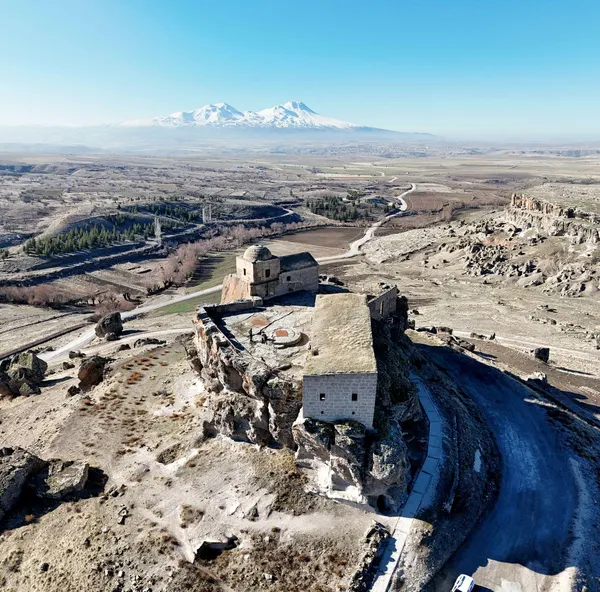
Perched on an enormous rocky outcrop stands a beautiful stone church, crowned by a dome and overlooking the spectacular landscape of Güzelyurt.
Its isolated position makes it look almost like a fortress.
But this remarkable building was once a place of Christian worship, religious celebrations, and communal life.
Welcome to High Church (Yüksek Kilise), also known as Analipsis Church and traditionally associated with Saint Mamas Monastery (Aziz Mamas Manastırı).
Located near Güzelyurt in Aksaray Province, High Church is one of Cappadocia's most distinctive late Ottoman-period Christian monuments.
Unlike the famous cave churches of Göreme, its most impressive features are not colourful Byzantine frescoes.
Instead, visitors discover something different.
A church constructed partly upon natural volcanic rock, a beautiful stone dome, an adjoining monastery building, and a remarkable courtyard overlooking the surrounding countryside.
And there's one particularly interesting detail!
Above its entrance, the date 1894 was carved directly into the stone, preserving the year associated with the church's present architectural form.
High Church offers an extraordinary opportunity to explore the final centuries of Greek Orthodox religious life in Cappadocia.
Before becoming Güzelyurt, the settlement was widely known as Gelveri, a town with a long history of Christian religious activity.
During the Byzantine and Ottoman periods, the surrounding area contained churches, monasteries, rock-cut dwellings, and agricultural settlements.
The town was also closely associated with Saint Gregory of Nazianzus, one of Christianity's most influential early theologians.
By the 19th century, its Greek Orthodox community continued maintaining religious institutions and constructing new churches.
High Church belongs to this later chapter of Cappadocia's Christian history.
The name Yüksek Kilise, meaning High Church, comes from its extraordinary location.
The building stands on a steep rocky elevation, overlooking the surrounding agricultural plains and the nearby lake.
Its prominent position makes it visible from considerable distances.
However, High Church was not necessarily its original religious name.
In historical literature, the complex is associated with Saint Mamas Monastery.
Saint Mamas was an early Christian martyr widely honoured in the Byzantine and Eastern Orthodox traditions.
According to Christian tradition, he lived in the 3rd century and became associated with stories of remarkable courage and divine protection.
One famous legend describes him riding a lion.
His cult became particularly important in parts of Anatolia and the wider Byzantine world.
In 1899, the researcher A. M. Lebides recorded a monastery dedicated to Saint Mamas on a hill near Güzelyurt.
Art historian M. Sacit Pekak subsequently connected that historical reference with the monument known today as High Church.
The church is also identified in academic publications as Analipsis Church.
The Greek word Analipsis means Ascension and refers to the Christian belief that Jesus Christ ascended into heaven following his Resurrection.
The name also appears in the designation Analipsis Hill.
Although these historical names are well documented, the precise relationship between the site's original dedication and the different names used over time is not completely established.
Historical accounts suggest that the monastery served as an important gathering place for local Christians during religious feast days.
Such celebrations brought families and religious communities together for prayer and worship.
The monastery's elevated location and adjoining residential facilities made it a distinctive religious destination outside the town.
Following the Greek-Turkish population exchange of 1923–1924, the departure of Güzelyurt's Greek Orthodox population brought major changes to the monument's religious life.
The complex subsequently experienced neglect and deterioration before later conservation efforts.
Unlike many Cappadocian churches, High Church preserves a particularly useful architectural date.
1894 AD.
The date is carved into the stones of the western entrance arch.
Art historian M. Sacit Pekak documented this inscription during his architectural research.
The construction or major rebuilding of High Church took place during the final decades of the Ottoman Empire.
This was a period when many Christian communities throughout Anatolia constructed or renovated religious buildings.
Changes in Ottoman legislation during the 19th century contributed to increased church-building activity.
High Church forms part of this wider architectural development.
Some local heritage descriptions refer to an earlier Byzantine chapel associated with the rocky site.
There is also evidence of much older human activity in the surrounding area.
However, the presence of ancient remains does not establish that the surviving High Church dates to the Byzantine period.
The present church's architecture and dated entrance belong primarily to the late 19th century.
The most reliable conclusion is that High Church received its present architectural form in 1894, although the rocky site may have supported earlier religious or settlement activities.
One of the most fascinating aspects of High Church is how its builders combined natural rock formations with carefully constructed stone architecture.
The complex was built on an elevated rocky plateau.
Its surviving buildings include the church, an adjoining residential structure, and a rock-cut cistern.
The main church follows an east–west rectangular arrangement.
From the outside, it appears to contain two distinct sections.
The western section is lower and covered by a pitched roof.
The eastern section is taller and crowned by a dome.
This contrast creates the church's distinctive silhouette.
The entrance is framed by a shallow arch beneath a triangular pediment.
A pediment is the triangular architectural feature above a doorway, frequently associated with classical and neoclassical architecture.
The date 1894 is carved across the stones of the entrance arch.
At its centre appears a relief carving of a Christian cross.
This entrance is one of the most historically important architectural details because it preserves direct evidence of the monument's late-19th-century phase.
Inside, the western section contains a single nave.
A nave is the principal interior area where worshippers gathered.
Its ceiling is covered by a barrel vault, resembling the curved interior of a tunnel.
Three supporting arches divide the ceiling into sections.
Windows along the side walls originally provided natural light.
The eastern portion is raised approximately two steps above the nave.
Its most impressive feature is a large central dome supported by pendentives.
Pendentives are curved triangular architectural elements that allow a circular dome to rest above a square space.
The dome gives the church its distinctive appearance.
Additional windows provide light from the north, south, and east.
The exterior walls were constructed using carefully dressed grey and dark volcanic stone.
However, parts of the lower structure incorporate the natural rock formation.
This combination demonstrates how Cappadocian builders adapted traditional masonry architecture to the region's unusual landscape.
To the northeast of the church stands an additional structure containing several rooms.
Academic descriptions identify approximately six chambers arranged around a passage.
The structure is generally interpreted as accommodation associated with the monastery.
Some official documentation describes it as a guesthouse.
Its rooms, corridors, and stone seating suggest that the complex could accommodate visitors or religious residents.
However, the identities and exact number of its occupants are not documented.
Between the church and the adjoining building is a cistern carved into the rock.
A cistern is a structure designed to collect and store water.
Its presence was particularly important because of the monastery's elevated location.
The cistern demonstrates how the site combined religious architecture with practical facilities.
High Church is an impressive example of late Ottoman Christian architecture, combining traditional stone construction, a domed sanctuary, and Cappadocia's natural volcanic formations.
Unlike Göreme's Dark Church or the painted sanctuaries of Ihlara Valley, High Church is not famous for surviving biblical frescoes.
In fact, official architectural records state that no frescoes were found inside the church.
This is an important distinction.
Rather than imagining colourful paintings of Jesus Christ, the Virgin Mary, or biblical events, visitors should appreciate the monument's surviving architectural decoration.
The most identifiable surviving Christian symbol appears above the western entrance.
At the centre of the doorway's dated arch is a carved cross.
In Christianity, the cross represents the Crucifixion of Jesus Christ and the belief in salvation through his death and Resurrection.
Its prominent position communicated the building's religious identity.
The historical name Analipsis refers to the Ascension of Jesus Christ.
According to the New Testament, Jesus ascended into heaven following his Resurrection.
In Eastern Orthodox Christianity, the Ascension is an important religious feast celebrated forty days after Easter.
However, the name does not prove that the church once contained an Ascension fresco.
No such surviving painting has been securely documented.
The church's dome is another meaningful architectural feature.
In Eastern Christian architecture, domes were often associated with the heavenly world.
Their elevated position created an impressive environment for religious worship.
At High Church, the dome remains one of the most striking elements of the entire building.
The triangular pediment and carefully organised façade reflect architectural preferences that became widespread during the 19th century.
Researchers have compared High Church with other late Ottoman-period churches in Central Anatolia.
These similarities demonstrate the exchange of architectural ideas between different Christian communities.
The artistic importance of High Church lies primarily in its stonework, architectural proportions, entrance decoration, and remarkable hilltop setting rather than a surviving fresco programme.
High Church was part of the religious landscape of Güzelyurt's former Greek Orthodox community.
Its location, monastery rooms, and historical associations suggest that it supported both worship and communal activities.
The main church provided a sanctuary for religious ceremonies.
Orthodox worship included prayers, scripture readings, and the celebration of the Eucharist, also known as Holy Communion.
The elevated eastern section formed the most important liturgical area.
Historical accounts recorded by later researchers indicate that local Christians gathered at the monastery during religious feast days.
These celebrations reinforced connections between the religious institution and the surrounding community.
The church's isolated hilltop setting may also have contributed to its importance as a special destination for religious gatherings.
The adjoining building contained rooms that may have accommodated religious residents or visitors.
The cistern supplied water.
The courtyard created a shared outdoor space.
Together, these features demonstrate how the monastery could function beyond the church itself.
However, the precise routine of its original occupants remains undocumented.
High Church is also popularly called Kızlar Manastırı, meaning Girls' Monastery or Nunnery.
This name is widely used in tourism descriptions.
However, the historical evidence examined does not securely establish that the entire complex was inhabited exclusively by nuns.
Some researchers refer to monks' quarters, while official inventories describe guest accommodation.
It is therefore more accurate to use Kızlar Manastırı as an alternative local name, rather than presenting a specific female monastic community as proven.
The population exchange of 1923–1924 transformed Güzelyurt's social and religious character.
The departure of its Greek Orthodox inhabitants affected the churches and monasteries they had maintained.
High Church gradually lost its original religious function.
Today, the building preserves an important architectural connection with the community that once gathered here.
High Church demonstrates how a relatively small religious complex could hold an important place in the cultural life of Ottoman-era Cappadocia.
High Church is located approximately three kilometres from Güzelyurt town centre, in Aksaray Province, Türkiye.
It stands on a rocky elevation overlooking the surrounding plains and nearby lake.
Its dramatic position makes it one of the most recognisable historical landmarks around Güzelyurt.
The 1894 Entrance Inscription
The carved date above the western doorway is one of the most important historical features.
The Stone Dome
The domed eastern section gives the building its distinctive appearance.
The Barrel-Vaulted Interior
The western nave preserves the church's traditional vaulted architecture.
The Cross Above the Entrance
The carved cross communicates the building's original Christian purpose.
The Former Monastery Rooms
The adjoining structure contains rooms and corridors associated with the complex's religious and residential functions.
The Rock-Cut Cistern
The water-storage facility demonstrates how the monastery adapted to its elevated location.
The Surrounding Landscape
The panoramic views extend across the countryside towards Mount Hasan and the Güzelyurt area.
Over time, the abandoned complex suffered deterioration.
According to official Turkish heritage information, restoration work began in 2001.
The monument was subsequently opened to visitors.
These conservation efforts helped preserve its distinctive architecture.
Nevertheless, access to individual rooms and surrounding structures may vary.
The church is situated approximately three kilometres outside Güzelyurt, near the local lake.
Visitors can travel towards the site by car.
The final approach involves an elevated rocky area and may include uneven walking surfaces.
Comfortable footwear is recommended.
Saint Gregory Church (Kilise Camii)
One of Güzelyurt's most significant religious buildings, formerly a Greek Orthodox church and currently used as a mosque.
Red Church (Kızıl Kilise)
A remarkable early Byzantine stone church near Sivrihisar village, famous for its reddish masonry and surviving dome.
Güzelyurt Monastery Valley
A beautiful valley containing numerous rock-cut churches and historical religious spaces.
Ihlara Valley
One of Cappadocia's most spectacular landscapes, known for its canyon scenery and Byzantine cave churches.
Selime Cathedral
A monumental rock-cut religious complex near the northern end of Ihlara Valley.
High Church is a recognised historical attraction and has previously been opened to visitors following restoration.
However, current opening hours, admission arrangements, and access to individual chambers should be confirmed locally.
Visitors should follow marked routes and avoid unstable sections of the rocky hillside.
Absolutely!
High Church is particularly rewarding for travellers interested in Ottoman-period architecture, Greek Orthodox history, and Cappadocia's lesser-known religious monuments.
Its spectacular position offers memorable views of the surrounding countryside.
Its stone dome and carefully carved entrance demonstrate the craftsmanship of 19th-century builders.
Its former monastery rooms reveal how worship and everyday activities could exist within the same complex.
And its 1894 inscription provides a rare, precise connection with the people who maintained the church during the final decades of Ottoman rule.
But perhaps its most interesting feature is the contrast between its history and its appearance today.
A church once visited during religious celebrations now stands quietly above the plains.
The community that built it has departed.
Its religious ceremonies have ended.
Yet its stone walls and distinctive dome continue to preserve the memory of their presence.
High Church is more than another ancient monument in Cappadocia. It is an extraordinary example of late Ottoman Christian architecture, Greek Orthodox heritage, and the cultural history of Güzelyurt.
Analipsis Church
Ascension Church
Yüksek Kilise
Kızlar Manastırı
High Church of Güzelyurt
Photography: Adrian Farwell / Wikimedia Commons – Creative Commons Attribution 3.0 Unported (CC BY 3.0).
No tours currently list High Church (Yüksek Kilise) – Güzelyurt, Cappadocia as a stop. Browse all day tours or plan a custom trip.
Browse all Cappadocia attractions