Cappadocia Adventures
Cappadocia Adventures

Imagine stepping inside an ancient cave church in Cappadocia.
At first, everything seems unusually dark.
Only a small amount of sunlight enters through a single window, leaving much of the interior in shadow.
But as your eyes adjust, something extraordinary begins to appear.
Beautifully painted angels look down from the domes. Biblical stories cover the walls. Images of Jesus Christ, the Virgin Mary, prophets, and saints emerge from the darkness, surrounded by vivid reds, golden yellows, and deep blues.
And here's the most remarkable part.
Many of these paintings have survived for approximately a thousand years, preserving colours and details that have disappeared from countless other medieval churches.
Welcome to Dark Church (Karanlık Kilise), one of the most beautiful and historically significant rock-cut churches in Cappadocia.
Located inside the famous Göreme Open-Air Museum, Dark Church is widely celebrated for its exceptionally preserved Byzantine frescoes and sophisticated religious architecture.
But why is it called the Dark Church?
And why are its paintings so much better preserved than those of many neighbouring churches?
Surprisingly, the answers are closely connected.
Unlike most churches, where large windows allowed sunlight to illuminate the interior, Dark Church receives very little natural light.
For centuries, this limited exposure helped protect its paintings from the damaging effects of sunlight.
What might initially seem like an architectural disadvantage became one of the greatest reasons for the church's remarkable preservation.
But Dark Church is much more than a collection of beautiful paintings.
Behind its extraordinary frescoes lies the story of a Byzantine religious community, wealthy benefactors, Christian burial traditions, and a sophisticated artistic programme designed to connect earthly worship with the heavenly kingdom.
The church was also part of a larger monastic complex containing living spaces, a communal dining hall, burial chambers, and an elaborate courtyard.
And the paintings themselves contain some fascinating details.
From the powerful image of Christ Pantocrator looking down from the dome to the mysterious biblical scene of three young men surviving a burning furnace, almost every corner has something interesting to tell.
So, who built this extraordinary church?
Why were so many religious figures painted across its walls and ceilings?
And what makes Dark Church one of the most important surviving examples of Byzantine art in Cappadocia?
Let's discover the remarkable history of Dark Church, a place where darkness helped preserve one of Cappadocia's greatest artistic treasures.
To understand Dark Church, we first need to travel back to the Byzantine period, when Cappadocia was one of Anatolia's most important centres of Christian religious life.
Between the 4th and 13th centuries, Christian communities throughout the region created an extraordinary network of rock-cut churches, monasteries, chapels, and religious settlements.
The landscape itself helped make this possible.
Cappadocia's soft volcanic rock could be excavated to create entire buildings without constructing traditional stone walls.
As a result, hillsides became places of worship, valleys developed into religious settlements, and some of the region's most impressive churches were carved directly into the rocks.
Dark Church became part of this remarkable tradition.
But unlike many small chapels scattered throughout the surrounding valleys, it belonged to a larger and more elaborate religious complex.
One of the most important facts about Dark Church is that it was not originally an isolated place of worship.
It formed the principal church of a Byzantine monastic complex.
In Byzantine Christianity, monasteries were communities where monks dedicated themselves to prayer, religious discipline, study, and communal life.
Some monasteries were relatively simple establishments containing only a few rooms.
Others developed into sophisticated complexes with churches, dining halls, storage areas, living quarters, and burial spaces.
The complex surrounding Dark Church belonged to this broader tradition.
Its architectural remains reveal an organised religious environment built around a courtyard.
The buildings were carefully excavated into the volcanic hillside, with different rooms serving different purposes.
Although parts of the original complex have been damaged or altered, several important features survive.
The original monastery was arranged around a courtyard bordered by rock-cut architectural spaces.
Historical studies describe a two-level portico, or covered passageway, associated with the courtyard.
The lower level included an open passage, while the upper level contained more enclosed architectural spaces.
Parts of the original arrangement have collapsed, and modern visitor facilities have changed the surrounding landscape.
However, surviving doorways, arches, niches, and decorative carvings provide clues to the monastery's original appearance.
Some sections of the façade were decorated with geometric designs and carved crosses.
These details demonstrate that the builders invested considerable effort not only in the church itself, but also in the surrounding complex.
One particularly fascinating part of the complex is its communal dining hall, known as a refectory.
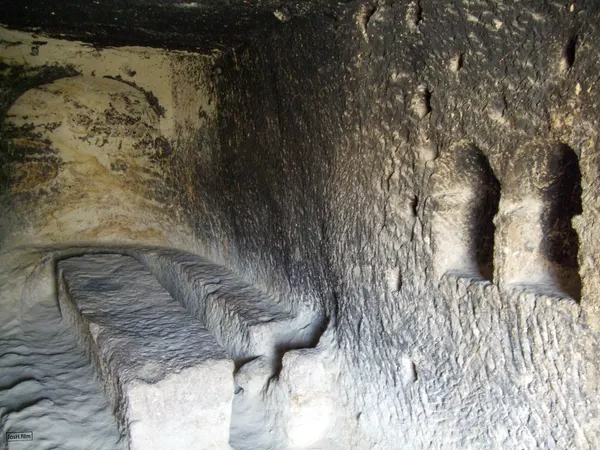
The refectory contains an exceptionally long table carved directly into the rock, accompanied by stone benches.
The table is approximately 15 metres long.
Imagine a group of Byzantine monks sitting together at this enormous stone table, sharing their daily meals after hours of prayer and religious duties.
Unlike a wooden dining table, this one was not placed inside the room.
It was created by excavating the surrounding volcanic rock and leaving the table and benches standing.
The dining hall provides an important glimpse into the everyday lives of the people who occupied the monastery.
It also demonstrates how practical architecture and religious life existed side by side.
Dark Church was not an ordinary construction project.
Its architectural complexity, extensive paintings, and exceptional decorative quality suggest that considerable resources were invested in its creation.
The artists responsible for its frescoes possessed highly developed technical skills.
Their paintings show careful planning, elaborate compositions, and a sophisticated understanding of Byzantine artistic traditions.
Some researchers have suggested connections with artistic workshops influenced by Constantinople, the capital of the Byzantine Empire.
However, the exact origins of the painters cannot be established with certainty.
What is clear is that Dark Church benefited from substantial patronage.
And the most interesting evidence comes from the paintings themselves.
Among the religious images decorating Dark Church are portraits of individuals who contributed to its construction or decoration.
These people are known as donors or patrons.
In Byzantine Christianity, wealthy individuals sometimes financed churches, monasteries, or religious paintings as expressions of their faith.
In return, they might be represented within the decoration, often kneeling or bowing before Christ, the Virgin Mary, or important saints.
At Dark Church, several such portraits have survived.
Among those identified through inscriptions are individuals named Nikephoros, Bassianos, John, and Genethlios.
Nikephoros is identified as a priest.
The remaining figures appear to have belonged to the wider community of benefactors connected with the church.
Some are shown kneeling before Christ, while others appear beneath the protective wings of archangels.
Unfortunately, the surviving evidence does not reveal their complete biographies or precisely how they were related to one another.
Nevertheless, their presence is extremely significant.
These were real people who helped create the magnificent monument visitors admire today.
The history of Dark Church did not end with the decline of Byzantine rule in Anatolia.
Evidence suggests that the building remained known to later generations, and inscriptions scratched into parts of its painted plaster record visits by Greek-speaking Christians.
Some of these historical markings date to the early modern period.
Following the departure of local Greek Orthodox communities during the population-exchange era of the 1920s, the religious landscape of Cappadocia changed dramatically.
Dark Church eventually ceased functioning as an active place of Christian worship.
During a later period, the building was used as a pigeon house.
Although this was very different from its original purpose, the enclosed character of the space helped maintain the limited light conditions that protected much of its decoration.
During the 20th century, growing recognition of Cappadocia's historical importance led to archaeological research and conservation programmes.
Specialists worked to stabilise the structure, protect its paintings, and restore damaged architectural elements.
Today, Dark Church is one of the most celebrated monuments within Göreme Open-Air Museum.
Its remarkable survival allows modern visitors to experience a religious interior that still preserves much of the artistic atmosphere created by Byzantine painters centuries ago.
So, exactly how old is Dark Church?
The answer is slightly more complicated than identifying a single construction year.
According to the Republic of Türkiye's Ministry of Culture and Tourism, Dark Church is traditionally dated to the late 11th and early 12th centuries.
However, several academic studies have proposed an earlier date.
Art historians examining the church's architecture and painting style have connected the monument with the middle of the 11th century.
So why are there different dates?
Because, unlike some Byzantine churches, Dark Church does not possess a securely established original construction inscription that provides an exact year.
Instead, researchers have relied on architectural comparisons, painting styles, inscriptions, and similarities with other churches in Göreme.
Dark Church belongs to a distinctive group of monuments commonly known as the Column Churches.
The other two principal members are:
Elmalı Church (Apple Church) and Çarıklı Church (Sandal Church).
These three churches share important architectural and artistic characteristics.
All follow variations of the cross-in-square plan, with a central dome, supporting columns, and richly decorated interiors.
Their paintings also display similarities in the arrangement of biblical scenes, treatment of human figures, and decorative details.
Because of these connections, researchers have suggested that the three churches were created within a related artistic tradition.
Some have even proposed that the painters worked in connected workshops.
However, identifying one particular artist or establishing the exact order in which the churches were completed remains difficult.
Dark Church is particularly valuable because its paintings represent a mature stage of Byzantine art in Cappadocia.
The figures are carefully proportioned, the narrative scenes are elaborate, and the decoration follows a sophisticated religious programme.
These characteristics help historians understand the development of monumental painting in the region.
Although its precise construction year remains uncertain, Dark Church belongs to the medieval Byzantine period, with its principal painting programme generally associated with the 11th century or the beginning of the 12th century.
That means the frescoes admired by visitors today are roughly nine hundred to one thousand years old.
And considering the exceptional quality of their preservation, that's rather extraordinary.
From the outside, Dark Church might appear relatively modest.
Its entrance does not resemble the monumental stone façades of famous European cathedrals.
There are no enormous towers rising above the surrounding landscape.
Instead, the entire building was excavated directly into Cappadocia's volcanic rock.
But once you step inside, the architectural sophistication becomes immediately apparent.
The church contains domes, arches, columns, cross-vaulted spaces, and three apses arranged within a compact but carefully organised interior.
And here's what makes the construction particularly impressive.
The builders created these architectural features by removing rock rather than assembling individual stones.
Dark Church follows a Byzantine architectural arrangement known as the cross-in-square plan.
But what exactly does that mean?
Imagine looking at the church from directly above.
Its principal interior spaces form a cross-shaped arrangement contained within a roughly square area.
A central dome rises above the main space, while surrounding arches and vaults connect the different sections.
This design became particularly popular in Byzantine church architecture during the Middle Byzantine period.
It allowed builders to create a compact religious interior with a strong central focus.
At Dark Church, the arrangement was adapted to the natural volcanic rock.
The main interior was originally organised around four central columns supporting the arches beneath the dome.
These columns helped define the principal worship space.
However, not all of the original supports have survived intact.
Historical and architectural studies indicate that only one of the original freestanding columns remains, while the others were reconstructed during conservation work.
The interior also contains pilasters, which are column-like features attached to the walls.
Together, the columns, arches, and pilasters create an impressive architectural rhythm.
And although the church is carved from rock, its design imitates features commonly found in churches constructed from masonry.
One of the most beautiful architectural features is the arrangement of domes above the main worship area.
In Byzantine Christianity, the upper parts of a church frequently symbolised the heavenly world.
This symbolism influenced the placement of religious paintings.
At Dark Church, the domes contain extraordinary representations of Christ Pantocrator and heavenly angels.
The central position of Christ above the congregation reinforces the idea of divine authority.
The surrounding angels create the impression of a heavenly court.
In this way, the architecture and artwork work together.
The building does not simply contain religious pictures.
Its very arrangement helps communicate a vision of heaven.
At the eastern end of Dark Church are three apses.
An apse is a curved architectural space associated with the sanctuary of a Christian church.
In Byzantine religious architecture, the central apse generally contained the principal altar.
The side apses could serve additional functions connected with the preparation of religious ceremonies.
At Dark Church, the three apses are richly decorated with Christian imagery.
The central apse contains the extraordinary Deesis composition, showing Jesus Christ enthroned between the Virgin Mary and John the Baptist.
The sanctuary also preserves traces of architectural features associated with the altar and the separation of sacred space from the congregation.
Before entering the main church, worshippers passed through a space known as the narthex.
In Byzantine architecture, the narthex was an entrance hall or transitional area preceding the main worship space.
At Dark Church, this section is particularly impressive.
The rectangular room is covered by a barrel-vaulted ceiling and contains an extensive collection of religious paintings.
Among the most important is the Ascension of Jesus Christ.
The narthex also contains donor portraits and additional biblical scenes.
Its arrangement demonstrates that the religious decoration began before visitors entered the principal nave.
Another fascinating architectural feature is the burial area connected with the narthex.
The surviving funerary chamber contains graves associated with the religious complex.
Its presence reflects the close relationship between Christian worship and burial traditions.
For Byzantine Christians, death was understood within the wider religious framework of resurrection and eternal life.
Burial chambers near churches provided places for remembrance and prayer.
At Dark Church, the proximity of the graves to paintings associated with Christ's Resurrection may have carried particular religious significance.
However, the identities of the individuals buried here have not been securely established.
And now we return to the architectural feature that makes Dark Church famous.
Its small window.
The principal natural light enters through an opening associated with the narthex.
Unlike churches with several large windows, Dark Church receives relatively little daylight.
As a result, its interior remains noticeably dim.
But this darkness became an unexpected advantage.
Sunlight can gradually damage pigments and painted surfaces through long-term exposure.
Because the paintings of Dark Church received comparatively little light, many retained their remarkable colours.
Other factors, including environmental conditions, later use, and conservation, also influenced their survival.
Still, limited natural illumination remains one of the most important reasons for the church's exceptional preservation.
The very darkness that gave the building its name helped protect the extraordinary artwork hidden inside.
Now comes the part that makes Dark Church truly unforgettable.
Its paintings!
While Cappadocia contains hundreds of rock-cut churches, few preserve such an extensive collection of richly coloured Byzantine frescoes.
Almost every major architectural surface contains religious imagery.
The domes display Christ and heavenly figures.
The arches contain Old Testament prophets.
The upper walls depict important events from the life of Jesus Christ.
The lower sections contain portraits of saints and other holy figures.
But these images were not arranged randomly.
Their placement followed a sophisticated religious programme designed to communicate Christian beliefs about heaven, salvation, and the relationship between God and humanity.
Look upward towards the domes.
One of the most impressive images represents Christ Pantocrator.
The Greek word Pantocrator is commonly translated as Almighty or Ruler of All.
In Byzantine art, Christ Pantocrator usually appears as a majestic figure looking directly towards the viewer.
He frequently holds a Gospel book while raising his other hand in a gesture of blessing.
At Dark Church, the image occupies a prominent position in the upper interior.
Christ appears surrounded by decorative patterns, angels, and other sacred figures.
His placement above the congregation communicates an important religious idea.
Jesus Christ is represented not simply as a historical teacher, but as the divine ruler of the universe.
For Byzantine worshippers standing beneath the dome, the image would have been particularly powerful.
They were looking upward towards a representation of the heavenly kingdom.
And according to Christian belief, Christ was looking down upon them.
One of the most fascinating details of Dark Church is the biblical passage associated with an image of Christ.
The Gospel book contains a reference to John 8:12, in which Jesus identifies himself as the light of the world.
Think about that for a moment.
Here, inside a church famous for its darkness, Christ is represented as the source of spiritual light.
The contrast is extraordinary.
The building receives very little natural illumination, yet the religious imagery communicates the Christian belief that Christ brings light into the world.
Whether this relationship was deliberately emphasised by the original artists cannot be established with certainty.
Nevertheless, it creates one of the church's most memorable connections between architecture and religious symbolism.
Another extraordinary composition appears in the central apse.
This painting is known as the Deesis.
The word comes from Greek and refers to prayer or supplication.
In Byzantine art, a Deesis composition typically shows Jesus Christ enthroned, accompanied by the Virgin Mary and John the Baptist.
Mary and John are represented as intercessors, asking Christ to show mercy towards humanity.
At Dark Church, the composition is especially impressive because of its scale and preservation.
Jesus occupies the central position, while Mary and John the Baptist stand beside him.
The painting communicates ideas about divine judgement, mercy, and salvation.
And there's another fascinating detail.
Small donor figures appear near the enthroned Christ.
These individuals are represented kneeling in prayer, visually connecting the people who supported the church with the sacred figures they honoured.
Dark Church also contains representations of the Four Evangelists.
These are the traditional authors of Christianity's four canonical Gospels:
Matthew, Mark, Luke, and John.
The paintings depict them as writers, seated with books, writing materials, and other objects associated with the production of manuscripts.
This is particularly interesting because it provides a glimpse into how Byzantine artists imagined the writing of sacred texts.
The Evangelists are not represented simply as abstract religious symbols.
They appear as individuals engaged in the act of recording the life and teachings of Jesus Christ.
Their inclusion connects the painted biblical narratives with the written Gospels from which many of those stories originated.
The walls of Dark Church contain an extensive series of scenes illustrating important moments from the life of Jesus.
Unlike a modern book, the narrative does not always follow a simple chronological sequence.
The position of each scene was also influenced by the architectural space and its religious significance.
Among the most important paintings are the following.
The Archangel Gabriel announces to the Virgin Mary that she will give birth to Jesus Christ.
The scene represents the beginning of the Incarnation, one of Christianity's central beliefs.
Mary and Joseph travel towards Bethlehem before the birth of Jesus.
The painting connects the biblical narrative with the circumstances surrounding Christ's arrival.
One of the church's most recognisable subjects is the birth of Jesus.
The Nativity introduces the central Christian belief that God entered human history through Christ.
Within Byzantine religious art, the scene often includes Mary, the infant Jesus, Joseph, and other traditional figures.
The Magi, or wise men from the East, travel to honour the infant Jesus.
Their presence symbolises the recognition of Christ by people beyond his immediate community.
Jesus is baptised by John the Baptist in the Jordan River.
The event marks an important moment at the beginning of his public ministry.
It is also associated with the manifestation of the Holy Trinity in Christian theology.
One of the most dramatic biblical scenes depicts Jesus raising Lazarus from the dead.
According to the Gospel of John, Lazarus had already been buried when Jesus arrived.
The miracle became an important symbol of Christ's authority over death.
Its significance was especially powerful in a church containing burial spaces.
For Byzantine Christians, the raising of Lazarus expressed hope in the resurrection of the dead.
Jesus appears in radiant glory before three of his disciples.
Moses and Elijah are traditionally represented beside him.
The event reveals the divine nature of Christ and connects him with important figures from the Old Testament.
Jesus enters Jerusalem riding a donkey while crowds welcome him.
This event is commemorated in Christianity as Palm Sunday.
It marks the beginning of the events leading towards the Crucifixion.
Another particularly beautiful fresco depicts the Last Supper.
Jesus is shown sharing his final meal with his disciples before his arrest.
The composition is closely connected with the Eucharist, one of Christianity's central religious ceremonies.
In Byzantine art, the Last Supper was especially meaningful because of its relationship with the religious services celebrated inside the church.
Judas identifies Jesus to the people who have come to arrest him.
The scene forms part of the Passion narrative, depicting the events leading towards Christ's death.
One of the most important paintings represents Jesus Christ upon the cross.
The scene communicates the central Christian belief in Christ's sacrifice.
At Dark Church, the Crucifixion is particularly striking because of the clarity of its figures and the rich colours of the surrounding decoration.
The Anastasis is one of the most important themes in Byzantine religious art.
It is commonly associated with Christ's descent into the realm of the dead following his Crucifixion.
In traditional Byzantine representations, Jesus raises Adam and Eve, symbolising the liberation of humanity from death.
The scene is especially important within Eastern Christianity, where it became a major visual expression of the Resurrection.
Women arrive at the tomb of Jesus and discover that his body is no longer there.
An angel announces the Resurrection.
The scene communicates the Christian belief that Christ has conquered death.
Its placement near other Resurrection-related imagery reinforces the church's message of salvation and eternal life.
The church also includes scenes associated with Jesus blessing his disciples and preparing them to continue his mission.
These paintings connect the life of Christ with the beginnings of the Christian Church.
They emphasise the responsibility of the apostles to spread his teachings.
One of the most impressive paintings appears on the vault of the narthex.
The scene depicts the Ascension.
Jesus is represented rising into heaven, surrounded by angels.
Below him stand the Virgin Mary and the apostles.
Christ is enclosed within a sacred field of light known as a mandorla.
The mandorla is commonly used in Byzantine art to represent divine glory.
At Dark Church, the Ascension occupies a prominent position within the entrance area.
Its scale and composition make it one of the monument's most important paintings.
Dark Church does not contain only scenes from the New Testament.
Some of its frescoes are inspired by the Old Testament.
One especially interesting painting represents the Hospitality of Abraham.
The story comes from Genesis 18.
According to the biblical account, Abraham receives three mysterious visitors and offers them hospitality.
Within Christian artistic traditions, these three figures were frequently represented as angels.
The scene also became associated with interpretations of the Holy Trinity.
This makes the painting particularly interesting.
What appears at first to be a simple meal shared between travellers carries a much deeper religious meaning.
For Byzantine Christians, the composition could express divine presence, hospitality, and the mystery of God.
Another remarkable Old Testament subject is the story of the Three Hebrew Youths in the Fiery Furnace.
The narrative comes from the Book of Daniel.
According to the story, three young men refuse to worship the golden image established by King Nebuchadnezzar.
As punishment, they are thrown into a blazing furnace.
However, they miraculously survive the flames through divine protection.
In Christian tradition, the event became an important example of faith, courage, and deliverance.
Its inclusion at Dark Church connects the stories of the Old Testament with the broader Christian belief in salvation.
The arches of Dark Church contain portraits of Old Testament prophets.
These figures are often shown holding scrolls containing passages associated with their writings.
Among the prophets represented are figures identified as Jeremiah, Isaiah, Daniel, Jonah, Zechariah, and Habakkuk.
Their placement is particularly meaningful.
In Byzantine Christianity, the prophets were understood as figures whose writings anticipated the coming of Jesus Christ.
The scrolls and their surrounding images help connect Old Testament traditions with scenes from the life of Jesus.
Angels are another important feature of Dark Church's religious decoration.
Among the most prominent are the Archangels Michael and Gabriel.
Michael is traditionally associated with heavenly protection and the struggle against evil.
Gabriel is especially associated with divine messages, including the Annunciation to the Virgin Mary.
At Dark Church, angelic figures appear in domes, wall paintings, and compositions connected with the church's donors.
Their presence helps communicate the idea that the church is a sacred space surrounded by heavenly protection.
Among the painted saints associated with the church are Saint Hieron and Saint Theodore.
Both were honoured within Byzantine Christian traditions.
Saint Hieron is particularly interesting because of his regional association with Cappadocia.
According to Christian tradition, he was a soldier who suffered martyrdom during the Roman period.
His veneration became especially important in the Göreme area.
Saint Theodore was another widely honoured military martyr.
His presence reflects the popularity of military saints in Byzantine religious art.
One particularly intriguing religious image appears in the sanctuary decoration.
It represents the Holy Mandylion, a cloth bearing the face of Jesus Christ.
According to a Christian legend associated with the city of Edessa, the image of Christ appeared miraculously upon a cloth.
The tradition became extremely important in Byzantine religious culture.
The Mandylion was understood as a sacred image connected with the divine identity of Jesus.
Its presence at Dark Church demonstrates the significance of holy images within medieval Byzantine devotion.
After examining all these extraordinary paintings, one question naturally comes to mind.
How have they survived for so long?
The answer involves several factors.
First, the church receives very little natural light.
This reduced the long-term exposure of its paintings to sunlight.
Second, the enclosed rock-cut environment provided some protection from direct weathering.
Third, the building's later history and conservation interventions influenced the survival of its painted surfaces.
Of course, not every fresco remains completely untouched.
Some sections have suffered damage through time, environmental changes, and human activity.
Nevertheless, Dark Church preserves an exceptional amount of original painted decoration.
And the quality is extraordinary.
Its frescoes are not merely among the most beautiful in Cappadocia. They are also among the region's most valuable surviving records of Byzantine religious art.
Today, most visitors enter Dark Church to admire its beautiful frescoes.
But imagine standing here during the 11th century.
There would have been no tourists, information signs, or museum tickets.
Instead, the building would have been filled with religious activity.
Monks gathered for prayer.
Sacred texts were read.
Religious ceremonies took place before the altar.
And the painted figures surrounding the congregation helped transform the interior into a symbolic representation of the Christian universe.
During the Byzantine period, churches were central to religious and community life.
The most important ceremonies included the Divine Liturgy.
This service involved prayers, hymns, scripture readings, and the celebration of the Eucharist.
The Eucharist commemorates the Last Supper of Jesus Christ.
At Dark Church, the sanctuary and religious paintings were closely connected with these ceremonies.
The image of Christ Pantocrator above the congregation emphasised divine authority.
The Deesis composition in the apse communicated themes of mercy and intercession.
The biblical narratives illustrated the story of salvation.
Together, these images surrounded worshippers with the central ideas of Byzantine Christianity.
One of the most fascinating aspects of Dark Church is the relationship between its architecture and its painted decoration.
The upper domes were associated with heaven.
The walls displayed events from the life of Jesus Christ.
The lower surfaces contained images of saints and other holy figures.
This arrangement created a symbolic connection between the heavenly kingdom and the earthly world.
For people participating in religious ceremonies, the paintings were more than illustrations.
They helped communicate sacred stories and encouraged prayer, reflection, and devotion.
And because literacy was not universal during the medieval period, religious images also played an important educational role.
The surrounding buildings suggest that Dark Church served an organised religious community.
Monastic life involved prayer, discipline, and shared responsibilities.
Monks could spend much of their day following religious routines while also performing practical work necessary for the survival of the monastery.
The surviving dining hall, storage areas, and other carved chambers demonstrate that the complex was designed for more than worship alone.
The community needed places to prepare food, eat, store supplies, and carry out everyday activities.
Its architecture therefore reflects the practical realities of religious life.
The enormous rock-cut dining table provides one of the clearest examples of daily life at the monastery.
Monastic meals were frequently connected with traditions of communal discipline.
The monks would gather together to eat, often according to established religious routines.
Some Byzantine monastic communities also observed practices involving silence or the reading of sacred texts during meals.
We cannot reconstruct the exact daily timetable of the monks at Dark Church.
However, the surviving refectory demonstrates that communal dining was an important part of life within the complex.
The portraits of church benefactors provide another fascinating glimpse into Byzantine society.
People who financed religious buildings often believed that supporting a church was an important act of devotion.
Some wished to commemorate family members.
Others sought prayers for their salvation.
At Dark Church, the painted donors appear in humble positions before Christ and the archangels.
Their gestures communicate reverence and dependence upon divine mercy.
The inscriptions beside them preserve names that would otherwise have disappeared from history.
Nearly a thousand years later, we can still identify some of the individuals who helped create this extraordinary church.
The presence of a burial chamber demonstrates the relationship between the monastery and Christian funerary traditions.
In Byzantine Christianity, the dead were remembered through prayer and religious ceremonies.
The belief in resurrection and eternal life played a central role in these practices.
At Dark Church, the proximity of the burial spaces to paintings associated with the Resurrection is particularly meaningful.
Scenes such as the Raising of Lazarus and the Empty Tomb communicated hope in Christ's victory over death.
Although we cannot establish the intentions behind every painted scene, the relationship between death, salvation, and resurrection is an important part of the church's religious programme.
Perhaps the most remarkable aspect of Dark Church is the way its architecture and decoration communicate a complete religious vision.
Above the congregation, Christ looks down from the domes.
Angels surround the sacred spaces.
Prophets connect the Old Testament with the coming of Jesus.
The walls recount his life, miracles, death, and Resurrection.
The sanctuary presents divine mercy and salvation.
And the donors kneel beneath the sacred figures, asking for protection and forgiveness.
Together, these elements create an extraordinary experience.
For Byzantine worshippers, Dark Church was not simply a building decorated with religious paintings.
It was a place where the earthly world and the heavenly kingdom were symbolically brought together.
So, after discovering the fascinating history of Dark Church, what should you look for when visiting?
Quite a lot!
Located inside Göreme Open-Air Museum, Dark Church is one of the most impressive historical monuments in Cappadocia.
Although the interior is relatively compact, almost every wall, arch, and dome contains something worth examining.
And because its frescoes are so well preserved, visitors can appreciate details that are difficult to recognise in many other rock-cut churches.
The frescoes are undoubtedly the main attraction.
Look closely at the biblical scenes, the expressive figures, and the remarkable colours that have survived for centuries.
The reds, blues, yellows, and earthy tones create a richly decorated interior unlike almost anything else in the region.
Pay particular attention to the details of clothing, facial expressions, and architectural backgrounds within the paintings.
These features reveal the extraordinary craftsmanship of Byzantine artists.
One of the first details worth examining is the image of Christ Pantocrator.
Look upward towards the central dome.
Christ is presented as the ruler of the universe, surrounded by sacred figures and elaborate decoration.
The painting's position above the congregation was carefully connected with the religious meaning of the church.
The Deesis composition is another essential feature.
Jesus appears enthroned between the Virgin Mary and John the Baptist.
The painting communicates the themes of mercy, prayer, and divine intercession.
Look for the small donor figures near Christ.
These portraits provide an extraordinary connection with the real individuals who helped finance the church.
The paintings depicting Christ's final days are among the most memorable scenes in the church.
The Last Supper illustrates the final meal shared by Jesus and his disciples.
The Crucifixion represents his death upon the cross.
Both were central subjects in Byzantine Christian art.
Their preservation allows visitors to appreciate the sophisticated religious storytelling of the original painters.
Before leaving, take time to examine the paintings in the narthex.
The Ascension is one of its most impressive compositions.
Jesus rises towards heaven, surrounded by angels, while the Virgin Mary and the apostles appear below.
The arrangement creates a dramatic visual representation of one of Christianity's most important events.
Don't overlook the paintings inspired by the Old Testament.
The Hospitality of Abraham and the Three Young Men in the Fiery Furnace are particularly interesting.
These stories demonstrate that Byzantine religious artists drew from both the Old and New Testaments.
They also reveal the richness of the theological symbolism used inside the church.
Dark Church is only one part of a larger historical environment.
The surrounding rock-cut spaces include remains associated with the monastery's courtyard, dining hall, and other functional rooms.
The enormous stone dining table is especially memorable.
It provides a rare opportunity to imagine the everyday activities of the monks who once lived here.
The burial chamber connected with the narthex offers another important connection with the site's religious history.
Its presence demonstrates how Christian worship and the remembrance of the dead were closely related.
Dark Church has benefited from important conservation efforts.
Specialists have worked to protect its frescoes, stabilise fragile surfaces, and repair damaged architectural elements.
Some original columns were lost and subsequently reconstructed.
These interventions help preserve the building while allowing visitors to appreciate its surviving historical features.
Remember that the paintings are extremely fragile.
Touching the walls or using prohibited photography equipment can contribute to their deterioration.
Dark Church is situated inside Göreme Open-Air Museum, in Göreme, Nevşehir Province, Türkiye.
The museum is one of Cappadocia's most important archaeological attractions.
Its churches and rock-cut settlements form part of the Göreme National Park and the Rock Sites of Cappadocia, which were inscribed on the UNESCO World Heritage List in 1985.
Yes.
Dark Church has a separate admission arrangement from the general entrance to Göreme Open-Air Museum.
This is partly because its interior is relatively small and the historical paintings require careful protection.
Limiting the number of visitors helps reduce pressure on the monument.
Ticket prices and admission arrangements may change, so visitors should check the official Turkish Museums website before travelling.
Absolutely, especially if you're interested in history, religious art, or Byzantine architecture.
Although Göreme Open-Air Museum contains several beautiful churches, Dark Church stands apart because of the remarkable condition of its paintings.
The extra admission provides access to one of the richest surviving Byzantine fresco interiors in Cappadocia.
Even travellers who aren't particularly interested in religious history can appreciate the extraordinary colours, detailed artwork, and unusual atmosphere.
Dark Church is not a particularly large building.
However, the amount of artistic detail inside is extraordinary.
Allowing approximately 15–25 minutes to appreciate the main paintings is a reasonable choice, depending on visitor numbers and any time restrictions in effect.
Visitors with a strong interest in Byzantine art may wish to spend longer if permitted.
Göreme Open-Air Museum contains several other important rock-cut churches.
Among the most interesting are Elmalı Church (Apple Church), Çarıklı Church (Sandal Church), Yılanlı Church (Snake Church), and Saint Barbara Church.
These monuments allow visitors to compare different architectural designs, artistic traditions, and religious subjects.
For an especially interesting comparison, examine Dark Church alongside Elmalı and Çarıklı.
Their similarities reveal the connections between the famous Column Churches of Göreme.
And don't forget Tokalı Church (Buckle Church), another extraordinary Byzantine monument located near the museum.
Without a doubt!
Dark Church is one of those places that demonstrates why Cappadocia is much more than fairy chimneys, cave hotels, and hot-air balloons.
Its architecture reveals the remarkable abilities of Byzantine craftsmen.
Its frescoes preserve centuries-old artistic traditions.
Its donor portraits introduce us to real individuals who helped create the monument.
Its monastery complex provides fascinating clues about religious communities and everyday life.
And its extraordinary preservation allows modern visitors to experience a beautiful medieval Christian interior in remarkable detail.
But perhaps the most fascinating thing about Dark Church is also the simplest.
For centuries, its small window allowed only a limited amount of sunlight to reach the paintings.
While many other churches gradually lost their colours, much of Dark Church's decoration survived.
And now, almost a thousand years after its artists completed their work, visitors can still look upward and see the same biblical figures, sacred symbols, and extraordinary compositions.
Dark Church is more than one of Cappadocia's most beautiful cave churches. It is a remarkable surviving masterpiece of Byzantine art, religious architecture, and human history.
Because sometimes, the greatest treasures aren't preserved by sunlight.
Sometimes, they're protected by darkness.
Photo: Wolfgang Sauber / Wikimedia Commons / CC BY-SA 3.0. Original: [individual photo URL]. Licence: https://creativecommons.org/licenses/by-sa/3.0/ . Changes: none.
No tours currently list Dark Church Cappadocia – History, Frescoes & Visiting Guide as a stop. Browse all day tours or plan a custom trip.
Browse all Cappadocia attractions