Cappadocia Adventures
Cappadocia Adventures

Hidden among the extraordinary rock formations of Cappadocia, Pancarlık Church (Pancarlık Kilisesi) is one of the region's most fascinating examples of Byzantine religious art and rock-cut architecture.
Located in Pancarlık Valley, just south of Ortahisar, this remarkable church offers something rather different from Cappadocia's more famous attractions. Behind its weathered rock exterior lies an extraordinary collection of centuries-old frescoes, biblical stories, and religious symbols that once surrounded the people who gathered here to worship.
And here's what makes Pancarlık Church particularly interesting!
Unlike many historical churches where only fragments of the original paintings survive, Pancarlık still preserves substantial portions of its colourful decoration. Its walls and ceiling tell stories from the life of Jesus Christ, while the impressive painting above the altar introduces visitors to the symbolism of Byzantine Christianity.
But Pancarlık is more than a beautifully decorated cave church. Its architecture, burial chambers, inscriptions, and centuries of alterations offer a fascinating glimpse into the lives of the Christian communities that once inhabited Cappadocia.
For travellers interested in history, religion, art, or simply discovering places beyond the usual tourist routes, Pancarlık Church is certainly worth exploring.
To understand Pancarlık Church, we first need to travel back to a time when Cappadocia was an important part of the Byzantine world.
During the Byzantine period, Christian communities throughout the region carved churches, chapels, living spaces, and burial chambers into Cappadocia's soft volcanic rock. These structures became places of worship, community gatherings, and religious life.
Pancarlık Church developed within this historical setting, although its story is considerably more complicated than that of a building constructed during a single period.
Architectural evidence suggests that the church may originally have been carved as early as the 6th century AD. One particularly interesting clue comes from a burial inscription associated with a monk named John, discovered in a funerary niche near the entrance.
The inscription expresses the monk's hope for the resurrection of the dead and the eventual return of Christ. It provides an important connection between the church, early Christian burial traditions, and the religious beliefs of its community.
The burial also suggests that Pancarlık may initially have been associated with a monastic community, although its exact function throughout the centuries remains uncertain.
As time passed, the interior underwent significant changes.
The church was decorated with an elaborate series of religious paintings, its sanctuary was modified, and additional spaces were carved into the surrounding rock. Some alterations even damaged parts of the original frescoes, leaving visible traces of the building's changing history.
Evidence of later use suggests that Pancarlık continued to hold religious importance long after its Byzantine decoration was completed. Local historical accounts describe the church remaining in use by Greek Orthodox Christians until the early 20th century, around the period of the 1923 population exchange between Greece and Türkiye.
Today, those centuries of religious activity have left behind an extraordinary historical monument.
Rather than belonging to just one moment in history, Pancarlık Church tells the story of a sacred space that was adapted, modified, and appreciated by successive generations.
So, how old is Pancarlık Church?
The answer is a little more interesting than you might expect!
According to the Republic of Türkiye's Ministry of Culture and Tourism, Pancarlık Church is dated to the first half of the 11th century.
However, detailed academic studies suggest that different parts of the church may belong to considerably earlier periods.
Some researchers propose that the original rock-cut structure dates back to approximately the 6th century, based on its architectural features, carved crosses, and burial inscriptions.
Meanwhile, art-historical research has dated the church's principal fresco decorations to the 9th or 10th century, based on comparisons with other Byzantine paintings in Cappadocia.
These different dates do not necessarily contradict one another. They may reflect separate stages in the church's development: its original carving, its painted decoration, and subsequent modifications.
Because Pancarlık has no securely established construction date, its precise age remains a subject of historical discussion.
What we can confidently say is that Pancarlık Church preserves an important example of medieval Byzantine art and architecture, with evidence suggesting that its origins may be even older than its celebrated frescoes.
And considering how much of its original decoration has survived, that's quite impressive!
At first glance, Pancarlık Church might appear to be another simple cave church hidden inside Cappadocia's rocky landscape.
Step inside, however, and you'll discover that its architecture is anything but ordinary.
Like many of the region's historic churches, Pancarlık was carved directly into soft volcanic tuff, a type of rock formed from ancient volcanic deposits.
Instead of constructing walls with individual stones, the builders excavated the rock itself, gradually creating the interior spaces.
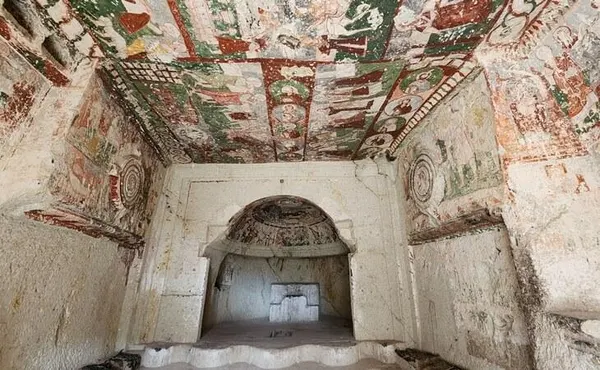
The church follows a relatively simple architectural plan, consisting of a single nave, a flat ceiling, and one apse.
The nave is the main interior space where worshippers gathered, while the apse is the semicircular area at the eastern end of the church, traditionally associated with the altar and the celebration of Christian religious services.
Although this general layout is common in Cappadocian rock-cut churches, Pancarlık contains several unusual architectural details.
Its interior walls feature different depths and angles, while carved benches, niches, and changes in floor level make the church noticeably less symmetrical than many other examples.
An especially interesting feature is the presence of undulating stone steps leading towards the sanctuary.
These steps were created during later alterations, demonstrating how the interior was modified to accommodate changing needs over time.
The apse itself was also recarved, creating a deeper altar area. Unfortunately, this modification destroyed parts of the original paintings, providing a visible reminder that historic buildings were not always preserved in their original form.
Other noteworthy details include a carved preaching platform, known as an ambon, decorative crosses enclosed within circular frames, and burial spaces associated with the church.
Near the entrance, visitors can also observe the remains of funerary chambers, reflecting the important relationship between religious worship and burial practices in Byzantine Christianity.
And the church wasn't necessarily an isolated building!
Additional rock-cut rooms can be found in the surrounding valley. Some may have served domestic, agricultural, or religious purposes, although their precise connections with the main church are not always clear.
Together, these architectural features reveal something particularly fascinating about Cappadocia: its inhabitants didn't simply build within the landscape.
They transformed the landscape into places where people could live, worship, and remember their dead.
Now comes the part that makes Pancarlık Church truly unforgettable: its extraordinary wall paintings.
The interior contains an extensive collection of Byzantine frescoes illustrating events from the Bible, particularly the life, miracles, suffering, and glorification of Jesus Christ.
These paintings are especially recognisable for their green backgrounds, deep reddish-brown tones, expressive figures, and detailed religious compositions.
Although some sections have been lost or damaged, many scenes remain remarkably clear.
Interestingly, while differences in appearance might suggest that several artists decorated the church at separate times, studies of the paintings and their inscriptions indicate that the main decorative programme was probably produced by a single artist or workshop.
But what exactly are these paintings trying to tell us?
The frescoes guide visitors through significant events in the Christian story.
Scenes associated with Christ's early life include the Annunciation, when the angel Gabriel announces to Mary that she will give birth to Jesus, and the Visitation, depicting Mary's meeting with Elizabeth.
Other paintings illustrate the Flight into Egypt, Joseph's dream, and the Massacre of the Innocents.
As the narrative continues, visitors encounter scenes from the public ministry of Jesus.
Among them are the Wedding at Cana, where Jesus transforms water into wine, his encounter with the Samaritan woman, and several miraculous healings.
These paintings were more than decorative illustrations.
For Byzantine worshippers, they communicated fundamental Christian teachings about faith, salvation, compassion, and the divine nature of Christ.
The church also contains scenes associated with his suffering and final earthly days, including the journey to Golgotha, the Crucifixion, the Descent into Hades, and the Ascension.
Together, these images transform the interior into a visual account of Christian belief.
One of Pancarlık Church's most extraordinary features is the monumental composition within its apse.
Known as Christ in Glory, the painting presents Jesus seated upon an elaborate heavenly throne, surrounded by symbolic creatures, angels, and Old Testament prophets.
Although parts of Christ's figure have deteriorated over time, the composition remains one of the church's most fascinating artistic features.
Surrounding the enthroned Christ are four winged creatures: a human figure, a lion, an ox, and an eagle.
These creatures originate from biblical visions of heaven, particularly those found in the Book of Ezekiel and the Book of Revelation.
Within Christian artistic traditions, they also became associated with the Four Evangelists: Matthew, Mark, Luke, and John.
The message is powerful.
Christ is presented not simply as a historical figure, but as the heavenly ruler before whom all creation gathers.
Beneath the central figure, angels and prophets appear in an elaborate scene of heavenly worship.
The composition also contains a representation of the crystal-like sea described in the Book of Revelation, together with six-winged angels known as seraphim.
For worshippers standing before the altar, this arrangement connected the religious ceremonies taking place inside the church with the heavenly worship described in Christian scripture.
The ceiling and walls contain additional depictions of saints, prophets, and holy figures.
Among the most interesting are circular portraits identified with the Forty Martyrs of Sebaste, a group of Christian soldiers traditionally remembered for their martyrdom during the Roman period.
Figures associated with Saints Theodore and George, both important military saints in Byzantine Christianity, also appear in the church.
Greek inscriptions accompany several paintings, identifying figures and reinforcing their religious meanings.
One particularly significant inscription beneath the image of Christ connects the act of seeing a sacred image with the awe and reverence expected from the viewer.
Research has also identified inscriptions written in an unusual mirrored arrangement, demonstrating the creativity and symbolic complexity of the decorative programme.
For a modern visitor, these details might initially seem small.
But imagine standing here a thousand years ago, surrounded by brightly coloured religious paintings, listening to prayers while looking towards the image of Christ enthroned in heaven.
Suddenly, the purpose of the decoration becomes much easier to understand.
The paintings weren't simply intended to be admired. They were designed to make worshippers feel part of the sacred stories surrounding them.
During the Byzantine period, churches were much more than places people visited for occasional religious ceremonies.
They played an important role in the spiritual and social lives of local communities.
At Pancarlık Church, worshippers would have gathered for prayers and Christian liturgical celebrations, including the Eucharist, the ceremony commemorating the Last Supper of Jesus Christ.
The interior decoration was carefully related to these religious activities.
The image of Christ enthroned above the altar, accompanied by angels and prophets, reflected the belief that earthly worship was connected to the heavenly kingdom.
For the people standing inside the church, religious images offered a way to experience biblical stories and spiritual teachings through art.
This was particularly important in a world where access to written religious texts and the ability to read them were not universal.
The frescoes, together with spoken prayers, hymns, and scripture readings, helped communicate Christian teachings to the congregation.
The burial chambers provide another important clue about the church's role.
They demonstrate how closely religious devotion was connected with the remembrance of the dead and the Christian hope of resurrection.
The inscription associated with the monk John is especially meaningful in this respect, expressing faith in the eventual return of Christ and the resurrection of those who had died.
Beyond the church, the surrounding carved rooms suggest that the area formed part of a broader landscape of human activity.
A rock-cut winepress has been identified nearby, along with additional chambers and a church space that was subsequently adapted for other uses.
These remains offer glimpses of the agricultural and domestic activities that supported communities living in Cappadocia's valleys.
Whether Pancarlık functioned primarily as a monastic church, a local community church, or a combination of different religious spaces over time is still debated.
Nevertheless, its surviving architecture and paintings demonstrate the importance of Christianity in the region.
For centuries, the people of Cappadocia shaped their surroundings around the practical demands of everyday life and their religious beliefs.
Pancarlık Church is one of the places where those two worlds meet.
Today, Pancarlık Church offers visitors an opportunity to explore a remarkable piece of Cappadocia's Byzantine heritage away from some of the region's busiest historical attractions.
The church is located in Pancarlık Valley, south of Ortahisar, near the Ürgüp–Mustafapaşa road, surrounded by the distinctive volcanic formations that make Cappadocia famous.
Its rugged surroundings are part of the experience.
Unlike a conventional stone-built church, Pancarlık is carved directly into the rock, blending into the natural landscape until you approach its entrance.
Once inside, there are several particularly interesting features worth taking the time to explore.
The colourful wall paintings are undoubtedly the main attraction.
Look closely at the biblical scenes, the distinctive green backgrounds, and the surviving expressions of the figures.
Even after centuries of exposure and deterioration, the quality of the artwork remains impressive.
Make sure to spend some time examining the eastern end of the church.
The image of Christ enthroned among angels, prophets, and symbolic creatures is the artistic and religious centrepiece of the interior.
You can also observe how later modifications to the altar area damaged the original decoration.
Pay attention to the carved benches, irregular wall surfaces, niches, and sanctuary steps.
These details reveal how the church was modified throughout its history.
They also help explain why Pancarlık stands out among Cappadocia's many rock-cut churches.
Near the entrance, the surviving burial spaces provide an interesting connection to the people who once worshipped here.
The association with the monk John and the church's funerary inscriptions offers a particularly personal glimpse into the beliefs of its early community.
Don't forget to explore the surrounding landscape!
The valley contains additional rock-cut spaces, unusual geological formations, and traces of historical human activity.
Some of these remains are difficult to access or interpret, but they provide valuable context for understanding how people once lived within this remarkable environment.
Pancarlık Church is also encountered on some local valley excursions and Jeep Safari routes, making it possible to combine a historical visit with an exploration of Cappadocia's landscapes.
Because the terrain is uneven and access conditions may change, comfortable footwear is recommended. Visitors should also check current opening arrangements before travelling and avoid touching the fragile wall paintings.
Absolutely, especially if you enjoy discovering the stories behind the places you visit.
Pancarlık Church might not be as famous as the churches of Göreme Open-Air Museum, but that is part of its appeal.
Here, you can examine centuries-old paintings, discover unusual Byzantine architecture, and explore a historic religious space surrounded by Cappadocia's extraordinary natural scenery.
And perhaps the most fascinating thing is knowing that the people who once stood inside this church were looking at many of the same religious images that you can still admire today.
Pancarlık Church is more than another cave church in Cappadocia. It is a surviving piece of the region's religious, artistic, and human history — and one that certainly deserves a place on your Cappadocia itinerary.
Photo: Dosseman / Wikimedia Commons, CC BY-SA 4.0. Original: [individual photo URL]. License: https://creativecommons.org/licenses/by-sa/4.0/ . Changes: none.
No tours currently list Pancarlık Church Cappadocia | History, Frescoes & Guide as a stop. Browse all day tours or plan a custom trip.
Browse all Cappadocia attractions