Cappadocia Adventures
Cappadocia Adventures

Another Beautiful Chapter of Anatolia's Stuffed Food Tradition!
Pumpkins have a special place in Cappadocia's traditional cuisine. The region is particularly famous for its pumpkin seeds, but did you know that even the beautiful flowers of the pumpkin plant can become a delicious dish?
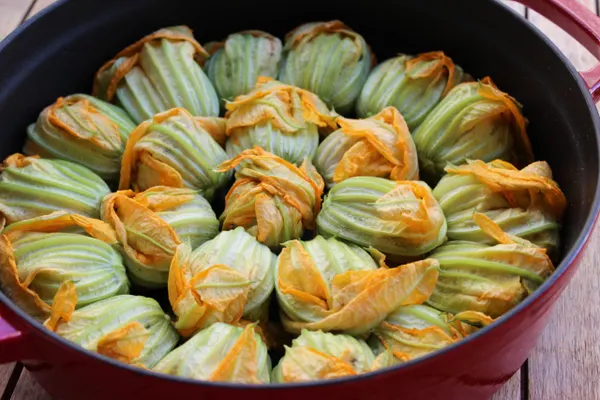
Welcome to Kabak Çiçeği Dolması, or Stuffed Pumpkin Blossoms!
Fresh pumpkin blossoms are carefully collected during the growing season, usually in the early morning while their petals are still open and delicate.
Each blossom is gently filled with a mixture of rice or bulgur, fresh herbs, and aromatic spices, then slowly cooked to preserve its beautiful texture.
Served warm or cold, sometimes accompanied by yogurt, stuffed pumpkin blossoms offer a wonderful combination of freshness, tradition, and local ingredients.
A beautiful example of how Anatolian cuisine makes use of the ingredients nature provides!
Pumpkin Blossoms
Fresh pumpkin blossoms (squash flowers)
Filling
Rice or bulgur
Finely chopped onions
Olive oil
Tomato paste
Fresh parsley
Fresh dill
Salt
Black pepper
Red pepper flakes
For Cooking
Olive oil
Water
The preparation begins early in the morning!
Fresh pumpkin blossoms are collected from the fields, preferably before their delicate petals begin to close. Male blossoms are commonly selected because, unlike female blossoms, they do not develop into pumpkins.
The blossoms are carefully cleaned, and their inner reproductive structures are removed without damaging the petals.
Meanwhile, finely chopped onions are sautéed in olive oil, followed by tomato paste and rice or bulgur. Water is added to partially cook the filling before fresh herbs and seasonings complete the mixture.
Once the filling is ready, a small amount is gently placed inside each blossom. The petals are carefully folded inward to keep everything together.
The stuffed blossoms are then arranged closely in a cooking pot, with additional water and olive oil, and simmered over low heat until tender.
Cooking generally takes around 15–30 minutes, depending on the filling and preparation. After a short rest, they are ready to serve!
You might be wondering:
Why would someone pick a beautiful flower from a pumpkin plant just to cook it?
Well, there is more to this story than simply enjoying its taste!
To understand the idea, we first need to understand how pumpkins grow.
Pumpkin plants produce two different types of flowers: male and female.
The female blossoms contain a small developing fruit at their base. When successfully pollinated and fertilized, this develops into a pumpkin.
Male blossoms, meanwhile, provide the pollen needed for this process. They do not produce fruit themselves.
This creates an interesting opportunity for farmers and home cooks.
By carefully collecting some male blossoms while leaving enough for pollination, growers can enjoy an additional edible part of the plant without necessarily sacrificing the pumpkin harvest.
Of course, there is another important reason!
They are delicious!
Their delicate texture makes them suitable for stuffing, and their mild flavor complements the herbs, spices, and grains used in Anatolian cooking.
In a region where agriculture has long played an important part in daily life, making use of different edible parts of a crop fits naturally into the broader traditions of local cooking.
But what makes stuffed pumpkin blossoms particularly interesting is how a plant originating thousands of kilometers away became part of Anatolian food culture.
And that takes us into history!
An American Plant, an Anatolian Kitchen, and an Ottoman Culinary Tradition.
The history of stuffed pumpkin blossoms is rather interesting because it brings together two different culinary stories.
The first begins in the Americas.
The second takes place in the kitchens of Anatolia and the Ottoman Empire.
Let's begin with the pumpkin itself!
It might surprise you to learn that the pumpkins and squashes belonging to the genus Cucurbita are not originally from Anatolia.
In fact, they are native to the Americas!
Different species were domesticated thousands of years ago in regions including Mesoamerica and South America, long before Europeans arrived on the continent.
For centuries, Indigenous American communities cultivated these plants for their edible fruits, seeds, and other uses.
Everything began to change following European contact with the Americas in 1492.
The movement of crops between the Americas and the rest of the world, commonly known as the Columbian Exchange, introduced numerous ingredients to European, Asian, and African food cultures.
Pumpkins and squashes were among them.
Historical botanical evidence demonstrates that Cucurbita plants had reached Europe by the early 16th century.
Some of the earliest surviving European illustrations of these plants date from the first decades of the 1500s.
From there, different varieties gradually spread and became established in agricultural traditions far beyond their original homeland.
And eventually, they became familiar crops in Anatolia.
Now comes the interesting part!
Long before pumpkin blossoms became a familiar ingredient in regional cooking, Ottoman kitchens already had a remarkable tradition of stuffing different foods.
The Turkish word dolma comes from the verb dolmak, meaning "to be filled."
And Ottoman cooks took that idea quite seriously!
Historical accounts of Ottoman cuisine describe the preparation of stuffed vegetables, fruits, leaves, and even various meats.
The possibilities were enormous.
Onions, apples, cabbage, eggplants, and different varieties of squash all appeared in the wider history of Ottoman stuffed dishes.
Dolma recipes developed over the centuries, with different fillings and cooking techniques becoming popular in different regions.
Some contained meat, while others eventually became especially associated with rice, vegetables, herbs, and olive oil.
This established culinary tradition provides an important part of the historical context for stuffed pumpkin blossoms.
As pumpkins and squashes became established in Anatolia, their edible blossoms offered another ingredient that could be prepared using the familiar technique of stuffing.
It is a fascinating meeting of a plant from the Americas and a culinary practice deeply rooted in Ottoman and Anatolian food culture.
But here is an important historical distinction!
Although the wider history of Ottoman dolma is well documented, there is no securely established date identifying when stuffed pumpkin blossoms were first prepared in Cappadocia.
Nor is there sufficient evidence to credit one particular cook, village, or century with inventing the dish.
So, rather than claiming that a specific Ottoman chef created it, we can appreciate what its history genuinely represents:
The ability of Anatolian cuisine to embrace new ingredients while preserving established cooking traditions.
Over time, pumpkin cultivation became an important part of agriculture in and around Nevşehir.
Today, the region is especially well known for its pumpkin seeds, which have become one of its recognizable agricultural products.
In fact, Nevşehir Kabak Çekirdeği, or Nevşehir Pumpkin Seeds, received geographical indication registration in Türkiye in 2019.
But the relationship between local people and pumpkins extends beyond the seeds.
The blossoms are also used in regional cooking.
In the summer, when pumpkin plants produce their flowers, local cooks can gather fresh blossoms and prepare them with rice or bulgur fillings.
The short period during which blossoms remain fresh makes their collection and preparation particularly delicate.
Traditional methods of cooking them also reflect something deeply familiar in Anatolian home kitchens: patience,
practical knowledge, and the careful handling of seasonal ingredients.
It is tempting to connect this resourcefulness directly to Cappadocia's cold winters and historically demanding agricultural conditions.
However, no particular historical document establishes that stuffed pumpkin blossoms were invented specifically because of winter hardship.
What we can say is that the dish belongs to a much broader culinary culture in which seasonal crops and locally available ingredients are transformed into satisfying meals.
And there is something quite beautiful about that.
A flower that lasts only a short time in the garden becomes a dish whose tradition can be passed from one generation to another.
Here comes the delicious part!
Unlike some of the more widely available dishes in Cappadocia, stuffed pumpkin blossoms are not necessarily something you will find on every restaurant menu.
And there is a good reason for that!
Freshness and seasonality.
Pumpkin blossoms are delicate ingredients, and their availability depends heavily on the growing season.
Summer is generally the best time to look for freshly prepared Kabak Çiçeği Dolması, although the season can vary
according to local growing conditions.
Traditional local restaurants and home-style kitchens are worth asking, particularly when seasonal specialties are being prepared.
But there is another way to discover the dish.
Why simply taste a traditional recipe when you can learn the art behind making it?
One of the most enjoyable ways to understand Cappadocian cuisine is to experience it in the kitchen.
Through our Traditional Turkish Cuisine Cooking Class, you can cook alongside local women who continue to share
traditional Anatolian recipes and preparation techniques.
Instead of simply receiving a beautifully prepared plate, you discover the work behind it.
You learn how ingredients are prepared, how delicate fillings are handled, how traditional dishes are assembled, and how familiar local flavors come together.
And, of course, you get to enjoy the meal you have helped prepare!
If stuffed pumpkin blossoms are the dish you are particularly interested in, please contact our team before booking.
Because fresh blossoms are seasonal and the cooking-class menu varies, we can check whether this particular recipe can
be arranged during your visit.
After all, experiencing Cappadocia should not end with admiring its landscapes.
Its kitchens have stories worth discovering, too!
Come for the landscapes. Stay for the flavors. Leave with a recipe and a story of your own!
Afiyet olsun!
1 guided tour includes a stop at Pumpkin But Blossom! Kabak Çiçeği Dolması.
Browse all Cappadocia attractions