Cappadocia Adventures
Cappadocia Adventures

Imagine exploring the peaceful valleys of Mustafapaşa, surrounded by extraordinary volcanic cliffs, ancient cave dwellings, and centuries-old churches hidden within Cappadocia's rocks.
High above Beyderesi Valley stands a remarkable religious complex with an unusual history.
A church carved into several levels of volcanic rock, decorated with colourful religious paintings, and preserving the signatures of artists who worked here more than a century ago.
Welcome to Saint Basilios Church (Aziz Basileios Kilisesi), also known as Ayios Vasilios Church, one of Mustafapaşa's most important surviving Greek Orthodox monuments.
But here's what makes this church particularly fascinating!
Unlike many Cappadocian churches whose original artists remain anonymous, Saint Basilios preserves paintings signed by two individuals: Kostis Meletiadis in 1902 and Georgiou Yordanidou in 1915.
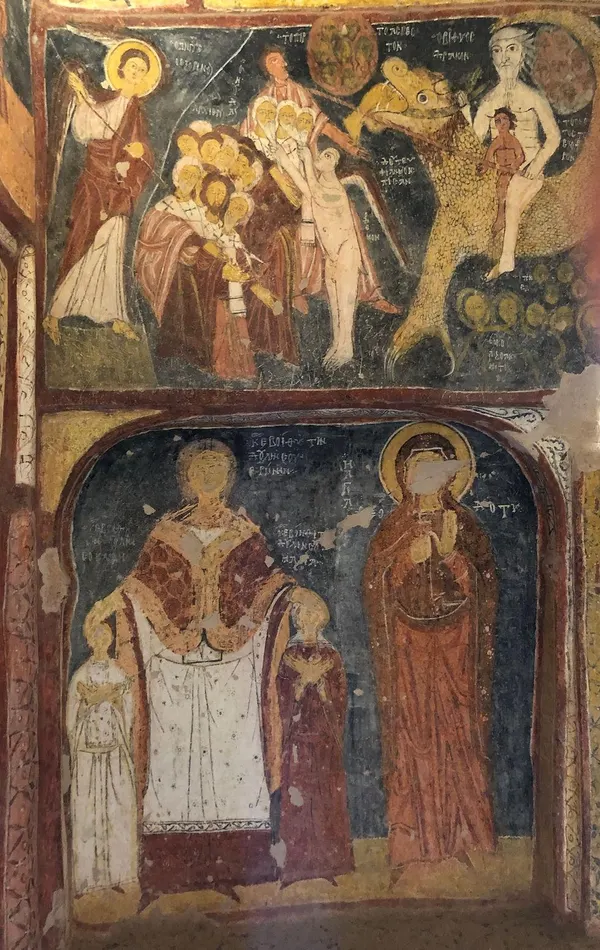
Its decorations include Jesus Christ enthroned, the Virgin Mary, important Christian saints, and an extraordinary representation of John the Baptist with wings.
The church also played an important role in the religious life of Sinasos, the historic Greek name of Mustafapaşa.
However, its history has a tragic chapter.
After years of deterioration, part of the rock formation collapsed in 2018, seriously damaging the monument.
Saint Basilios Church is more than another ancient cave sanctuary. It preserves an extraordinary connection between Cappadocia's rock-cut architecture, Greek Orthodox traditions, and the remarkable artists of historic Sinasos.
Let's discover its story.
Before becoming Mustafapaşa, this beautiful Cappadocian settlement was known as Sinasos.
During the Ottoman period, it was home to a prosperous Greek Orthodox community alongside Muslim Turkish residents.
The town became particularly wealthy during the 19th century, when its merchants developed important commercial connections with Istanbul.
This prosperity supported the construction and decoration of magnificent stone mansions, schools, churches, and religious institutions.
Saint Basilios Church belonged to this remarkable cultural environment.
The church was dedicated to Saint Basil the Great, one of Christianity's most influential theologians.
Born around 330 AD, Basil became Bishop of Caesarea, present-day Kayseri, during the 4th century.
He was one of the famous Cappadocian Fathers, alongside Gregory of Nazianzus and Gregory of Nyssa.
Their writings helped shape Christian theology, particularly teachings concerning the Holy Trinity.
Basil was also known for supporting organised religious communities and charitable activities.
He died in 379 AD and remains one of the most respected saints in Eastern Orthodox Christianity.
For the Greek Orthodox community of Sinasos, Saint Basil held particular religious importance.
Historical accounts describe him as a heavenly intercessor who could communicate their prayers to God.
His popularity was reflected in personal names.
Vasilios and Vasiliki were common names among local Greek Orthodox families, expressing devotion to the saint.
Every year on January 1, the feast day of Saint Basil, the community held an important religious celebration.
It was regarded as one of the most solemn religious occasions in Sinasos.
One of the church's greatest historical treasures is the preservation of two painters' signatures.
The artists were Kostis Meletiadis and Georgiou Yordanidou.
Both were associated with the flourishing artistic culture of late Ottoman Sinasos.
Yordanidou also decorated private mansions within the town.
Their work demonstrates how local artists continued Orthodox religious painting traditions into the early 20th century.
Following the Greek-Turkish population exchange of 1923–1924, the departure of most local Greek Orthodox residents dramatically changed the church's religious life.
Over time, the building suffered deterioration and structural damage.
The exact construction date of Saint Basilios Church remains uncertain.
Unlike some Cappadocian churches, no securely established original inscription records its founding year.
The monument contains several interconnected rock-cut spaces that may have developed during different periods.
Some architectural studies have proposed medieval origins for portions of the complex.
However, the most reliable dated evidence comes from its surviving paintings.
Two important dates appear within the decorative programme.
1902 – Kostis Meletiadis
An inscription connects part of the church's painted decoration with the artist Kostis Meletiadis.
1915 – Georgiou Yordanidou
Another inscription beneath the painting of Christ Pantocrator identifies Georgiou Yordanidou.
It includes the phrase Ergon Georgiou Yordanidou 1915, meaning the work of Georgiou Yordanidou.
These dates provide valuable evidence of the church's artistic activity in the final decades of the Ottoman period.
However, they do not establish when the original rock-cut structure was excavated.
The most reliable conclusion is that Saint Basilios Church may preserve earlier architectural phases, while its documented painting campaigns continued into the early 20th century.
This makes it particularly important for understanding the continuation of Byzantine-inspired religious art in Ottoman Cappadocia.
Saint Basilios Church was carved into the eastern slope of Beyderesi Valley, north of Mustafapaşa.
The area was historically known as Vrathes, a Greek name associated with its rocky landscape.
Unlike a simple single-room chapel, Saint Basilios is an extensive complex containing several interconnected spaces arranged on different levels.
Historical descriptions refer to the building as a religious establishment with three levels.
Its rooms were excavated at different elevations within the volcanic rock.
The principal church occupied the middle level, while lower chambers may have served as shelters or other practical spaces.
The exact original functions of these rooms remain uncertain.
The original approach was from the upper part of the valley.
Visitors entered through a rectangular opening leading towards a barrel-vaulted landing.
A barrel vault resembles the inside of a semicircular tunnel.
From there, a rock-cut staircase descended towards the main church.
Two smaller adjoining chapels were also located along this internal route.
The main sanctuary contains several aisles separated by rock-cut pillars.
These architectural divisions created spaces associated with different religious dedications.
According to historical descriptions:
The central section was dedicated to Saint Basil.
The right section was dedicated to Saint Demetrius.
The left section was dedicated to Saint Eleutherius.
The church contains two principal apses.
An apse is the rounded sanctuary space traditionally associated with the altar.
Architectural features known as templon barriers separated portions of the sanctuary from the congregation.
These barriers formed an important part of traditional Byzantine and Orthodox church design.
One of the most remarkable features is how the paintings interact with the architecture.
Pillars, arches, ceilings, and sanctuary partitions provided surfaces for religious imagery.
The walls were decorated with portraits of saints, angels, and biblical figures.
Saint Basilios Church demonstrates how Cappadocia's traditional rock-cut architecture continued to support elaborate Orthodox religious decoration during the late Ottoman period.
Now comes the most fascinating part of Saint Basilios Church.
Its extraordinary religious paintings!
Unlike many earlier Cappadocian churches, Saint Basilios contains important examples of Post-Byzantine painting, meaning religious art created after the Byzantine Empire's political existence but continuing its artistic traditions.
The decorations feature rich reds, blues, gold tones, and carefully painted religious figures.
Several compositions are particularly remarkable.
One of the church's most important paintings represents Christ Pantocrator.
The Greek word Pantocrator means Almighty or Ruler of All.
Jesus appears enthroned, wearing red and blue garments and surrounded by heavenly imagery.
He raises his hands in blessing, communicating divine authority.
But there's something especially important about this painting.
It preserves the signature of Georgiou Yordanidou, dated 1915.
This makes it one of the church's most valuable historical artworks.
Another important fresco depicts the Deesis.
In Orthodox Christian art, the Deesis normally shows Jesus Christ accompanied by the Virgin Mary and John the Baptist.
Mary and John appear as intercessors, appealing to Christ for mercy on behalf of humanity.
At Saint Basilios, the composition is particularly unusual.
Jesus sits upon a throne holding a book, while Mary and John the Baptist stand beside him.
Instead of the usual gestures of intercession, Mary and John hold their hands crossed over their chests.
This unusual arrangement has attracted the attention of art historians studying the development of Orthodox religious imagery.
Perhaps the church's most extraordinary painting is its representation of John the Baptist with wings.
But why would John the Baptist have wings?
Within certain Orthodox artistic traditions, John was represented as the Angel of the Desert.
The wings symbolised his role as God's messenger, rather than suggesting that he was literally an angel.
At Saint Basilios Church, John appears wearing religious garments and holding a staff or making a gesture of blessing.
His winged representation is particularly important because it reflects later Orthodox artistic traditions that differ from the imagery commonly found in earlier Byzantine cave churches.
Research suggests that these paintings may belong to the same early-20th-century decorative tradition as Yordanidou's signed work.
Another painting represents the Baptism of Jesus.
According to the Gospels, John the Baptist baptised Jesus in the Jordan River.
The event marks an important moment in Christ's public ministry and is associated with the manifestation of the Holy Trinity.
Its position within the church's decorative programme helps connect the imagery of John the Baptist with Christian beliefs about salvation.
One particularly interesting fresco depicts Jesus raising Lazarus from the dead.
According to the Gospel of John, Lazarus had been dead for four days when Jesus called him out of his tomb.
The miracle became an important symbol of Christ's power over death.
In Orthodox Christianity, the event is also connected with the hope of resurrection and eternal life.
Additional paintings represent Saint Basil himself and other important Christian figures.
Saint George, the famous military martyr, appears among the decorative subjects.
The walls also contain portraits of apostles and saints arranged within painted medallions.
These figures helped connect the religious ceremonies performed inside the church with the wider history of Christianity.
What makes Saint Basilios particularly special is that its artwork can be connected with identifiable artists.
The signatures of Kostis Meletiadis and Georgiou Yordanidou preserve evidence of the individuals who helped decorate the sanctuary.
This is especially valuable because many earlier Cappadocian church painters remain anonymous.
Saint Basilios Church is therefore not only a monument of religious history but also an important record of artistic life in late Ottoman Sinasos.
During the Ottoman period, Saint Basilios Church was an important place of Greek Orthodox religious devotion.
Its architecture and paintings reveal the continuing importance of Christian worship in Mustafapaşa.
Saint Basil's religious importance extended throughout the Eastern Orthodox world.
His writings influenced Christian theology, monastic traditions, and religious worship.
The Divine Liturgy of Saint Basil the Great, a form of Orthodox Eucharistic worship, remains associated with his name.
For the people of Sinasos, dedication to Basil represented a connection with Cappadocia's ancient Christian heritage.
Saint Basil's feast day was celebrated on January 1.
Historical accounts describe solemn religious ceremonies taking place throughout Sinasos.
These celebrations brought the community together and reinforced its religious identity.
The popularity of the saint also influenced family naming traditions.
The church's frescoes were not simply decorative.
They communicated important theological beliefs.
Christ Pantocrator represented divine authority.
The Deesis expressed prayers for mercy.
The Baptism symbolised spiritual renewal.
And the Raising of Lazarus communicated hope in the Resurrection.
Together, these paintings created an environment designed for prayer and religious reflection.
During the 19th century, Mustafapaşa's Greek Orthodox community maintained numerous religious institutions.
Churches were closely connected with local culture, family traditions, and community life.
Their decoration was supported by the prosperity of local merchants and families.
The signed paintings of Saint Basilios demonstrate how this tradition continued into the early 20th century.
Saint Basilios Church preserves an extraordinary connection between Cappadocia's early Christian heritage and the religious traditions of the Greek Orthodox community that lived here until the population exchange.
Saint Basilios Church is located on the eastern slope of Beyderesi Valley, north of Mustafapaşa, in the Ürgüp district of Nevşehir Province, Türkiye.
Its location within the volcanic landscape makes it an important historical monument.
However, there's a crucial detail visitors should know.
According to the Cappadocia University heritage documentation, the church was closed to visitors in 2012 because of structural risks.
In 2018, part of the rock formation detached and collapsed towards the valley, destroying a section of the complex.
As a result, the surviving structure is fragile.
The site should not be treated as an ordinary visitor-accessible cave church.
Christ Pantocrator
A remarkable painting of Jesus Christ associated with the artist Georgiou Yordanidou and the date 1915.
The Winged John the Baptist
An unusual Orthodox religious image that has received particular attention in academic research.
The Deesis
A distinctive composition showing Jesus, the Virgin Mary, and John the Baptist.
The Raising of Lazarus
A biblical scene associated with resurrection and salvation.
The Multi-Level Architecture
Rock-cut rooms, staircases, chapels, and sanctuary spaces that demonstrate the complexity of the original monument.
The Artists' Signatures
The names of Kostis Meletiadis and Georgiou Yordanidou, preserving evidence of the people who painted the church.
Due to the documented closure and rock collapse, interior access should not be assumed to be permitted or safe.
Visitors should confirm current conditions with local heritage authorities before approaching the monument.
Do not enter unstable rock-cut chambers or cross conservation barriers.
Historical photographs and academic publications remain valuable ways to study the surviving artwork.
Constantine and Helena Church
One of Mustafapaşa's most important Ottoman-period Greek Orthodox churches.
Saint Nicholas Monastery
A historic religious complex associated with a sacred spring and community celebrations.
Saint Stephen Church
Another monument preserving the region's Christian heritage.
Gomeda Valley
A scenic valley known for rock-cut architecture, ancient dwellings, and walking routes.
Absolutely!
Saint Basilios Church is one of Mustafapaşa's most valuable surviving religious monuments.
Its architecture preserves the region's extraordinary tradition of carving entire buildings into volcanic rock.
Its paintings demonstrate how Orthodox religious art continued developing into the early 20th century.
Its unusual representation of John the Baptist provides an important subject for art historians.
And its signed paintings connect the monument with two artists whose names have survived.
But perhaps the most remarkable aspect is its relationship with the people of Sinasos.
For generations, the community honoured Saint Basil as one of its most important religious figures.
They celebrated his feast day.
They supported the decoration of their churches.
And they preserved artistic traditions that connected their community with Cappadocia's Christian past.
Saint Basilios Church is more than another historic cave church in Cappadocia. It is an extraordinary surviving record of Greek Orthodox heritage, Post-Byzantine religious painting, and the artistic traditions of Mustafapaşa.
Even after centuries of change and significant structural damage, its surviving paintings continue to tell the stories of those who once worshipped here.
No tours currently list Saint Basil Church (Aziz Vasilios Church) – Mustafapaşa, Cappadocia as a stop. Browse all day tours or plan a custom trip.
Browse all Cappadocia attractions