Cappadocia Adventures
Cappadocia Adventures

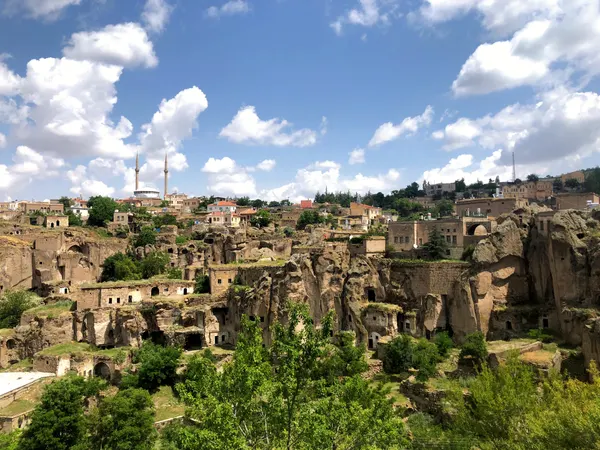
Imagine walking through the peaceful streets of Güzelyurt, surrounded by traditional stone houses, ancient rock-cut dwellings, and Cappadocia's beautiful volcanic landscape.
Suddenly, you discover something remarkable.
An enormous stone church crowned by a dome, surrounded by historic buildings, and standing beside a minaret.
But here's what makes this place extraordinary!
The building was once one of Cappadocia's most important Greek Orthodox churches. Today, it serves as a mosque.
Welcome to Saint Gregory Church (Aziz Gregorius Kilisesi), also known as Kilise Camii (Church Mosque) or Büyük Kilise Camii.
Located in Güzelyurt, formerly known as Gelveri, this fascinating monument is traditionally associated with 385 AD and one of Christianity's greatest theologians, Saint Gregory of Nazianzus.
Unlike Cappadocia's famous cave churches, Saint Gregory Church was constructed from carefully cut stone.
Its magnificent central dome, monumental arches, historic wooden decorations, and sacred spring preserve evidence of centuries of religious history.
And perhaps the most fascinating detail?
Some of the church's original Christian furnishings were adapted for Islamic worship, rather than simply disappearing.
Saint Gregory Church offers an extraordinary opportunity to explore Cappadocia's Byzantine, Ottoman, Greek Orthodox, and Turkish cultural heritage within a single building.
Let's discover its fascinating story!
During the 4th century, Cappadocia became one of the most influential centres of early Christian theology.
The region was associated with three remarkable religious thinkers:
Saint Basil the Great, Saint Gregory of Nyssa, and Saint Gregory of Nazianzus.
Together, they became known as the Cappadocian Fathers.
Their writings helped shape Christian teachings about the Holy Trinity and influenced the development of Eastern Christianity.
Saint Gregory was born around 329–330 AD, near Nazianzus in Cappadocia.
He became one of Christianity's most influential theologians and is often remembered as Gregory the Theologian.
His religious writings and sermons played a major role in the theological debates of the 4th century.
Gregory also served as Bishop of Constantinople during the early 380s.
He died around 390 AD.
His connection with the Güzelyurt region made him an important figure in the area's religious identity.
According to historical tradition, Emperor Theodosius I supported the construction or rebuilding of a church associated with Saint Gregory in 385 AD.
This tradition comes from an inscription recorded by later writers but lost during subsequent renovations.
The inscription also referred to a fragment of the True Cross, traditionally believed to be connected with the Crucifixion of Jesus Christ.
However, the inscription no longer survives, and its historical claims cannot be independently confirmed in full.
The present building also contains architectural features created long after the 4th century.
One of the most important moments in the building's history occurred in 1835.
During the Ottoman period, architect Gregorios Madentzis, also known as Grigorius Madenci, undertook a major restoration.
The work substantially changed the church's interior arrangement.
Its earlier cross-shaped design was adapted into a more spacious three-nave basilica.
Additional modifications continued during the 19th century, with another important building phase documented in 1896.
The Greek-Turkish population exchange of 1923–1924 dramatically changed Güzelyurt.
The local Greek Orthodox population departed for Greece, while Muslim families from Greece settled in the town.
Following these changes, Saint Gregory Church was converted into a mosque.
It became known as Kilise Camii, meaning Church Mosque.
Today, the building continues to serve the local Muslim community.
Its history reflects the extraordinary cultural transformations experienced by Cappadocia over more than sixteen centuries.
Saint Gregory Church is traditionally dated to 385 AD.
However, its architectural history is more complicated than this single date suggests.
According to historical accounts, an inscription formerly associated with the church attributed its construction to Emperor Theodosius I.
The inscription also mentioned the donation of a relic associated with the True Cross.
Unfortunately, this inscription was reportedly lost during the 1835 restoration.
Therefore, the original construction date cannot be established with complete certainty.
Art historian M. Sacit Pekak proposed that the monument developed through several architectural phases.
These include an early Christian building, a possible 4th-century reconstruction, and a later medieval church with a cross-in-square arrangement.
The cross-in-square plan is particularly associated with Middle Byzantine architecture.
The most clearly documented major alterations occurred during the 19th century, especially in 1835 and 1896.
These changes significantly affected the building's appearance.
The most reliable conclusion is that Saint Gregory Church has an early Christian historical tradition associated with 385 AD, while much of its surviving architecture reflects medieval and 19th-century modifications.
This makes it one of Cappadocia's most interesting examples of a religious building that evolved across different historical periods.
One of the most remarkable features of Saint Gregory Church is its monumental stone architecture.
Unlike the rock-cut churches of Göreme, the building was constructed using carefully shaped masonry blocks.
Its exterior combines Byzantine architectural traditions with later Ottoman-period modifications.
Today, the interior follows a three-nave basilica arrangement.
A nave is the main space where worshippers gather.
The interior is divided into three sections by substantial stone columns and supporting arches.
Eight masonry supports help carry the church's impressive vaulted structure.
The present arrangement largely reflects the major renovation of 1835.
One of the building's most impressive features is its high central dome.
The dome rises above the principal interior space and receives natural light through a series of windows.
Official descriptions record twelve windows illuminating the dome.
Together with the surrounding arches and columns, the dome creates a spacious and elegant interior.
The original eastern sanctuary contains an apse.
An apse is the rounded architectural space traditionally associated with a Christian altar.
The church's surviving apse preserves evidence of earlier construction phases.
Its exterior contains three arched windows accompanied by decorative niches.
Another important architectural feature is a smaller chapel attached to the northwest side.
Known as a parekklesion, this secondary worship space follows a simpler single-nave arrangement.
Its presence demonstrates that the church was more than one large sanctuary.
The western entrance is particularly impressive.
Its façade contains three pointed arches supported by stone columns.
Decorative carvings surround the doorway and windows.
The exterior also preserves animal and floral ornaments, including lions, birds, and rosettes.
During its Christian history, the church possessed a bell tower.
Following its conversion into a mosque, the western entrance area was adapted for a minaret.
Historical descriptions differ on how much of the original bell-tower structure was retained or replaced.
Today, the minaret is one of the most visible reminders of the building's changing religious functions.
Within the courtyard is an ayazma, or sacred spring.
According to architectural documentation, approximately 40 steps lead down to this underground water source.
In Eastern Christian traditions, sacred springs were often associated with prayer, blessing, and healing.
Saint Gregory Church is particularly remarkable because its architecture preserves evidence of different periods of Byzantine Christian and Islamic religious history.
Unlike Göreme's brightly painted cave churches, Saint Gregory Church does not display an extensive collection of clearly visible Byzantine frescoes today.
Many of its original religious paintings were covered during later alterations.
However, the building preserves something equally fascinating.
Extraordinary wooden decorations that connect its Christian past with its present Islamic function.
Historical descriptions refer to paintings of Jesus Christ, the Virgin Mary, and Saint Gregory.
Some compositions are associated with Christ's divine authority and heavenly judgement.
However, most of these paintings were covered with plaster or whitewash when the church was adapted for Islamic worship.
Small traces of painted figures remain visible where the covering has deteriorated.
Their exact subjects are not always identifiable.
It would therefore be misleading to describe Saint Gregory Church as a place where visitors can still admire a complete collection of Byzantine frescoes.
Perhaps the most important surviving decorative feature is the original wooden iconostasis.
But what exactly is an iconostasis?
In Eastern Orthodox churches, the iconostasis is a decorated screen separating the sanctuary from the principal worship area.
It traditionally displays religious icons and forms an important part of Orthodox liturgical architecture.
At Saint Gregory Church, the iconostasis contained beautifully carved wooden panels decorated with floral patterns and other ornamental designs.
Following the conversion into a mosque, portions of this woodwork were repositioned and adapted.
Some of the historic wooden panels were incorporated into the mosque's minbar, or pulpit.
The current mihrab area also preserves elaborate wooden decoration, although researchers disagree about which elements originally belonged to the iconostasis.
The carvings feature floral motifs, geometric patterns, and carefully arranged decorative forms.
This transformation is particularly important.
Rather than disappearing entirely, parts of the church's original artistic heritage continued to be used within a different religious setting.
Another fascinating feature is an elaborately carved wooden pulpit, historically known as an ambo.
In Orthodox churches, an ambo provided an elevated position for religious readings and sermons.
The surviving structure contains impressive floral carvings and decorative panels.
Official descriptions associate it with a gift from a Russian tsar, although historical accounts differ about which ruler donated it.
The object's craftsmanship remains one of the building's most impressive artistic features.
The entrance and surrounding façades preserve decorative carvings featuring crosses, birds, lions, and other figures.
These ornaments demonstrate the artistic traditions of the communities that maintained the building.
Together with the historic woodwork, they reveal the church's architectural and cultural richness.
Saint Gregory Church is especially valuable because its surviving decorations tell the story of two religious traditions within one historic building.
For centuries, Saint Gregory Church was one of the most important religious institutions in Güzelyurt.
Its history reflects the changing communities that inhabited the region.
Saint Gregory of Nazianzus played an important role in early Christian theology.
His writings helped develop the language used to explain the relationship between the Father, Son, and Holy Spirit.
He also influenced Eastern Christian religious traditions through his sermons and theological works.
For the Greek Orthodox population of Gelveri, his connection with the region was an important part of local religious identity.
Before the population exchange, the church served as an important place of Christian worship.
Religious ceremonies included the Divine Liturgy, scripture readings, prayers, and major Orthodox festivals.
The surrounding religious landscape contained smaller chapels, clergy residences, burial spaces, and monastic buildings.
The church therefore belonged to a much larger Christian cultural environment.
The ayazma within the courtyard was an important religious feature.
According to local traditions, its water was believed to possess beneficial or healing properties.
Sacred springs often became places of pilgrimage and personal devotion.
However, such healing associations belong to historical religious belief rather than established medical evidence.
The population exchange of 1923–1924 brought profound changes.
Greek Orthodox families left Güzelyurt for Greece, while Muslim families arrived from Greece and established new lives in the town.
The church's conversion into a mosque reflected this transformation.
Its interior was adapted to Islamic prayer, including changes to the furnishings and worship orientation.
Unlike many Cappadocian churches that function only as museums, Saint Gregory Church remains a place of worship.
Its continuing use demonstrates how historic buildings can acquire new religious and social meanings across generations.
Saint Gregory Church preserves an extraordinary connection between Cappadocia's early Christian heritage, Ottoman history, and the lives of modern Turkish communities.
Saint Gregory Church is located in Aşağı Mahalle, in the centre of Güzelyurt, Aksaray Province, Türkiye.
It stands within one of Cappadocia's most historically interesting settlements.
The building is currently known as Kilise Camii (Church Mosque) and remains in religious use.
The Magnificent Central Dome
The impressive dome and its surrounding windows demonstrate the architectural ambition of the building.
The Eight Stone Supports
The columns and arches divide the interior into three principal sections.
The Historical Wooden Carvings
Look for the beautifully decorated wooden furnishings adapted from the church's former interior.
The Wooden Ambo
The elaborately carved pulpit is one of the building's most remarkable historical objects.
The Decorative Façade
The western entrance contains elegant arches and ornamental stone carvings.
The Historic Minaret
The minaret reflects the building's transformation from Greek Orthodox church to mosque.
The Sacred Spring
The courtyard contains the ayazma, reached by a staircase descending below ground level. Access may vary.
The Adjoining Chapel
The smaller side chapel preserves another part of the original Christian architectural arrangement.
The building stands in central Güzelyurt, approximately 38 kilometres from Aksaray city.
Visitors can reach the town by car from Aksaray or include it in a longer historical excursion around Ihlara Valley.
The church is located within the historic lower quarter, surrounded by traditional houses and rock-cut structures.
Red Church (Kızıl Kilise)
An extraordinary early Byzantine stone church near Sivrihisar village, famous for its reddish masonry and surviving central dome.
Güzelyurt Monastery Valley
A remarkable landscape containing numerous rock-cut churches and religious chambers.
Yüksek Church (High Church)
A historic religious monument standing prominently above the surrounding landscape.
Ihlara Valley
One of Cappadocia's most beautiful natural and historical destinations, filled with Byzantine cave churches.
Selime Cathedral
A monumental rock-cut church complex near the northern end of Ihlara Valley.
Saint Gregory Church currently functions as a mosque.
Visitors should respect its religious purpose.
Non-worshippers may be able to enter outside prayer times, subject to local arrangements.
Modest clothing is appropriate, and shoes should be removed before entering the prayer area.
Visitors should check current access conditions and avoid disturbing religious services.
Absolutely!
Saint Gregory Church is one of the most historically significant religious monuments in Güzelyurt.
Its traditional association with Emperor Theodosius and Saint Gregory connects it with the early history of Christianity.
Its architecture preserves centuries of Byzantine and Ottoman-period development.
Its magnificent wooden carvings reveal the artistic traditions of the Greek Orthodox community.
And its transformation into a mosque tells a remarkable story of cultural change.
But perhaps the most fascinating detail is that the building continues to serve as a place of prayer.
The people have changed.
The religious ceremonies have changed.
And the surrounding town has experienced centuries of transformation.
Yet the building remains.
Saint Gregory Church is more than another ancient monument in Cappadocia. It is an extraordinary surviving example of Byzantine architecture, Greek Orthodox heritage, Islamic worship, and the multicultural history of Anatolia.
And more than sixteen centuries after its earliest traditional foundation date, the story of Saint Gregory Church continues to unfold.
Photography credits:
Nurbanu Karaman / Wikimedia Commons – CC BY-SA 4.0.
Engin Mutlu 58 / Wikimedia Commons – CC BY-SA 4.0.
No tours currently list Saint Gregory Church (Aziz Gregorius Church) – Güzelyurt, Cappadocia as a stop. Browse all day tours or plan a custom trip.
Browse all Cappadocia attractions