Cappadocia Adventures
Cappadocia Adventures

Imagine walking through a quiet valley in Cappadocia, surrounded by ancient fairy chimneys, vineyards, and churches carved into towering volcanic rocks.
Hidden just outside Mustafapaşa is a remarkable monastery that once attracted both Christian and Muslim visitors.
Some came to pray.
Others came seeking healing from its sacred spring.
And many gathered to honour one of Christianity's most beloved saints.
Welcome to Saint Nicholas Monastery (Aya Nikola Manastırı), one of the most historically significant religious complexes in Mustafapaşa, formerly known as Sinasos.
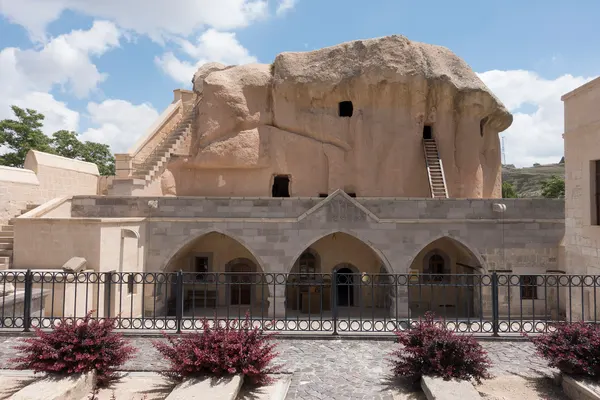
Located in Monastery Valley (Manastırlar Vadisi), this extraordinary complex contains rock-cut churches, ancient burial spaces, a decorated courtyard, and chambers associated with religious and healing practices.
But here's what makes it particularly fascinating!
Saint Nicholas Monastery wasn't simply a place where monks lived and prayed.
During the 19th century, it became an important centre of social gatherings, charitable activities, and religious celebrations for the Greek Orthodox community of Sinasos.
Even local Muslims participated in some of its traditions.
And according to historical accounts, an icon donated to the monastery in 1775 survived the population exchange and was taken all the way to Greece.
Saint Nicholas Monastery is more than another ancient cave church. It preserves an extraordinary story of faith, healing, cultural coexistence, and the communities that shaped Cappadocia's history.
Let's discover its fascinating past!
Before becoming Mustafapaşa, this beautiful Cappadocian settlement was known as Sinasos.
During the Ottoman period, it was home to a prosperous Greek Orthodox community alongside Muslim Turkish residents.
The town became particularly wealthy during the 19th century, partly through commercial connections with Istanbul.
Its residents financed magnificent stone mansions, schools, churches, and religious institutions.
Saint Nicholas Monastery was among the most important.
Who Was Saint Nicholas?
Saint Nicholas was a Christian bishop of Myra, in present-day Antalya Province, who is traditionally associated with the 4th century.
He became famous for his generosity, concern for the poor, and stories of miraculous assistance.
Within Eastern Orthodox Christianity, he is honoured as a protector of travellers, sailors, and people in need.
Over the centuries, traditions surrounding Saint Nicholas also contributed to the development of the modern Santa Claus figure.
For the Greek Orthodox people of Sinasos, however, he was much more than a legendary gift-giver.
Saint Nicholas was one of their most important religious protectors.
The Remarkable 1775 Icon
One of the monastery's most fascinating historical records concerns an icon donated by the local grocers' guild in 1775.
The image depicted Saint Nicholas, who was believed to protect people travelling far from home.
Families whose relatives worked in Istanbul would light candles before the icon, praying for their safety.
Following the Greek-Turkish population exchange of 1923–1924, former Sinasos residents carried the icon to Greece.
Their accounts describe its preservation and later placement in a church established by the displaced community.
This makes the icon an extraordinary connection between Cappadocia and the descendants of its former residents.
A Monastery That Survived Change
Historical evidence suggests that the complex underwent important architectural changes during the 19th century.
It also experienced financial difficulties during the 1870s.
Local residents and people originally from Sinasos who had settled in Istanbul organised support to help preserve the institution.
After the population exchange, the monastery lost the community that had maintained its religious and social activities.
The buildings subsequently experienced deterioration, although restoration projects have since helped preserve parts of the complex.
The exact founding date of Saint Nicholas Monastery remains uncertain.
There is no securely established original construction inscription recording the year the monastery was first created.
However, several historical clues help establish its development.
The 1775 Icon
The documented donation of a Saint Nicholas icon in 1775 demonstrates that a religious institution dedicated to the saint already existed here during the 18th century.
The 19th-Century Buildings
Architectural research suggests that much of the monastery's present arrangement developed during the second quarter of the 19th century.
Inscriptions and graffiti within the complex include dates as early as 1855.
Historical accounts also record repairs and administrative reorganisation during the 1870s.
An Even Older Church?
One particularly interesting possibility concerns the southern church.
Art historian M. Sacit Pekak identified this chamber as potentially the oldest part of the complex.
Its architecture and surviving paintings suggest that it may have originated during the medieval Byzantine period.
However, its precise date has not been established.
The most reliable conclusion is that Saint Nicholas Monastery existed by 1775, underwent important development during the 19th century, and may preserve an older Byzantine church within the complex.
One of Saint Nicholas Monastery's most impressive features is its combination of rock-cut architecture and carefully constructed stone buildings.
Unlike a single cave church, the monastery contains several interconnected religious spaces arranged around a courtyard.
The Main Entrance and Courtyard
The monastery is entered through a decorated doorway featuring two interlocking rounded arches.
Above the entrance is a Greek inscription identifying Saint Nicholas.
Inside, a spacious courtyard connects the principal buildings.
The courtyard also contains features associated with the monastery's religious and social activities.
The Four Adjoining Churches
Architectural studies identify four principal religious spaces within the complex, traditionally associated with:
Saint Nicholas
Saint Barbara
Saint Sabbas
Saint Menas
The churches are arranged irregularly along the rock formation.
Some were excavated directly into the volcanic rock, while others include masonry construction.
This unusual arrangement suggests that the complex developed through different architectural phases.
The Southern Domed Church
The southern church is particularly interesting because it may be the oldest surviving part of the complex.
Its interior follows a cross-in-square plan, with a central dome and smaller domed spaces.
This architectural arrangement was common in Byzantine church design.
However, at Saint Nicholas Monastery, the architectural features were carved directly into the rock.
The builders also used curved corner elements, known as squinches, to create the transition towards the central dome.
The Upper Chambers
The monastery extends across several levels.
Rock-cut staircases and passages connect rooms on the second and third floors.
Some chambers contain niches, windows, and other carved architectural features.
Their original purposes are not always clear.
The Healing Chambers and Burial Spaces
The western part of the complex includes chambers historically associated with people seeking healing.
There are also burial areas and spaces connected with religious remembrance.
These features demonstrate that the monastery served purposes beyond ordinary worship.
Saint Nicholas Monastery is an impressive example of Cappadocian architecture, where natural volcanic rock and constructed stone buildings were combined to create a complex religious environment.
Although many original paintings have suffered damage, the southern church preserves evidence of an important Byzantine decorative programme.
Research identifies several biblical scenes and Christian religious figures.
Some paintings are heavily darkened by smoke, making their details difficult to recognise.
Nevertheless, their historical importance remains considerable.
Christ Pantocrator – The Almighty
One of the principal paintings appears in the dome of the southern church.
It represents Christ Pantocrator.
The Greek word Pantocrator means Almighty or Ruler of All.
Jesus appears as the heavenly ruler, surrounded by figures associated with Christian religious tradition.
The composition communicates divine authority and the sacred character of the church.
Pentecost – The Descent of the Holy Spirit
Another remarkable painting depicts Pentecost.
According to the New Testament, the Holy Spirit descended upon the apostles following the Resurrection and Ascension of Jesus Christ.
The event became an important symbol of the beginnings of the Christian Church.
At Saint Nicholas Monastery, the Pentecost scene was painted in the dome of the southern church's entrance area.
The Deesis – A Prayer for Mercy
Another important composition is the Deesis.
In Byzantine art, this scene usually depicts Jesus Christ accompanied by the Virgin Mary and John the Baptist.
Mary and John appear as intercessors, appealing to Christ for mercy on behalf of humanity.
At Saint Nicholas Monastery, researchers have documented two Deesis compositions within the southern church's entrance area.
This repetition is a particularly interesting feature of its surviving religious decoration.
The Three Hebrew Youths in the Fiery Furnace
Another painting illustrates a remarkable story from the Old Testament.
According to the Book of Daniel, three young men refused to worship a golden image established by King Nebuchadnezzar.
As punishment, they were thrown into a burning furnace.
However, according to the biblical account, they survived through divine protection.
For Byzantine Christians, the story represented religious faith, courage, and deliverance.
Decorative Leaves and Architectural Symbols
The church also contains decorative plant motifs.
Acanthus leaves appear on the architectural elements supporting the dome.
Such decorations were widely used in Byzantine art, connecting religious imagery with established artistic traditions.
The Icons of Saint Nicholas
Icons also played an important role in the monastery's religious life.
The most historically significant was the Saint Nicholas icon donated in 1775.
However, visitors should distinguish the monastery's documented historical icons from religious images displayed during modern restoration or reuse.
Not every icon visible today necessarily belongs to the original decorative programme.
The surviving frescoes make Saint Nicholas Monastery an important monument for understanding Byzantine religious imagery and the artistic traditions of Cappadocia.
One of the most fascinating aspects of Saint Nicholas Monastery is its importance beyond ordinary religious ceremonies.
During the 19th century, it was closely connected with the social, charitable, and spiritual life of Sinasos.
A Sacred Spring Believed to Heal
The monastery courtyard contained a fountain whose water was traditionally believed to possess healing properties.
According to historical accounts, both Greek Orthodox Christians and local Muslims visited the spring.
People seeking relief from illness sometimes tied pieces of cloth to nearby trees as part of their devotional practices.
These traditions demonstrate the religious importance of the site.
However, the healing properties of the water belong to local religious belief, not established medical evidence.
The December Celebrations
Saint Nicholas is commemorated on December 6 in the Eastern Orthodox tradition.
Historical accounts describe special celebrations at the monastery during the first week of December.
Visitors gathered for religious services, lit candles, and honoured the saint.
After the celebrations, processions carrying icons continued towards important churches in the village.
These events connected the monastery with the wider religious life of Sinasos.
A Place Respected by Christians and Muslims
One particularly remarkable aspect is the participation of Muslim residents in certain monastery traditions.
Historical testimonies describe local Muslims making donations, lighting candles, and attending religious ceremonies.
Such accounts reveal how religious customs sometimes crossed community boundaries in Ottoman-era Cappadocia.
Charity and Social Support
Saint Nicholas Monastery was also connected with charitable activities.
Historical accounts describe organisations that helped poor families, widows, and people in need.
The Saint Nicholas Association and a charitable women's organisation contributed to social assistance within Sinasos.
The monastery also possessed agricultural property and other resources used to support its activities.
Agriculture, Hospitality, and Education
The surrounding land included vineyards, gardens, and agricultural fields.
Historical research also records a silkworm-production enterprise associated with the monastery's wider community.
The institution maintained a library containing religious and literary works.
Local accounts also describe facilities for accommodating visitors and assisting travellers.
In fact, by the late Ottoman period, Saint Nicholas may have functioned more as a countryside religious and charitable institution than as a monastery inhabited by a large permanent community of monks.
Saint Nicholas Monastery was not simply a place of worship. It was a centre of healing traditions, community celebrations, charity, and cultural exchange.
Saint Nicholas Monastery is located in Monastery Valley, approximately one kilometre south of Mustafapaşa, in the Ürgüp district of Nevşehir Province, Türkiye.
The surrounding valley contains fairy chimneys, vineyards, and several important Christian monuments.
Its peaceful atmosphere makes it a fascinating destination for travellers interested in Cappadocia's Greek Orthodox heritage.
What Should You Look For?
The Decorated Entrance
The doorway features carefully carved rounded arches and a Greek inscription identifying Saint Nicholas.
The Monastery Courtyard
The courtyard connects the principal buildings and preserves evidence of the monastery's historical layout.
The Southern Domed Church
This is one of the most historically significant parts of the complex.
Its architecture and surviving frescoes suggest an older Byzantine phase.
The Biblical Frescoes
Look for the documented subjects of Christ Pantocrator, Pentecost, Deesis, and the Three Hebrew Youths in the Furnace.
Some paintings may be difficult to identify because of their condition.
The Sacred Fountain
The courtyard fountain is associated with the monastery's famous healing traditions.
The Burial Spaces
Ancient burial features reflect the importance of religious remembrance within the complex.
The Upper Rock-Cut Chambers
The multi-level rooms demonstrate the scale and architectural complexity of the monastery.
Access to individual chambers may be restricted.
How Do You Reach Saint Nicholas Monastery?
The monastery is located approximately one kilometre south of Mustafapaşa village centre.
Visitors can follow Dere Street towards Monastery Valley.
The walk takes approximately 10–20 minutes, depending on the starting point and walking conditions.
Some sections of the route may be uneven.
Other Historical Places Nearby
Constantine and Helena Church is one of Mustafapaşa's most important surviving Greek Orthodox churches.
Saint Stephen Church is another historic sanctuary located along the Monastery Valley route.
Saint John Theologos Church preserves another part of the valley's Christian heritage.
Saint John the Baptist (Prodromos) Monastery Church is a separate rock-cut religious complex nearby.
Gomeda Valley offers scenic walking routes and additional historical remains.
Can You Visit Saint Nicholas Monastery?
The monastery has undergone restoration, including work reported in 2012.
However, access conditions may change, and not every chamber is necessarily open to visitors.
Check current local information before travelling and avoid entering unstable or restricted areas.
Is Saint Nicholas Monastery Worth Visiting?
Absolutely!
Saint Nicholas Monastery is particularly rewarding for travellers interested in Christian history, Byzantine architecture, and the multicultural heritage of Cappadocia.
Its churches preserve remarkable religious traditions.
Its surviving paintings reveal stories from the Bible.
Its sacred spring connects visitors with centuries of local belief.
And its historical records demonstrate how a religious institution could support an entire community.
But perhaps the most extraordinary story concerns the people who once gathered here.
Greek Orthodox Christians celebrated their religious festivals.
Muslim residents participated in certain local traditions.
Families prayed for loved ones working far from home.
And when the population exchange changed Sinasos forever, former residents carried their treasured Saint Nicholas icon to Greece.
Saint Nicholas Monastery is more than another ancient religious complex in Cappadocia. It is an extraordinary surviving symbol of faith, community life, and the cultural connections that shaped historic Sinasos.
And centuries after its earliest documented traditions, the monastery continues to preserve the stories of those who once called this beautiful valley home.
Photography: Dosseman / Wikimedia Commons – Creative Commons Attribution-ShareAlike 4.0 International (CC BY-SA 4.0).
No tours currently list Saint Nicholas Monastery (St. Nicholas Monastery) – Mustafapaşa, Cappadocia as a stop. Browse all day tours or plan a custom trip.
Browse all Cappadocia attractions