Cappadocia Adventures
Cappadocia Adventures

Peravi
If you enjoyed Turkish ravioli, here's another traditional dish worth discovering!
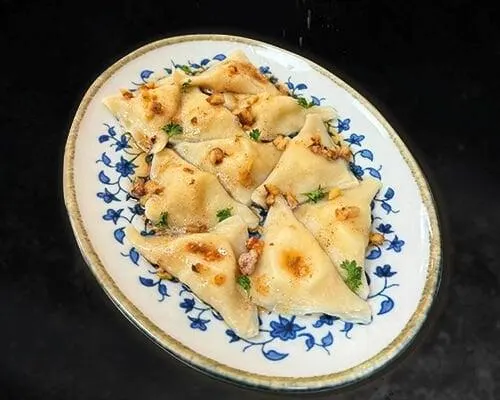
Peravi shares a similar preparation method with mantı, but it has its own distinctive character.
The dough is rolled out thinly, cut into pieces, and folded into triangular shapes. Unlike traditional meat-filled mantı,
Peravi can be prepared with a delicious cheese filling, making it an excellent choice for vegetarians.
The dumplings are then boiled until tender and served with flavorful sauces.
Simple ingredients, careful preparation, and a wonderful taste of Cappadocian home cooking!
Unlike the famous meat-filled Kayseri Mantı, traditional Cappadocian Peravi is prepared with a delicious cheese filling, wrapped inside thin handmade dough and served with a rich tomato paste sauce.
2 cups wheat flour
½ cup water
1 teaspoon salt
1 cup traditional Cappadocian clay-pot cheese (çömlek peyniri)
1 teaspoon dried mint
1 teaspoon red pepper flakes
2 tablespoons tomato paste
2 tablespoons vegetable oil
2 cups water
1 egg (sometimes added to the dough)
Finely chopped onion (sometimes mixed into the cheese filling)
1. Preparing the Dough
The preparation begins by combining wheat flour, water, and salt in a large mixing bowl.
The ingredients are kneaded thoroughly until a firm and smooth dough is formed.
Once ready, the dough is covered and left to rest for at least 30 minutes, allowing it to become more manageable for rolling.
2. Preparing the Cheese Filling
While the dough rests, the traditional Cappadocian clay-pot cheese (çömlek peyniri) is crumbled into a bowl.
Dried mint and red pepper flakes are added and mixed thoroughly.
In some local variations, finely chopped onion is also incorporated into the filling to enhance its flavour.
3. Rolling and Shaping the Dumplings
The rested dough is rolled out into a very thin sheet using a traditional rolling pin (oklava).
The dough is then carefully cut into small squares.
A small portion of the prepared cheese mixture is placed in the centre of each square.
The squares are folded diagonally into triangular shapes, and their edges are pressed together to prevent the filling from escaping during cooking.
4. Cooking the Peravi
A large pot of water is brought to a boil.
The prepared dumplings are carefully placed into the boiling water and cooked until the dough becomes tender and the filling is heated through.
Once cooked, the dumplings are gently removed using a strainer.
5. Preparing the Tomato Paste Sauce
In a separate saucepan, vegetable oil is heated over medium heat.
Tomato paste is added and gently sautéed to release its flavour.
Water is gradually poured into the mixture, and the sauce is stirred until smooth.
The mixture is brought to a boil and briefly simmered until the ingredients combine into a rich, flavourful sauce.
6. Serving Peravi
The freshly cooked dumplings are transferred to a serving plate.
The prepared tomato paste sauce is poured generously over the dumplings.
Traditionally served warm, Peravi combines the delicate texture of handmade dough with the distinctive flavour of locally produced cheese.
The main difference between traditional Kayseri Mantı and Cappadocian Peravi lies in their fillings, shapes, and preparation traditions.
Although both belong to the Turkish mantı family, they offer two distinctive experiences of Anatolian cuisine.
Traditional Kayseri Mantı is famous for its tiny pieces of handmade dough, commonly filled with seasoned minced meat and onions. The dumplings are carefully folded, boiled, and often served with garlic yoghurt and a buttery, spiced sauce.
Peravi, also known as Peravu Mantı, is a regional speciality associated particularly with Nevşehir and Cappadocia.
Unlike the classic meat-filled Kayseri version, Peravi traditionally contains a cheese-based filling, commonly prepared with locally produced çömlek peyniri (clay-pot cheese), dried mint, and red pepper flakes.
Some regional recipes also include finely chopped onions, parsley, or different varieties of local cheese.
Another remarkable difference is the shape!
While traditional Kayseri Mantı is usually folded into tiny bundles, Peravi is commonly prepared as larger triangular
dumplings.
This gives Peravi its distinctive appearance and allows the cheese filling to remain enclosed during cooking.
Yes, traditional cheese-filled Peravi can be a vegetarian dish when prepared without meat-based sauces or stocks.
However, not every regional recipe is completely meat-free.
Some versions of Peravi are served with meat-based sauces, while others use a simple tomato paste sauce prepared with oil and water.
Therefore, visitors following a vegetarian diet should always check how the sauce is prepared.
Anatolian cuisine has developed through centuries of agricultural traditions, animal husbandry, and household cooking.
Cheese has long been an important ingredient in rural Anatolian kitchens, particularly in communities where dairy products were produced and preserved locally.
In Cappadocia, çömlek peyniri became one of the region's distinctive dairy products.
Traditionally stored in earthenware containers, this cheese offered a practical way of preserving dairy products and using them in everyday meals.
It is therefore unsurprising that cheese became an important filling for local dough-based dishes such as Peravi.
One possible explanation for the popularity of cheese-filled dumplings is their practicality in households where meat was not always available or affordable.
However, there is no established historical evidence proving that Peravi was specifically invented as a cheaper alternative to meat-filled mantı.
Both dishes belong to Anatolia's broader tradition of transforming simple ingredients into satisfying meals through careful preparation.
Two different fillings, two different traditions, and one shared passion for handmade Turkish food!
Peravi is traditionally folded into triangular dumplings using a technique often described as muska şeklinde katlama, meaning amulet-shaped folding.
But why a triangle?
The answer involves both practical cooking techniques and an interesting resemblance to an element of Anatolian cultural
heritage.
Preparing traditional Peravi requires patience, precision, and a little practice.
The dough is rolled out into a thin sheet using an oklava, a traditional Turkish rolling pin.
It is then cut into small squares, with a portion of cheese filling placed in the centre of each piece.
The dough is folded diagonally, bringing two opposite corners together to create a triangle.
The edges are carefully pressed together to seal the filling.
This technique offers several practical advantages.
The triangular shape is relatively straightforward to produce, making it suitable for preparing multiple dumplings by hand.
Cutting the dough into squares also allows the cook to divide the rolled-out sheet into regular portions with relatively
little leftover dough.
Most importantly, the folded edges help prevent the cheese filling from escaping while the dumplings are boiling.
However, these practical advantages should not be confused with a documented historical explanation of why the shape
was first adopted.
Here is where the cultural story becomes particularly interesting!
In Turkish, the word muska refers to an amulet traditionally associated with protection against misfortune or harmful
influences.
Throughout Anatolian history, these amulets have appeared in different forms, including small triangular packages
containing written prayers or other protective texts.
Because Peravi dumplings are folded into a similar triangular shape, the preparation is often described using the word
muska.
The resemblance connects the culinary vocabulary of the dish with a recognisable form from Anatolian cultural life.
However, there is an important distinction.
Although triangular amulets have historical associations with protection and good fortune, there is no reliable
evidence establishing that Peravi was deliberately shaped to carry those meanings.
The connection is best understood as a visual and linguistic resemblance rather than a proven symbolic origin of the dish.
Beyond its shape, Peravi represents an important aspect of Anatolian culinary culture: the tradition of preparing food by
hand.
Rolling dough, preparing fillings, and folding dumplings are skills that can be learned through observation and repeated
practice.
These techniques form part of the broader heritage of Turkish home cooking, where recipes and preparation methods are
often passed between generations.
And that is what makes traditional Peravi special.
It is not simply the cheese, the dough, or the sauce that defines the dish.
It is the craftsmanship behind every carefully folded piece.
A little triangle of dough, a generous filling of local cheese, and a beautiful example of Cappadocian cooking
traditions!
One of the most memorable ways to discover traditional Cappadocian Peravi is by joining a local Turkish cooking
class!
Why settle for simply tasting a traditional dish when you can learn how to prepare it yourself?
Cooking classes in Cappadocia offer visitors an opportunity to explore Anatolian culinary traditions through hands-on
experiences with local cooks.
In a class that includes Peravi, you can discover how the dough is prepared, learn about locally produced cheeses, and
practise the traditional triangular folding technique.
From preparing the filling to cooking the dumplings and adding the finishing sauce, every stage offers a closer look at the
craftsmanship behind this regional speciality.
And the best part?
You get to enjoy the delicious meal you've prepared with your own hands!
Peravi is not included in every cooking class, so be sure to check the available menu or request the dish when arranging
your experience.
Don't just taste Cappadocian food. Discover the traditions behind it, learn the techniques, and take a little piece of
Anatolian culinary culture home with you!
Afiyet Olsun!
1 guided tour includes a stop at Sister of Turkish Ravioli, Peravi!.
Browse all Cappadocia attractions