Cappadocia Adventures
Cappadocia Adventures

Imagine entering a thousand-year-old church where ancient graves cover the entrance floor, Byzantine warrior saints decorate the walls, and the name of a medieval monk survives through a faded inscription.
Welcome to St. Basil's Chapel (Aziz Basil Şapeli), one of the fascinating historical churches inside Göreme Open-Air Museum in Cappadocia, Türkiye.
Unlike the richly decorated Tokalı and Dark Churches, St. Basil's Chapel is known for its modest architecture, ancient burial chambers, and religious paintings.
Dedicated to Saint Basil the Great, one of Cappadocia's most influential Christian figures, this small 11th-century chapel offers a remarkable glimpse into Byzantine religious life.
But why does its entrance contain so many graves, and who was the mysterious monk Ignatios?
St. Basil's Chapel belongs to Cappadocia's medieval Byzantine period, when Christian communities carved churches, chapels, monasteries, and burial chambers into the region's volcanic rock.
The chapel is associated with a group of 11th-century monuments sometimes called the Yılanlı Group, known for relatively simple architecture and paintings of individual saints.
One of its most important characteristics is its funerary function.
The entrance hall contains numerous rock-cut graves, suggesting that burial and remembrance of the dead were significant parts of the chapel's religious history.
Who Was Saint Basil the Great?
Saint Basil (approximately 329–379 AD) was Bishop of Caesarea, modern-day Kayseri, and one of the famous Cappadocian Fathers.
He contributed to Christian theology and helped shape Eastern Christian monastic traditions through his teachings on prayer, discipline, and communal responsibility.
However, Basil did not build this chapel. It was created centuries after his death and honours his religious legacy.
The Monk Ignatios
An inscription associated with a painting of the Virgin Mary and infant Jesus mentions a monk named Ignatios.
Historical photographs also document a small figure near Mary's feet, possibly representing the person named in the inscription.
Some researchers suggest Ignatios may have been an important member or benefactor of the community, but his exact identity remains unknown.
According to Türkiye's Ministry of Culture and Tourism, St. Basil's Chapel dates to the 11th century AD.
Some researchers favour a date around the middle of that century, based on architectural characteristics and similarities with nearby churches.
No securely established inscription records the exact construction year.
The burial spaces and surrounding chambers also suggest that the building underwent changes during its history.
The most reliable conclusion is that St. Basil's Chapel is an 11th-century Byzantine rock-cut church, approximately 1,000 years old.
St. Basil's Chapel was excavated directly into Cappadocia's soft volcanic tuff.
Its architecture is relatively simple compared with Göreme's larger churches, but several features make it historically significant.
The Narthex and Ancient Graves
The entrance hall, known as the narthex, contains numerous burial pits carved into the floor.
One architectural study describes approximately twelve graves, together with an arcosolium, an arched burial recess.
Some smaller graves may have been intended for children, although the identities of those buried here remain unknown.
The Main Worship Area
Beyond the entrance is a transverse rectangular nave covered by a barrel-vaulted ceiling.
An arcade of carved supports and arches separates the main chamber from the entrance hall.
The Three Apses
The church contains three apses, the curved sanctuary spaces associated with Byzantine Christian worship.
Each includes simple rock-cut features connected with religious ceremonies, including altar arrangements and seating.
Low sanctuary barriers, known as templon structures, distinguished the sacred areas from the congregation.
Additional rock-cut chambers near the chapel suggest that it belonged to a wider religious environment, although their original functions cannot all be established.
Despite its modest appearance, St. Basil's Chapel preserves several important Byzantine paintings.
Unlike churches filled with extensive biblical narratives, its decoration focuses primarily on individual saints and religious figures.
Saint Basil the Great
A painting on the northern wall depicts Saint Basil, the influential 4th-century bishop of Caesarea.
His portrait connects the chapel with Cappadocia's important theological and monastic heritage.
Saint George and Saint Theodore
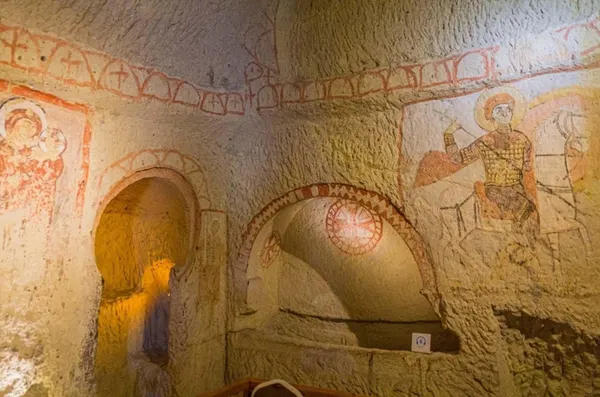
Two remarkable frescoes depict Byzantine military saints on horseback.
Saint George rides a white horse, while Saint Theodore appears on a red horse, confronting a serpent-like creature.
In Byzantine Christian art, these warrior saints represented courage, spiritual protection, and victory over evil.
Their opposing positions create one of the chapel's most distinctive artistic arrangements.
Saint Demetrius and Saint Catherine
Other paintings include Saint Demetrius, the military martyr associated with Thessaloniki, and Saint Catherine, traditionally remembered for her wisdom and martyrdom.
These figures reflect the importance of saints within Byzantine Christianity.
Christ Pantocrator
The central apse contains a representation of Christ Pantocrator, meaning Almighty or Ruler of All.
Jesus is depicted as the heavenly ruler, emphasising divine authority within the sanctuary.
The Virgin Mary and Monk Ignatios
One of the chapel's most historically interesting paintings depicts the Virgin Mary holding the infant Jesus.
Although heavily faded today, historical photographs preserve additional details, including a small figure associated with the monk Ignatios.
The painting provides a rare connection between medieval religious art and an individual associated with the chapel.
Red Crosses and Religious Symbols
Red crosses and geometric decorations appear around some architectural features and burial areas.
Several crosses have widened arms resembling the Maltese cross.
These symbols represented Christian faith, Christ's Crucifixion, and the hope of salvation.
During the Byzantine period, St. Basil's Chapel served as a place of Christian prayer, worship, and remembrance.
Its three apses provided spaces for religious ceremonies, while the portraits of saints communicated important Christian beliefs.
The chapel's numerous graves are particularly significant.
In Byzantine Christianity, burial near sacred spaces was closely connected with prayers for the dead and belief in resurrection.
The military saints symbolised divine protection, while Saint Basil represented religious teaching and communal spiritual life.
Some individual paintings may also have served as votive images, commissioned in connection with personal prayers or expressions of gratitude.
The inscription mentioning Ignatios demonstrates that real individuals associated with the religious community could become part of the chapel's decoration.
Together, these features reveal how religious worship, personal devotion, and burial traditions were connected in Byzantine Cappadocia.
St. Basil's Chapel is located near the entrance of Göreme Open-Air Museum, approximately two kilometres from central Göreme in Nevşehir Province, Türkiye.
The museum forms part of the UNESCO-listed Göreme National Park and the Rock Sites of Cappadocia, inscribed in 1985.
What Should You Look For?
The ancient graves carved into the entrance floor.
The arched burial recesses and rock-cut architecture.
Saint Basil the Great on the northern wall.
Saint Theodore riding a red horse.
Saint George riding a white horse.
The paintings of Saint Demetrius and Saint Catherine.
Christ Pantocrator in the central apse.
The faded Virgin Mary and infant Jesus painting associated with Ignatios.
The red crosses and geometric decorations.
Nearby Churches
St. Basil's Chapel can be explored alongside other important monuments inside Göreme Open-Air Museum, including Yılanlı Church (Snake Church), Saint Barbara Church, Elmalı Church (Apple Church), Karanlık Church (Dark Church), and Çarıklı Church (Sandal Church).
Tokalı Church (Buckle Church) is another remarkable Byzantine monument situated near the museum.
Access and photography restrictions may apply to protect the original paintings and burial features.
Is St. Basil's Chapel Worth Visiting?
Definitely!
It may not contain the elaborate frescoes of Dark Church or Tokalı Church, but its ancient graves, warrior saints, and historical inscription reveal something equally fascinating.
St. Basil's Chapel provides a rare opportunity to understand the religious traditions and personal lives of medieval Cappadocia.
Sometimes, the most fascinating stories aren't found in Cappadocia's grandest churches, but inside its smallest chapels.
Photo Credits & Copyright Information
Photographs by Dosseman / Wikimedia Commons — CC BY-SA 4.0.
Photograph by Ji-Elle / Wikimedia Commons — CC BY-SA 3.0.
Photograph by Cobija / Wikimedia Commons — CC0 1.0.
We acknowledge these photographers for documenting the Byzantine heritage of St. Basil's Chapel in Cappadocia. All copyrighted photographs remain the property of their respective creators and are used according to their Creative Commons licences.
No tours currently list St. Basil's Chapel Cappadocia | History, Frescoes & Tombs as a stop. Browse all day tours or plan a custom trip.
Browse all Cappadocia attractions