Cappadocia Adventures
Cappadocia Adventures

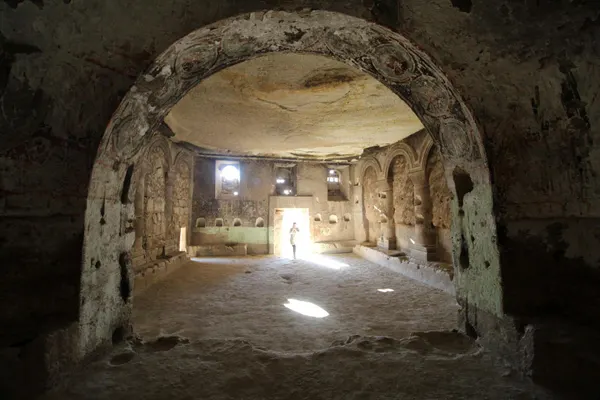
Imagine discovering an enormous Byzantine church hidden high above the ancient village of Çavuşin.
Its monumental columns, spacious sanctuary, centuries-old frescoes, and extraordinary rock-cut architecture reveal an impressive history stretching back nearly 1,500 years.
But here's what makes this place particularly remarkable.
The entire church was carved directly into Cappadocia's volcanic rock!
Welcome to St. John the Baptist Church (Vaftizci Yahya Kilisesi), one of the oldest and largest surviving rock-cut basilicas in Cappadocia.
Located above Old Çavuşin Village, between Göreme and Avanos, this impressive monument belongs to the early development of Byzantine Christianity in Central Anatolia.
Unlike Cappadocia's smaller cave chapels, the church features an enormous three-aisled interior, substantial columns, an elaborate sanctuary, and architectural features associated with important religious ceremonies.
Its surviving frescoes illustrate the life of Jesus Christ, his Crucifixion, Resurrection, and Ascension, alongside a particularly important painting depicting the execution of John the Baptist.
And perhaps even more fascinating?
A mysterious cross-shaped cavity within the sanctuary may once have been associated with the preservation of sacred relics.
St. John the Baptist Church is more than another ancient cave sanctuary. It is an extraordinary monument to early Byzantine architecture, Christian devotion, and the remarkable craftsmanship of Cappadocia's communities.
During the Early Byzantine period, Cappadocia became an important centre of Christian religious life.
Following Christianity's legalisation in the Roman Empire during the 4th century, churches developed into important institutions for worship, education, and community activities.
Cappadocia was already associated with influential Christian thinkers, including Saint Basil the Great, Saint Gregory of Nazianzus, and Saint Gregory of Nyssa.
By the late 5th and early 6th centuries, increasingly ambitious churches were being created throughout the region.
St. John the Baptist Church developed within this tradition, representing one of Cappadocia's most impressive early rock-cut basilicas.
The church takes its name from Saint John the Baptist, known in Turkish as Vaftizci Yahya.
John is remembered in Christianity as the prophet who preached repentance, baptised Jesus Christ in the Jordan River, and prepared the way for his ministry.
An inscription associated with the church's entrance arch identifies its dedication to John the Baptist.
The dedication is particularly meaningful because the surviving frescoes include a representation of John's execution, directly connecting the church's religious identity with its artwork.
The church's monumental dimensions, elaborate sanctuary, and possible relic-related features suggest that it may have played an important role beyond ordinary local worship.
Some researchers have considered whether it attracted pilgrims or served an important ceremonial function.
However, the scale of its religious influence and any pilgrimage activity remains uncertain.
The church overlooks Old Çavuşin, a historic cliffside settlement containing rock-cut houses, storage rooms, passages, and religious buildings.
These spaces formed part of an inhabited community for centuries.
However, rockfalls and structural instability eventually made parts of the village unsafe.
During the 1960s, particularly around 1963, residents were relocated from much of the old cliffside settlement.
Today, the abandoned buildings surrounding the church preserve a remarkable record of traditional Cappadocian life.
St. John the Baptist Church is generally associated with the late 5th or early 6th century AD.
This makes it considerably older than many of Cappadocia's famous fresco-covered churches.
However, researchers differ in their proposed dates, and no securely established founding inscription identifies an exact construction year.
The church belongs to a period when Christian architecture became increasingly sophisticated throughout the Eastern Roman Empire.
Large basilicas were designed to accommodate congregations, religious ceremonies, and important liturgical furnishings.
Cappadocian craftsmen adapted these architectural traditions by excavating entire buildings directly into volcanic rock.
St. John the Baptist Church represents one of the most ambitious examples of this architectural development.
An important distinction must be made between the church's construction and its surviving wall paintings.
Although the building is generally associated with the late 5th or early 6th century, its frescoes belong to later decorative phases.
Researchers have proposed dates ranging approximately from the 7th to the 9th centuries for important parts of the surviving painting programme.
The exact chronology remains debated.
The most reliable conclusion is that St. John the Baptist Church originated in the Early Byzantine period, while its surviving frescoes reflect later stages of Byzantine artistic development.
Now comes one of the most extraordinary features of St. John the Baptist Church.
Its monumental architecture!
Rather than being constructed from individual stone blocks, the church was excavated directly into the natural volcanic rock.
Its columns, arches, sanctuary furnishings, and religious decorations were carefully carved from the surrounding hillside.
The church follows a three-aisled basilica plan, consisting of a broad central nave and two side aisles.
Its surviving width approaches 20 metres, although measurements vary depending on which architectural sections are included.
Unlike traditional long basilicas, St. John the Baptist Church is unusually wide and comparatively short.
The nave has a relatively low, flat ceiling rather than an exceptionally high barrel vault.
The precise reason for this arrangement is unknown, although the existing rock formation may have influenced the design.
Substantial rock-cut columns and arches separate the three aisles.
Two particularly prominent columns feature broad bases and relatively flat capitals.
The arcade arrangement rises from a continuous stone bench, creating a monumental appearance.
Originally, the arches connected the principal worship space with the side aisles.
However, several openings were later blocked with masonry walls, probably during periods when the building was adapted for agricultural storage or animal shelter.
Three arched windows and a large framed doorway helped illuminate the interior.
Because the church was carved into a hillside, conventional high windows could not easily be created along every wall.
The builders therefore adapted the basilica design to the natural rock formation.
The church originally possessed a monumental narthex, an entrance hall separating the outside world from the principal worship area.
Unfortunately, much of this section has collapsed.
Historical photographs document architectural features that no longer survive.
Today, fallen rock fragments beneath the church provide dramatic evidence of this destruction.
Sections of the original narthex floor remain, including traces of rock-cut graves associated with Christian burial traditions.
With much of the original entrance destroyed, a smaller southern chamber became an important alternative approach.
Its walls contain elaborate geometric reliefs, floral decorations, and diamond-shaped frames.
One particularly impressive carving features a Maltese-style cross enclosed within a circle.
These decorations were sculpted in raised relief by removing the surrounding rock.
They demonstrate the precision and artistic imagination of Cappadocia's Byzantine craftsmen.
At the eastern end stands an impressive horseshoe-shaped apse measuring approximately 6 × 5 metres.
This was the principal sanctuary, associated with the altar and Christian liturgy.
Along the curved rear wall is a synthronon, a built-in stone bench used by clergy during religious ceremonies.
At its centre stands a large ceremonial seat known as a cathedra, traditionally associated with bishops.
The presence of such an elaborate seat has encouraged researchers to consider whether the church served an important episcopal function.
However, its precise ecclesiastical status remains uncertain.
Above the central seat is a large cross enclosed within a circle, emphasising the sanctuary's religious significance.
One of the church's most intriguing architectural features is a cross-shaped cavity carved into the sanctuary floor.
Researchers have interpreted it as a possible reliquary, a space intended for preserving sacred relics.
Relics were physical remains or objects associated with important Christian saints.
Some interpretations suggest that the cavity may have contained relics associated with John the Baptist.
Others connect it with Saint Hieron, an early Christian martyr associated with Cappadocia.
However, no surviving evidence confirms that the remains of either saint were kept here.
The original altar may have stood above or near the cavity, possibly as a free-standing structure.
Its exact arrangement remains unknown.
The northern aisle is another unusual feature.
Measuring approximately 6 × 3 metres, it contains its own raised altar arrangement.
This suggests that it could support certain religious ceremonies independently of the main sanctuary.
A low stone barrier separated parts of the northern aisle from the central nave.
Its exact religious function remains uncertain.
Together, these features make St. John the Baptist Church one of Cappadocia's most sophisticated early rock-cut basilicas.
Although many of its original paintings have deteriorated, St. John the Baptist Church preserves important examples of early medieval Byzantine religious art.
Its frescoes illustrate major events from the life of Jesus Christ, alongside scenes directly connected with the church's patron saint.
The northern wall contains a painting of the Annunciation, when the Archangel Gabriel announces to the Virgin Mary that she will give birth to Jesus.
The event represents the beginning of the Incarnation in Christian theology.
Another damaged scene illustrates the Visitation, when the Virgin Mary visits Elizabeth, who is pregnant with John the Baptist.
Its presence is particularly meaningful in a church dedicated to John.
The birth of Jesus is represented in another composition.
An interesting surviving detail is the bathing of the infant Christ, a familiar motif in Byzantine Nativity paintings.
Although absent from the canonical Gospel accounts, this detail became important in Christian artistic tradition.
The lower northern wall contains scenes associated with Christ's Passion.
One illustrates Judas betraying Jesus, although much of the image has suffered damage and scratching.
Another fresco depicts the Roman governor Pontius Pilate washing his hands during the trial of Jesus.
The gesture represents his attempt to distance himself from responsibility for Christ's execution.
Pilate is shown wearing a decorated reddish garment.
A further painting depicts Simon of Cyrene helping Jesus carry the Cross towards the Crucifixion.
Only faded portions of the original composition survive.
One of the church's central religious paintings depicts Jesus Christ upon the Cross.
The Virgin Mary and Saint John the Evangelist appear in association with the scene.
John the Evangelist should not be confused with John the Baptist, who had already been executed before the Crucifixion.
The painting communicates Christ's sacrificial death and its importance within Christian belief.
Another remarkable fresco represents the Anastasis, the Byzantine depiction of Christ's victory over death.
Rather than showing Jesus emerging from an empty tomb, the composition illustrates his descent into Hades.
A figure representing Hades, the personification of the underworld, lies beneath Christ.
Jesus reaches towards Adam, lifting him by the wrist.
The scene symbolises the liberation of humanity and Christ's triumph over death.
Above the Anastasis appears a painting of Christ's Ascension into heaven.
The Virgin Mary stands among the apostles while angels raise Christ within a mandorla, an almond-shaped field symbolising divine glory.
The composition connects the earthly and heavenly aspects of Christian belief.
Another fresco illustrates the appearance of the resurrected Jesus to Thomas, traditionally remembered as Doubting Thomas.
According to the Gospel of John, Thomas initially questioned the Resurrection until he encountered the risen Christ.
The painting represents the relationship between faith, doubt, and belief.
Perhaps the church's most distinctive painting depicts the execution of its patron saint, John the Baptist.
According to the Gospel narratives, John criticised the marriage of Herod Antipas to Herodias and was imprisoned.
During a banquet, Herodias's daughter, traditionally identified as Salome, danced before Herod.
Following her mother's instructions, she requested John's head.
The surviving fresco includes:
Herod Antipas, seated at a banquet table.
Salome, represented as a dancing female figure.
Servants presenting John's severed head on a platter.
Herod Antipas was a tetrarch ruling under Roman authority, rather than a Roman emperor.
This relatively unusual narrative painting directly reinforces the church's dedication to John the Baptist.
The main apse originally contained a magnificent composition of Christ in Glory.
Jesus was represented in heavenly majesty, surrounded by holy figures and seraphim, heavenly beings associated with the worship of God.
The image emphasised Christ's divine authority and the sacred character of the sanctuary.
Another important apse painting illustrated John the Baptist baptising Jesus in the Jordan River.
In Christian theology, the event is associated with the revelation of the Holy Trinity.
Its presence within a church dedicated to John was particularly significant.
The apse also contained a painting of the Transfiguration, when Jesus revealed his divine glory before Peter, James, and John.
Moses and Elijah appear in the biblical account.
The Baptism and Transfiguration were placed together because both represented important moments of divine revelation.
The underside of the sanctuary arch originally displayed eight Old Testament figures within circular medallions.
Decorative braided patterns surrounded the portraits.
These figures connected the Hebrew Scriptures with Christian interpretations of Christ's life and identity.
Together, the frescoes form an extraordinary visual narrative of Christ's birth, ministry, Passion, Resurrection, and heavenly glory, alongside the martyrdom of John the Baptist.
St. John the Baptist Church was more than an impressive architectural monument.
Its sanctuary, religious furnishings, possible reliquary, and extensive paintings reveal the importance of Christian worship in early Byzantine Cappadocia.
The spacious nave accommodated the congregation.
The main apse provided the setting for the Eucharist, also known as Holy Communion.
The synthronon offered seating for clergy, while the central cathedra reflected the formal hierarchy of Christian religious ceremonies.
The northern aisle may have supported additional services or smaller gatherings.
The cross-shaped sanctuary cavity raises the possibility that relic veneration formed part of the church's religious life.
During the Byzantine period, relics associated with saints were important objects of devotion.
If the cavity originally preserved relics, the church may have attracted worshippers from neighbouring settlements.
However, the original contents have not survived, and any connection to a particular saint remains hypothetical.
An interesting scholarly interpretation connects historic Çavuşin with the Byzantine settlement of Kodessanè.
Art historian Catherine Jolivet-Lévy has examined this possible identification in relation to traditions surrounding the relics of Saint Hieron.
If correct, the connection could help explain the development of such a monumental religious building at Çavuşin.
However, the identification is not universally established.
It should not be considered proof that the church actually housed Hieron's relics.
The surviving graves in the entrance area demonstrate the relationship between Christian worship and funerary traditions.
Burial near sacred spaces was often associated with prayer, remembrance, and belief in the Resurrection.
The identities of those originally buried here remain unknown.
Over the centuries, parts of the church were modified for practical activities.
Some original archways were blocked, while sections of the interior were adapted for storage and animal shelter.
These alterations changed parts of the original basilica without completely destroying its architectural identity.
The church's later history is closely connected with the surrounding village.
Rockfalls and structural deterioration eventually forced residents to abandon much of the historic cliffside settlement during the 1960s.
Today, the empty rock-cut houses and passages surrounding the church demonstrate how Cappadocia's remarkable architecture remained part of everyday life long after the Byzantine period.
St. John the Baptist Church preserves the memory of both an important Christian community and the generations who continued living among Çavuşin's ancient rock formations.
St. John the Baptist Church stands high above Old Çavuşin Village, between Göreme and Avanos, in Nevşehir Province, Türkiye.
Although parts of the original building have collapsed and many frescoes have faded, its surviving architecture remains extraordinary.
The Monumental Three-Aisled Basilica
One of Cappadocia's largest early rock-cut churches, with an unusually broad worship space.
The Rock-Cut Columns and Arcades
Impressive architectural features sculpted directly into the volcanic hillside.
The Southern Entrance Reliefs
Beautiful floral decorations, geometric patterns, and a Maltese-style cross.
The Horseshoe-Shaped Main Apse
An enormous sanctuary containing a synthronon and central clerical seat.
The Cross-Shaped Reliquary Cavity
A mysterious sanctuary feature possibly associated with the preservation of sacred relics.
The Northern Aisle
A relatively independent religious space containing its own altar arrangement.
The Biblical Frescoes
Surviving paintings of Christ's birth, Passion, Crucifixion, Resurrection, and Ascension.
The Beheading of John the Baptist
One of the church's most distinctive frescoes, illustrating the execution of its patron saint.
The Abandoned Village
Historic rock-cut houses, passages, and chambers preserving centuries of Cappadocian settlement.
The church is located in the upper section of Old Çavuşin Village.
Historical walking descriptions suggest approximately 15–20 minutes uphill from the village centre.
The route passes through rocky terrain and near abandoned cave dwellings.
Because the cliffs have experienced significant erosion and rockfalls, some paths and entrances may be restricted.
Visitors should confirm current access conditions locally and avoid entering unstable sections.
Absolutely!
St. John the Baptist Church is particularly rewarding for travellers interested in early Christianity, Byzantine architecture, ancient frescoes, and Cappadocia's lesser-known historical monuments.
Its monumental basilica reveals the architectural ambitions of early Byzantine communities.
Its carved sanctuary and ceremonial seating preserve evidence of Christian religious practices.
Its mysterious reliquary opens an intriguing discussion about saints, pilgrimage, and sacred objects.
And its surviving paintings communicate some of Christianity's most important biblical stories.
But perhaps the most fascinating achievement is the building itself.
Nearly fifteen centuries ago, Cappadocian craftsmen transformed an enormous volcanic hillside into a sophisticated Christian basilica.
Although erosion, abandonment, and later alterations have changed its appearance, the surviving church remains a remarkable monument to their skill.
St. John the Baptist Church is more than another ancient cave sanctuary. It is an extraordinary example of early Byzantine Christianity, religious art, and the remarkable relationship between Cappadocia's inhabitants and their volcanic landscape.
Some of Cappadocia's greatest treasures are not found behind museum doors.
Sometimes, they are waiting quietly inside a mountain.
Photo: Jaba1977 / Wikimedia Commons / CC BY-SA 4.0. Original image: [insert individual Wikimedia file link]. Licence: https://creativecommons.org/licenses/by-sa/4.0/ . Changes: [none or describe edits].
No tours currently list St. John the Baptist Church in Çavuşin – History, Frescoes & Architecture as a stop. Browse all day tours or plan a custom trip.
Browse all Cappadocia attractions