Cappadocia Adventures
Cappadocia Adventures

Imagine exploring a quiet corner of Cappadocia, far from the busy valleys of Göreme, when you discover an ancient hillside filled with mysterious cave entrances.
Beneath the rocks lies an extraordinary underground settlement.
But just above it, something equally fascinating awaits.
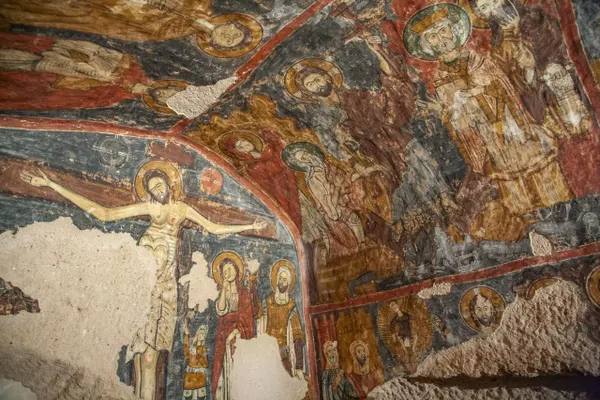
Two adjoining Byzantine churches decorated with colourful frescoes, biblical stories, and portraits of people who lived more than 800 years ago.
Welcome to Tatlarin Church (Tatların Kilisesi), one of Cappadocia's remarkable surviving examples of medieval Christian art.
Located near Tatlarin town in the Acıgöl district of Nevşehir Province, these rock-cut churches are famous for their extensive paintings of Jesus Christ, the Virgin Mary, Christian saints, and important biblical events.
But here's what makes them particularly fascinating!
Unlike many Cappadocian churches whose construction dates remain uncertain, Tatlarin preserves an inscription dating an important decorative campaign to 1214–1215 AD.
The inscription even identifies a woman named Rodathis, who helped finance the church's decoration.
Inside, visitors can discover extraordinary representations of the Last Supper, Crucifixion, Resurrection, and the Three Hebrew Youths surviving a burning furnace.
And among the paintings are the Roman Emperor Constantine and his mother Helena, shown holding the True Cross.
Tatlarin Church is more than another ancient cave sanctuary. It preserves an extraordinary story of Byzantine Christianity, religious art, and the people who maintained their faith in medieval Cappadocia.
Let's discover its fascinating history!
During the Byzantine period, Cappadocia became an important centre of Christian religious and cultural life.
Communities established churches, monasteries, and settlements throughout its volcanic landscape.
The relatively soft volcanic rock allowed craftsmen to excavate entire buildings directly into the hillsides.
Tatlarin developed within this remarkable environment.
Tatlarin is particularly famous for its extensive underground city.
The settlement lies beneath a rocky hill traditionally known as Kale, meaning Castle.
The underground chambers contain storage rooms, passages, defensive features, and spaces associated with everyday activities.
Nearby, the hillside preserves several rock-cut Christian churches.
The best-known monuments are two adjoining sanctuaries identified by researchers as Tatlarin Church I and Tatlarin Church II.
These churches should be distinguished from the underground city's individual chambers, although both belong to the same historic landscape.
By the early 13th century, Cappadocia was under Turkish Seljuk political authority.
Nevertheless, Christian communities continued to practise their religion and commission impressive religious paintings.
Tatlarin provides valuable evidence of this period.
Its frescoes demonstrate that Byzantine artistic traditions remained active in Central Anatolia even after the region's political circumstances had changed.
Art historians have also identified stylistic similarities between Tatlarin and other 13th-century churches, including St. John's Church (Karşı Kilise) in Gülşehir.
These similarities suggest connections between regional painters and artistic workshops.
One of Tatlarin's most important discoveries is an inscription in Church I.
The surviving text identifies a woman named Rodathis, described by the title protopapadia.
This title is associated with the wife of a senior Orthodox priest.
According to the inscription, Rodathis contributed to the decoration of the sanctuary.
Her name provides a rare historical connection with a real person who helped support Christian religious art in medieval Cappadocia.
The inscription demonstrates that women could play an important role in financing and maintaining religious buildings during the Byzantine period.
The exact excavation date of Tatlarin's churches is not securely established.
However, one inscription provides unusually precise evidence for their painted decoration.
An inscription in Church I records the Byzantine calendar year 6723.
Researchers interpret this as corresponding to approximately 1214–1215 AD.
It also identifies Rodathis as a contributor to the church's decoration.
This provides a much stronger historical basis than dating the frescoes solely through their artistic style.
Researchers generally associate Church II with the same historical period.
Its paintings contain religious subjects and stylistic features characteristic of the 12th–13th centuries.
However, the exact construction sequence of the two adjoining churches remains uncertain.
Some scholars suggest that Church II may have been excavated before Church I, based on how their architectural spaces connect.
Others emphasise the difficulties of reconstructing their original development.
The most reliable conclusion is that Tatlarin's two principal churches preserve important 13th-century Byzantine decoration, with Church I's inscription dating a painting campaign to 1214–1215 AD.
Tatlarin's churches were carved directly into Cappadocia's volcanic tuff.
Their architecture demonstrates how medieval builders could create connected religious spaces inside the same hillside.
The complex contains two principal churches, traditionally identified as Church I and Church II.
Both have two naves and two apses.
A nave is the main space where worshippers gathered.
An apse is the rounded sanctuary area traditionally associated with the altar.
The naves are separated by rock-cut pillars and supporting arches.
Their ceilings are covered by barrel vaults, which resemble the interior of a semicircular tunnel.
Church I contains two adjoining worship spaces with horseshoe-shaped sanctuary apses.
The interior also includes smaller rooms, niches, and architectural features associated with Christian ceremonies.
A former entrance area, known as a narthex, contains burial spaces.
Parts of the original access arrangements have been modified or damaged over time.
The church preserves some of the complex's most important biblical paintings and the inscription associated with Rodathis.
Church II follows a similar two-nave arrangement.
Its interior is distinguished by an extensive collection of religious paintings arranged in clearly separated bands.
The artists used different sections of the walls, vaults, and apses to organise biblical scenes and portraits of saints.
This created a carefully structured religious environment.
Both churches contain architectural features associated with Christian burial traditions.
Graves and funerary niches were often placed near sacred spaces because of religious beliefs concerning prayer, death, and resurrection.
Their presence suggests that remembrance of the deceased was an important aspect of religious activity at Tatlarin.
Tatlarin's architecture is particularly interesting because its two neighbouring churches preserve evidence of different building phases within a shared religious landscape.
Now comes the most fascinating part of Tatlarin Church.
Its extraordinary Byzantine frescoes!
The surviving paintings are especially valuable because they preserve a large collection of biblical scenes and Christian figures from the early 13th century.
Dark grey backgrounds contrast with rich reds, purple tones, mustard yellows, and other earthy colours.
The artists arranged individual scenes inside painted borders, creating a remarkable visual narrative.
One of the most important compositions depicts the Virgin Mary seated on a throne with the infant Jesus.
The image is associated with the Byzantine tradition of the Theotokos, meaning Mother of God.
Nearby appear Joachim and Anna, traditionally honoured as Mary's parents.
Their presence connects the scene with Christian traditions concerning the family of the Virgin Mary.
Another small niche contains a representation of the young Jesus known as Christ Emmanuel.
One of Church I's important surviving biblical scenes represents the Last Supper.
According to the Gospels, Jesus shared his final meal with his disciples before his arrest and Crucifixion.
The event became central to Christian worship through its association with the Eucharist, or Holy Communion.
Although parts of the painting have deteriorated, researchers have identified Christ and several apostles gathered around a table.
Another painting depicts Judas betraying Jesus Christ.
According to the Gospel accounts, Judas identified Jesus to the authorities who came to arrest him.
The scene forms part of the Passion narrative, describing the events leading towards Christ's Crucifixion.
One of Tatlarin's most significant paintings represents the Crucifixion of Jesus Christ.
Jesus appears upon the Cross, accompanied by figures associated with the biblical event.
For Byzantine Christians, the Crucifixion represented sacrifice, salvation, and the beginning of the events leading towards the Resurrection.
Another remarkable painting depicts the women who visited Christ's tomb after his Crucifixion.
According to the Gospel accounts, they discovered that the tomb was empty.
An angel announced the Resurrection.
This event became one of Christianity's most important symbols of hope and victory over death.
The churches also preserve a representation of the Anastasis.
In Byzantine art, the Anastasis commonly depicts Christ descending into Hades and raising Adam and Eve.
Rather than simply illustrating an empty tomb, the composition communicates the Christian belief that Christ overcame death and opened the possibility of salvation.
This subject was particularly meaningful in churches associated with burial and remembrance.
One of Tatlarin's most interesting paintings illustrates a story from the Book of Daniel.
According to the biblical narrative, three young men refused to worship a golden image established by King Nebuchadnezzar.
They were punished by being thrown into a burning furnace.
However, they survived through divine protection.
For Byzantine Christians, their story represented courage, perseverance, and faith in the face of persecution.
Other paintings illustrate important moments from the life of Christ.
The Transfiguration, known in Greek as Metamorphosis, represents Jesus revealing his divine glory before selected disciples.
The Entry into Jerusalem depicts Jesus arriving in the city shortly before his Crucifixion.
These scenes form part of the church's extensive narrative programme.
Another important composition is the Deesis.
In Byzantine art, the Deesis normally depicts Jesus Christ accompanied by the Virgin Mary and John the Baptist.
Mary and John appear as intercessors, appealing to Christ for mercy on behalf of humanity.
The subject communicates the importance of divine compassion and salvation.
One particularly interesting image represents the Virgin Mary with her hands raised in prayer.
This form is associated with the Blachernitissa tradition.
Mary appears in a prayerful position known as orans, symbolising intercession.
The composition demonstrates the importance of Marian devotion within Byzantine Christianity.
The churches also contain representations of Emperor Constantine the Great and his mother, Saint Helena.
They appear holding the True Cross, an important symbol within Eastern Christianity.
Constantine supported the development of Christianity during the 4th century.
According to later Christian tradition, Helena discovered the Cross of Christ during a pilgrimage to Jerusalem.
Their representation connects Tatlarin with the wider history and traditions of the Christian Church.
Numerous additional figures appear throughout the churches.
These include bishops, monks, martyrs, military saints, angels, and other Christian figures.
The official Turkish Museums documentation identifies 69 individual religious and historical figures within the studied painting programme.
Among these are representations of patrons who supported the churches.
Their presence is especially valuable because it connects religious art with the lives of medieval Cappadocian communities.
Tatlarin's frescoes preserve an extraordinary collection of biblical storytelling, Christian symbolism, and the personal history of the people who commissioned the artwork.
During the Byzantine period, Tatlarin's churches served as important places of Christian worship.
Their architecture and extensive paintings reveal the religious beliefs of the communities who used them.
The sanctuaries were associated with religious ceremonies, including the celebration of the Eucharist.
The paintings of the Last Supper, Crucifixion, and Resurrection connected these ceremonies with important events from the life of Jesus Christ.
Images of saints and angels encouraged prayer and religious reflection.
One particularly meaningful aspect of Tatlarin's decoration is its emphasis on death and resurrection.
The Crucifixion, Empty Tomb, and Anastasis communicate Christian beliefs concerning the hope of eternal life.
These subjects were especially significant within religious spaces associated with burial traditions.
The inscription naming Rodathis demonstrates the importance of personal contributions to church decoration.
Patrons could finance paintings as expressions of religious devotion, remembrance, or community responsibility.
Their support helped maintain artistic traditions even during periods of political change.
Tatlarin's underground city provides important historical context.
Its extensive chambers contain storage areas, defensive features, and practical facilities.
The unusual scale of the settlement has led researchers to suggest that it may have served as a military or religious centre.
However, its exact historical function remains uncertain.
The churches and underground structures together demonstrate that Tatlarin was part of a substantial medieval settlement.
Tatlarin Church preserves an important picture of Christian life during Seljuk-era Cappadocia, combining religious worship, artistic patronage, and beliefs about salvation.
Tatlarin Church is located near Tatlarin town, approximately 10 kilometres north of Acıgöl, in Nevşehir Province, Türkiye.
The churches are carved into the hillside known locally as Kale, close to Tatlarin Underground City.
Although less famous than Göreme Open-Air Museum, the area preserves some of Cappadocia's most interesting 13th-century Christian paintings.
The Two Adjoining Churches
The connected sanctuaries are among the most interesting architectural features of the complex.
The Virgin Mary and Infant Jesus
Look for the enthroned Virgin Mary, Joachim and Anna, and the image of Christ Emmanuel.
The Crucifixion and Resurrection
These paintings are among Tatlarin's most important surviving biblical scenes.
The Three Hebrew Youths
The Fiery Furnace scene preserves one of the Old Testament's most memorable stories of divine protection.
The Deesis and Blachernitissa
These compositions demonstrate the importance of prayer and the Virgin Mary within Byzantine Christianity.
The Portraits of Saints
Numerous surviving figures represent Christian bishops, martyrs, monks, and angels.
The Historical Donor Inscription
The inscription naming Rodathis is especially valuable because it provides evidence of a painting campaign dated to 1214–1215.
Visitors can also explore the nearby underground settlement.
The site was identified in 1975 and opened to visitors in 1991.
Official museum information describes a large network of underground chambers, although only part of the complex has been excavated and made accessible.
Among its unusual features are extensive storage spaces, defensive passages, and a rare rock-cut toilet reached through an L-shaped corridor.
Its purpose may have included shelter, storage, religious activity, or defence, but the exact historical interpretation remains debated.
Tatlarin is located north of Acıgöl, west of central Nevşehir.
The easiest approach is by car, following the road towards Tatlarin town.
The churches and underground city are associated with the historic Kale hillside.
Visitors should follow marked routes and local signs.
Approximately 20–30 minutes is reasonable for appreciating the principal church paintings, where access is permitted.
Allow additional time if you plan to explore Tatlarin Underground City.
The official Turkish Museums listing currently gives visiting hours of 08:00–17:00 and indicates free admission to Tatlarin Underground City.
However, these arrangements can change.
Access to individual churches or frescoed chambers may also differ from access to the underground city.
Visitors should confirm current conditions and avoid touching the fragile paintings.
Absolutely!
Tatlarin Church is particularly rewarding for travellers interested in Byzantine art, Christian history, and Cappadocia's lesser-known historical monuments.
Its two adjoining churches demonstrate the architectural creativity of medieval builders.
Its frescoes preserve important biblical stories.
Its paintings of saints and the Virgin Mary reveal the religious beliefs of the original congregation.
And its historical inscription provides something especially valuable.
The name of a woman who helped finance the decoration more than 800 years ago.
But perhaps the most fascinating aspect is the relationship between the churches and the surrounding settlement.
Above the hillside, sacred paintings tell stories of faith and salvation.
Below, underground chambers preserve evidence of everyday life, storage, and defence.
Together, they reveal a remarkable part of Cappadocia's medieval history.
Tatlarin Church is more than another ancient cave sanctuary. It is one of the region's valuable surviving records of 13th-century Byzantine religious painting, Christian patronage, and cultural life under Seljuk rule.
And centuries after its decoration, the name of Rodathis still survives within the painted walls of Tatlarin.
No tours currently list Tatlarin Church (Tatlarin Kilisesi) – Nevşehir, Cappadocia as a stop. Browse all day tours or plan a custom trip.
Browse all Cappadocia attractions