Cappadocia Adventures
Cappadocia Adventures
Imagine exploring the beautiful Rose Valley of Cappadocia, surrounded by towering fairy chimneys, ancient cave dwellings, and magnificent volcanic landscapes.
Hidden within these cliffs is a church with an extraordinary secret.
Three enormous crosses, decorated with intricate geometric patterns and palm trees, carved directly into the stone ceiling.
Welcome to Three Crosses Church (Üç Haçlı Kilise), one of Cappadocia's most remarkable examples of Byzantine religious art and rock-cut architecture.
Located in Güllüdere Valley, near Çavuşin, this ancient church is also known as Saint Agathangelus Church or Güllüdere Chapel No. 3.
But its spectacular ceiling is only the beginning!
The sanctuary preserves paintings of Jesus Christ enthroned in heavenly glory, surrounded by angels, biblical creatures, and Christian saints.
Another fresco depicts the Baptism of Jesus, while nearby chambers reveal evidence of burial traditions, everyday life, and agricultural activities.
Over the centuries, parts of the complex were even transformed into a water-storage system.
Three Crosses Church is more than another ancient cave sanctuary. It is an extraordinary place where Byzantine craftsmanship, Christian symbolism, and centuries of human history come together within a single volcanic hillside.
Let's discover its remarkable story.
During the Byzantine period, Cappadocia developed into an important centre of Christian religious life.
The region's soft volcanic rock allowed communities to create entire churches, dwellings, and religious complexes directly within the landscape.
Three Crosses Church developed within this remarkable architectural tradition.
However, its history is more complicated than that of a single building constructed during one period.
Architectural research suggests that the complex experienced several phases of excavation, decoration, and modification.
Some scholars associate its earliest architectural features with the early Byzantine period.
Others emphasise developments during the 9th and 10th centuries, when the surviving figurative paintings were probably created.
The differences between the carefully carved ceiling, surrounding rock-cut rooms, and later frescoes suggest a long history of use.
The answer is right above your head!
The church takes its name from three monumental crosses sculpted into the ceiling of its main worship area.
Unlike ordinary painted symbols, these crosses were created by carving away the surrounding stone.
Their elaborate decoration makes them among the monument's most impressive surviving features.
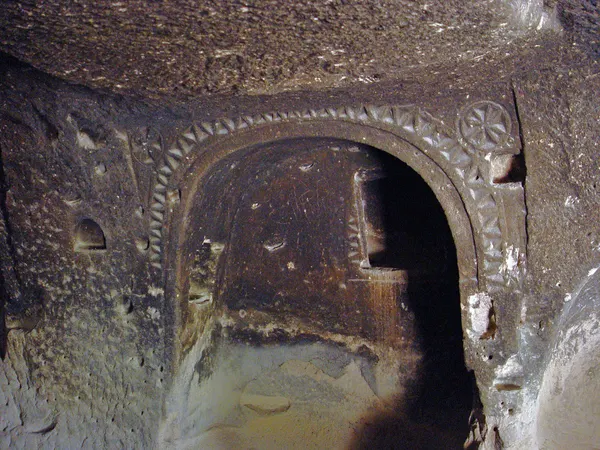
The surrounding hillside contains an extensive network of interconnected rooms, passages, and chambers.
Behind the church is a large room containing five carved features interpreted as sleeping platforms.
Other spaces preserve evidence of cooking installations, storage facilities, and animal troughs.
These features have led some researchers to propose that the complex accommodated a monastic community.
However, the surviving architecture does not establish whether its occupants were exclusively monks.
The most accurate interpretation is that Three Crosses Church belonged to a larger complex combining religious and practical activities, although the identity of its original inhabitants remains uncertain.
The exact construction date of Three Crosses Church is unknown.
Researchers have proposed different periods based on its architectural characteristics, carved decorations, and surviving frescoes.
Some architectural studies associate the earliest rock-cut structures and monumental ceiling crosses with the 6th or 7th century.
These dates are based on comparisons with other early Christian monuments in Cappadocia and neighbouring regions.
However, no securely established original inscription confirms an exact founding year.
Other scholars associate important architectural and decorative phases with the late 9th and early 10th centuries.
The surviving figurative frescoes are generally connected with medieval Byzantine painting traditions.
This suggests that the church's decoration may have developed significantly after its earliest excavation.
This is one of the church's most interesting historical questions.
Byzantine Iconoclasm refers to religious controversies concerning the use and veneration of sacred images.
Its principal phases occurred approximately during 726/730–787 and 814–843 AD.
Because crosses remained important Christian symbols, churches decorated primarily with crosses were once frequently associated with this period.
However, modern academic research has demonstrated that crosses were used before, during, and after Iconoclasm.
Their presence alone cannot establish a church's construction date or prove that its community opposed religious images.
The most reliable conclusion is that Three Crosses Church developed through several Byzantine phases, with its earliest construction date uncertain and significant painted decoration associated with the medieval period.
One of Three Crosses Church's most remarkable features is the extraordinary relationship between its architecture and religious decoration.
The church was excavated directly into Cappadocia's volcanic tuff.
Its main worship space follows an unusual transverse plan, meaning the interior is considerably wider than it is long.
The nave is the principal area where worshippers gathered during religious ceremonies.
At Three Crosses Church, the main space measures approximately eight metres across its broadest section.
Its relatively flat ceiling contains the church's magnificent carved crosses.
Some areas of the ceiling are carefully finished, while others show rougher excavation.
These differences may indicate that the interior was expanded or modified during a later period.
Now comes the church's most extraordinary architectural feature.
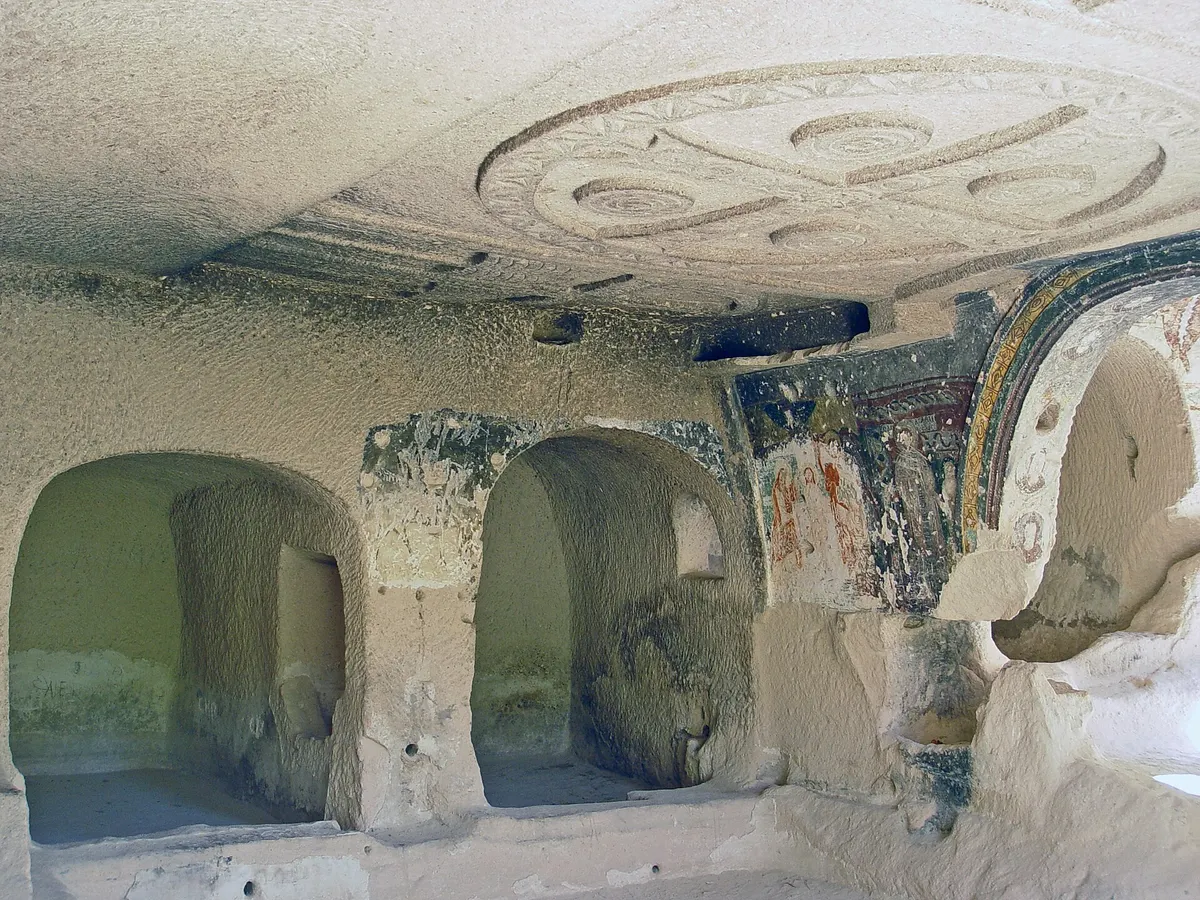
Three enormous crosses dominate the ceiling.
At the centre is an equal-armed Greek cross enclosed within a circular medallion.
The surrounding sections contain concentric circles and elaborate geometric decorations.
On either side appear two elongated crosses, commonly described as Latin crosses, surrounded by decorative arches and ornamental borders.
Their surfaces contain patterns resembling twisted ropes, stylised leaves, and interlocking geometric shapes.
But how were these magnificent decorations created?
Rather than attaching separate stone elements, Byzantine craftsmen removed the surrounding rock, leaving the crosses raised above the ceiling surface.
This technique is known as relief carving.
The precision required to produce such intricate decorations overhead is remarkable.
One of the most fascinating details is the presence of palm-tree reliefs beside the elongated crosses.
But why would palm trees appear in a church in Cappadocia?
In Christianity, palms were associated with several important religious ideas.
They could represent victory, martyrdom, paradise, and eternal life.
Palm branches were also connected with Jesus Christ's entry into Jerusalem, commemorated on Palm Sunday.
Some researchers have suggested that the palm decorations may evoke the religious landscapes of Egypt, Syria, and the eastern Mediterranean, regions associated with early Christian monasticism.
Another interpretation connects them with paradise imagery.
However, their precise intended meaning remains uncertain.
One interpretation associates the three crosses with the Crucifixion of Jesus Christ at Golgotha.
According to the Gospel accounts, Jesus was crucified between two other men.
The three ceiling crosses may therefore evoke this biblical event.
However, no surviving inscription confirms that interpretation.
Researchers have also suggested that the intricate ceiling decoration may have been inspired by elaborate wooden coffered ceilings.
Whatever their original meaning, the carved crosses are exceptional examples of Cappadocian craftsmanship and Christian symbolism.
The church's apse, or principal sanctuary, is positioned asymmetrically in relation to the broad nave.
Its raised liturgical area is known as the bema.
Along the curved sanctuary wall stands a rock-cut bench called a synthronon, traditionally used by clergy during religious ceremonies.
The original altar and any central seating arrangement have suffered damage.
However, the surviving architecture demonstrates that the sanctuary was carefully organised for Christian worship.
If the ceiling crosses represent the church's greatest architectural achievement, its surviving frescoes are equally fascinating.
Although many paintings have deteriorated, they preserve remarkable representations of Christ, angels, biblical figures, and Christian saints.
The most important fresco occupies the upper section of the sanctuary.
It represents Christ in Glory, also known as Maiestas Domini.
Jesus Christ appears enthroned, surrounded by a heavenly court.
Rather than illustrating an event from his earthly life, the painting presents Christ as the divine ruler of creation.
He is enclosed within a mandorla, an almond-shaped or elongated field representing heavenly radiance.
The composition expresses important Christian beliefs about divine authority and salvation.
Surrounding Christ are figures associated with the four living creatures described in the biblical books of Ezekiel and Revelation.
In Christian art, these creatures became symbols of the Four Evangelists.
Matthew is represented by a winged man, associated with Christ's human ancestry.
Mark is represented by a lion, symbolising strength and royal authority.
Luke is represented by an ox, connected with sacrifice.
John is represented by an eagle, associated with spiritual vision and divine revelation.
Together, these creatures connect the heavenly image of Christ with the teachings of the four Gospels.
Additional heavenly beings surround the central composition.
Seraphim are six-winged beings described in the Book of Isaiah, associated with worship before God.
The tetramorph combines the forms of the human, lion, ox, and eagle into a symbolic representation of divine revelation.
The paintings also contain figures interpreted as Adam and Eve, kneeling near the heavenly beings.
Some surviving gestures have been compared with the Anastasis, the Byzantine representation of Christ overcoming death and raising humanity.
However, the damaged condition of these figures makes their precise interpretation uncertain.
Two important heavenly figures appear near the sanctuary.
They are identified as Archangels Michael and Gabriel, both wearing elaborate garments inspired by Byzantine military and imperial traditions.
Michael is associated with heavenly protection and the struggle against evil.
Gabriel is remembered as the divine messenger who announced the birth of Jesus to the Virgin Mary.
Another remarkable detail is the Hand of God, emerging from a dark triangular area and symbolising divine presence and authority.
Three circular painted compositions appear near the upper sanctuary.
The central image is heavily damaged, while the two remaining busts have uncertain identities.
One has tentatively been interpreted as the Virgin Mary, although this identification is not established.
Another important fresco depicts the Baptism of Jesus.
According to the Gospels, John the Baptist baptised Jesus in the Jordan River.
The composition includes Christ standing in the water, John performing the baptism, two attending angels, and a dove representing the Holy Spirit.
Above the scene appears the Hand of God.
In Christian theology, the Baptism is associated with the manifestation of the Holy Trinity.
The surviving painting is also important for understanding Byzantine artistic techniques.
Damaged areas reveal several layers, including the rock surface, plaster preparation, preliminary outlines, coloured painting, and later deposits of soot and dirt.
These layers provide valuable evidence of how medieval craftsmen decorated rock-cut churches.
Another significant painted composition includes Saint Agathangelus and Saint Anastasia.
The presence of Agathangelus helps explain why the monument is sometimes called Saint Agathangelus Church.
Some historical interpretations associate him with a bishop and martyr connected with Damascus.
However, his exact identification remains a subject of scholarly discussion.
The name should not automatically be confused with Agathangelus, the author traditionally associated with an Armenian account of Saint Gregory the Illuminator and Armenia's conversion to Christianity.
Nearby appears Saint Anastasia.
Several Christian saints carried this name, including Anastasia of Sirmium, an early Christian martyr.
The surviving evidence does not securely establish which Anastasia is represented.
The sanctuary also preserves traces of standing angels, apostles, bishops, and other religious figures.
Circular medallions and decorative crosses appear around the arches.
Some figures have been interpreted as Old Testament prophets, connecting the paintings with Christian traditions concerning biblical prophecy.
Together, these images create a complex representation of heavenly worship, Christian salvation, and the community of saints.
During the Byzantine period, Three Crosses Church served as a place of Christian worship.
Its architectural features and paintings were not simply decorative.
They helped communicate religious beliefs and created an environment associated with prayer and sacred ceremonies.
The crosses represented one of Christianity's most important symbols.
They were associated with the Crucifixion, salvation, and Christ's victory over death.
Their prominent position above the congregation gave them particular religious significance.
Academic research has also explored how monumental ceiling crosses interacted with Byzantine liturgical practices and sacred objects used during worship.
The painted image of Christ in Glory occupied the most important part of the church.
Below it stood the synthronon, where clergy could sit during religious ceremonies.
This created a remarkable relationship between the heavenly kingdom represented in the paintings and worship taking place beneath them.
The surrounding rooms suggest that the complex supported practical activities alongside religious worship.
Sleeping platforms, storage areas, cooking facilities, and animal troughs reveal how occupants used the available rock-cut spaces.
The possibility of a monastic community remains interesting, but its precise organisation cannot be established.
Perhaps the most surprising chapter of the church's history came after its original religious function declined.
During a later period, parts of the complex were adapted into a cistern and agricultural irrigation system.
Channels carved into the rock directed water through the former religious spaces.
Some chambers were coated with plaster to reduce water loss.
Other passages helped distribute water towards surrounding cultivated land.
These alterations demonstrate how Cappadocia's inhabitants continued adapting ancient buildings to meet practical needs.
Unfortunately, the church's paintings have suffered extensive deterioration.
Moisture has weakened plaster surfaces, while salts, soot, erosion, and human activity have contributed to the loss of original decoration.
In certain places, the painted surfaces have detached from the underlying rock.
Other areas contain scratches and historical graffiti.
The preservation of Three Crosses Church is particularly important because its surviving architecture and frescoes provide valuable evidence of Byzantine artistic traditions and the changing lives of Cappadocia's communities.
Three Crosses Church is located in Güllüdere Valley (Rose Valley), near Çavuşin, Nevşehir Province, Türkiye.
The valley is famous for its colourful rock formations, vineyards, ancient cave dwellings, and spectacular hiking routes.
Although the church is relatively small, it contains some of Cappadocia's most remarkable religious decorations.
The Three Monumental Ceiling Crosses
The church's most recognisable feature, carved directly into the volcanic rock and surrounded by intricate geometric designs.
The Palm-Tree Reliefs
Unusual decorations associated with Christian symbolism, paradise imagery, and possible eastern Mediterranean artistic influences.
Christ in Glory
The principal sanctuary fresco depicting Jesus enthroned among heavenly beings.
The Four Evangelist Symbols
The winged man, lion, ox, and eagle surrounding Christ.
Archangels Michael and Gabriel
Two impressive figures wearing Byzantine ceremonial garments.
The Baptism of Jesus
A significant biblical painting that also preserves evidence of medieval fresco techniques.
Saint Agathangelus and Saint Anastasia
Religious portraits connected with the church's alternative name and historical identity.
The Rock-Cut Sanctuary
The surviving synthronon and raised bema reveal how religious ceremonies were arranged.
The Surrounding Chambers
Former living and working spaces provide evidence of the complex's practical functions.
The Agricultural Water Channels
Later alterations demonstrate how parts of the religious complex were transformed into a cistern and irrigation system.
The church lies within the hiking area of Güllüdere Valley, accessible from the Çavuşin side.
Older route descriptions place it approximately 300 metres along the valley path, near a narrowing section of the landscape.
However, paths and access arrangements can change because of erosion.
The church is positioned above the surrounding path, and some approaches involve steep or unstable rock surfaces.
Visitors should follow established routes, confirm current conditions, and avoid climbing unsafe sections.
Cross Church (Haçlı Kilise) is another remarkable monument famous for its monumental ceiling cross and Christ in Glory fresco.
Ayvalı Church (St. John Church) preserves important Byzantine religious paintings.
Joachim and Anna Church is associated with early Christian artistic traditions.
Column Church (Direkli / Kolonlu Kilise) is another important example of Cappadocia's rock-cut architecture.
Together, these monuments offer an extraordinary journey through the religious history of Red and Rose Valleys.
Absolutely!
Three Crosses Church is particularly rewarding for travellers interested in Byzantine architecture, Christian symbolism, and Cappadocia's lesser-known historical monuments.
Its ceiling crosses demonstrate extraordinary craftsmanship.
Its frescoes preserve complex representations of divine glory, biblical stories, and Christian saints.
Its surrounding chambers offer valuable insights into everyday life.
And its later transformation into a cistern reveals how local communities continued using ancient buildings long after their original purposes changed.
But perhaps the most fascinating thing is how the church's different features tell different stories.
The crosses reveal its artistic identity.
The frescoes reveal its religious beliefs.
The surrounding chambers reveal its practical history.
And together, they preserve a remarkable record of medieval Cappadocia.
Three Crosses Church is more than another cave sanctuary. It is an extraordinary example of Byzantine craftsmanship, Christian artistic traditions, and the changing relationship between people and Cappadocia's volcanic landscape.
More than a thousand years after much of its decoration was created, the three great crosses still remain above the ancient worship space, preserving the remarkable imagination of the people who carved them.
Photography: Dosseman, via Wikimedia Commons. Licensed under Creative Commons Attribution-ShareAlike 4.0 International (CC BY-SA 4.0).
No tours currently list Three Crosses Church (Üç Haçlı Kilise) in Cappadocia as a stop. Browse all day tours or plan a custom trip.
Browse all Cappadocia attractions