Cappadocia Adventures
Cappadocia Adventures

After all the hiking, sightseeing, ATV adventures, and exploring you've done in Cappadocia, don't you think your body deserves a little reward?
Come on!
You've been walking through valleys.
Climbing stairs in historical museums.
Waking up before sunrise to watch hot air balloons.
And probably taking enough photographs to fill your phone's storage three times over!
Surely you've earned a little relaxation!
Well, here's some good news.
The Turks have been developing their bathing traditions for centuries!
And no, we're not talking about an ordinary shower followed by five minutes of sitting around in a bathrobe.
We're talking about something considerably more interesting.
Welcome to the Turkish Bath, or as we call it, the Hamam!
Believe it or not, the roots of Turkish bathing culture are connected with ancient bathing traditions, including those of the Romans!
The Romans developed elaborate public bathhouses where people gathered not only to cleanse themselves, but also to socialize and relax.
These bathhouses could include heated rooms, pools, and carefully designed water systems.
And here's something fascinating.
For the Romans, bathing wasn't simply a five-minute activity before leaving for work!
It could be an important part of everyday social life.
Now, as centuries passed, bathing traditions continued evolving throughout the Byzantine and Islamic worlds.
During the Seljuk and Ottoman periods, public baths became important features of many Anatolian towns and cities.
And under the Ottoman Empire, the hamam developed a particularly recognizable architectural and social identity.
Beautiful marble interiors.
Domed ceilings.
Warm bathing chambers.
And carefully designed spaces where people could relax, cleanse themselves, and spend time together.
Apparently, ordinary bathrooms just weren't ambitious enough for the Ottomans!
And honestly, we appreciate the effort!
Now, here's something particularly interesting.
During the Ottoman period, hamams were important social spaces.
People visited them for cleanliness and relaxation.
But they also provided opportunities for social gatherings and traditional celebrations.
Friends could spend time together.
Families participated in particular customs.
And some important life events involved special bathing traditions.
One particularly well-known example is the bridal hamam!
Before a wedding, women might gather for a traditional bathing celebration associated with the bride.
Imagine an entire social event built around bathing, conversation, and celebration!
Quite different from the ordinary bathroom routine most of us follow today!
But there was also another important reason why bathing held such a significant place in Ottoman society.
Cleanliness has an important role in Islamic religious practice.
Ritual washing, commonly known as Wudu, is associated with preparation for prayer.
Full-body ritual purification, known as Ghusl, is required in certain religious circumstances.
However, the full Turkish hamam treatment isn't itself a religious obligation.
The connection lies in the broader importance of cleanliness and the development of public bathing facilities across Islamic societies.
And here's what makes the historical relationship so interesting.
Religious practices, social customs, architecture, and everyday hygiene all contributed to the development of the hamam tradition!
Quite a remarkable combination!
Now, before we discuss the actual treatment, let's appreciate the buildings themselves.
Traditional Ottoman hamams often feature impressive architectural designs.
Domed ceilings.
Marble surfaces.
Heated rooms.
And small openings that allow natural light to enter from above.
Imagine stepping into a beautiful historic hamam.
Soft light filters through the dome.
The surrounding marble feels warm.
And the atmosphere is completely different from your ordinary bathroom at home.
Suddenly, taking a bath feels like visiting an architectural monument!
Not a bad improvement!
But the architecture wasn't simply decorative.
The arrangement of heated spaces, water systems, and bathing areas served practical purposes.
Traditional hamams were designed to create a comfortable environment for washing and relaxation.
And centuries later, many of these architectural ideas remain closely associated with Turkish bathing culture.
Your Turkish Bath experience usually begins with time in a heated bathing area.
The warmth and humidity create an atmosphere where you can relax before the traditional treatment.
Depending on the facility, you may sit or lie in a suitable warm area.
And here's our advice.
Don't rush!
We know you're on holiday.
Perhaps you've got another activity planned.
Maybe you're thinking about where to eat afterward.
But the whole point of a Turkish Bath is to slow down!
Enjoy the warmth.
Relax.
And allow yourself to appreciate the experience.
Now, let's introduce one of the most recognizable features of the traditional Turkish Bath.
Göbek Taşı!
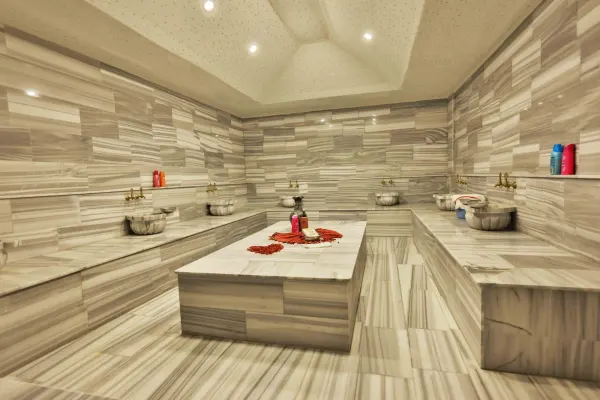
Literally associated with the central heated stone platform found in many hamams.
This large marble surface is usually located within the warm bathing chamber.
Guests may lie on the heated stone during part of the treatment.
Imagine stretching out comfortably on warm marble.
The surrounding atmosphere feels peaceful.
And you begin wondering why your ordinary bathroom doesn't have one of these.
Suddenly, the idea of renovating your entire bathroom becomes dangerously attractive!
But don't worry.
You can enjoy the tradition without redesigning your house!
Now comes one of the most famous parts of the experience.
The Kese!
A traditional exfoliating mitt is used by the bath attendant to remove dead skin cells from the surface of the skin.
And here's where things become rather entertaining.
You might think your skin is already perfectly clean.
After all, you shower regularly!
But during a traditional scrub, you may notice dead skin being removed.
And suddenly...
You begin wondering where all of that has been hiding!
Quite a surprising discovery!
The treatment should be performed with appropriate pressure and adjusted to the condition of your skin.
It shouldn't involve painful or excessively aggressive scrubbing.
And if you have sensitive or irritated skin, it's worth discussing that with the attendant beforehand.
Because the objective is to feel refreshed.
Not to emerge from the hamam looking like you've lost an argument with a piece of sandpaper!
Now, here's the part that many visitors absolutely love.
Köpük Massage!
The traditional foam treatment!
Imagine lying comfortably while the bath attendant covers you in soft, fluffy soap bubbles.
And we don't mean a tiny amount of ordinary soap.
We're talking about a wonderfully generous layer of foam!
The attendant then performs a gentle washing or massage treatment using the bubbles.
Quite relaxing, isn't it?
For a brief moment, you might feel like you've been transformed into an extremely comfortable cloud!
And after the exfoliation, the foam treatment can be a particularly pleasant part of the experience.
The traditional sequence generally ends with rinsing.
Depending on the facility, you may then have time to rest and enjoy the atmosphere.
Now, perhaps you're thinking:
"That sounds wonderful. But what if I want even more relaxation?"
Well, some Turkish Bath facilities also offer additional services.
For example, you might find optional oil massages or other spa treatments.
Certain venues provide relaxation areas where guests can enjoy refreshments afterward.
And of course, a glass of Turkish tea can be a lovely way to finish the experience.
Because apparently, even after spending an hour relaxing, Turks still believe a little tea will improve the situation!
And honestly?
They're probably right about the tea!
Actual services and treatment durations vary between hamams, so the experience depends on the selected facility and package.
Now, here's where things become even more interesting.
Cappadocia is famous for its extraordinary cave architecture.
Beautiful stone interiors.
Historical rock-cut buildings.
And unusual underground spaces.
So why should its wellness experiences look exactly like those in an ordinary city spa?
Some local spa facilities offer Turkish Bath experiences in cave-inspired or rock-carved surroundings.
Imagine entering a beautifully designed stone chamber.
The lighting is soft.
The atmosphere is peaceful.
And the surroundings remind you of Cappadocia's remarkable architectural heritage.
Now combine that environment with traditional Turkish bathing techniques.
Suddenly, centuries of Anatolian bathing culture meet the extraordinary atmosphere of Cappadocia!
Quite a wonderful combination!
Of course, not every hamam in Cappadocia is located inside an authentic historical cave.
Some use modern facilities inspired by local architecture.
But the atmosphere can still make the experience particularly memorable.
Here's something we particularly love about the hamam tradition.
It reminds us that slowing down can be an experience in itself.
Modern life is incredibly busy.
We're constantly working.
Traveling.
Answering messages.
And rushing toward the next responsibility.
Even during our holidays, we sometimes become so focused on sightseeing that we forget to relax!
But a Turkish Bath encourages something different.
Take your time.
Enjoy the warmth.
Appreciate the traditional treatments.
And give yourself an opportunity to rest.
And here's something worth remembering.
The most memorable part isn't always the treatment itself.
Sometimes it's discovering a cultural tradition that people have enjoyed for centuries.
Understanding the architectural history.
And experiencing a different approach to relaxation.
Because bathing isn't simply about getting clean.
In many cultures, it has also been connected with community, hospitality, and personal well-being.
And that's what makes the Turkish Bath such an interesting part of Anatolian heritage!
Experience:
Traditional Turkish Bath (Hamam)
Heated Bathing Area
Göbek Taşı (Heated Marble Platform)
Kese Exfoliation
Köpük Foam Massage
Relaxation and Rinsing
Optional Services:
Oil Massage
Additional Spa Treatments
Relaxation Area
Refreshments, depending on the facility
Location:
Selected Traditional or Cave-Inspired Turkish Bath Facilities in Cappadocia
Important Notes:
Treatment packages and durations vary by venue.
Guests should inform staff about sensitive skin, allergies, or relevant medical concerns.
Excessive heat may not be appropriate for everyone.
Guests should remain hydrated and avoid spending too long in uncomfortable temperatures.
Traditional bathing arrangements and attendant preferences vary by facility.
Come for the adventure, stay for the relaxation, and leave with a wonderful little piece of Turkish bathing culture!
And remember... there's absolutely nothing wrong with letting somebody else do the scrubbing for once!
1 guided tour includes a stop at Turkish Bath (Hammam) – A Journey Through Steam, Stone & History!.
Browse all Cappadocia attractions