Cappadocia Adventures
Cappadocia Adventures

History and architecture
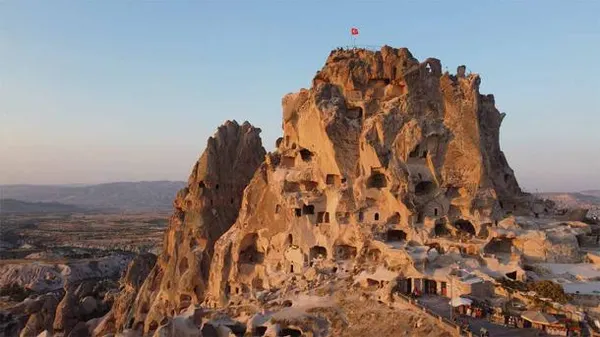
The “castle” is a natural volcanic outcrop honeycombed with man-made chambers, tunnels, and stairways. Occupied since at least Roman or early Byzantine times, it formed part of a network of rock-cut fortifications including Ortahisar Castle and Ürgüp. During periods of Arab raids (7th–11th centuries CE) it sheltered local Christians; later, under Seljuk and Ottoman rule, it retained value as a lookout. Many of its hundreds of carved rooms have since eroded, giving the formation its distinctive “honeycomb” appearance.
Visitor experience
Climbing to the summit takes about 15–20 minutes along steep, uneven stairs through cave-like passages. From the top, visitors see the entire Cappadocian landscape—Göreme’s fairy-chimney valleys, Ortahisar, and on clear days both Mount Erciyes and Mount Hasan. Around the base lie cafés, artisan shops, and the trailhead for Pigeon Valley leading toward Göreme. Sunrise and sunset are the most popular times for photography, when the rock glows gold and hundreds of hot-air balloons rise over the valleys.
Practical notes
Uçhisar lies 5 km from Göreme and 7 km from Nevşehir, reachable by minibus, taxi, or the standard Cappadocia “Red Tour.” The climb is moderately strenuous and not wheelchair-accessible; sturdy shoes and sun or wind protection are advised. Despite its modest size, the site remains one of Cappadocia’s defining viewpoints and an enduring symbol of the region’s blend of geology, history, and human adaptation.
Key facts
Location: Uçhisar village, Nevşehir Province, Türkiye
Elevation: ~1,350 m a.s.l.; ~60 m above the village
Historic use: Fortress and refuge since Roman–Byzantine eras
Current role: Protected viewpoint and major Cappadocia attraction
3 guided tours include a stop at Uçhisar Castle.
Browse all Cappadocia attractions