Cappadocia Adventures
Cappadocia Adventures

Geology, History, Craftsmanship, and a Little Bit of Madness!
Welcome to the Red Tour, one of the most fascinating ways to discover the extraordinary landscapes and remarkable history of Cappadocia!
Before we begin, here's something you should know.
Millions of years ago, volcanoes were erupting, the earth was moving, and nature was apparently feeling extremely creative.
The result?
A landscape filled with towering fairy chimneys, strange rock formations, mysterious cave dwellings, ancient churches, and castles that look like they belong in a fantasy movie.
But Cappadocia is not simply a geological wonder.
It is also a place where civilizations learned to live inside the very rocks nature created, where monks sought peace and isolation, where craftsmen transformed river clay into beautiful creations, and where communities developed extraordinary ways of surviving in an environment unlike almost anywhere else.
And today?
You get to explore it all without having to survive a volcanic eruption or build your own cave!
Quite a luxury, isn't it?
The Red Tour brings together three extraordinary elements of Cappadocian heritage: geology, history, and craftsmanship.
But instead of simply reading about them, you're going to stand where history happened, walk among nature's masterpieces, and meet the people keeping ancient traditions alive.
Because Cappadocia isn't a place you should only learn about.
It's a place you should feel, touch, explore, and remember.
Ready?
Let's discover what makes this remarkable region so special!
The excitement begins right in your hotel lobby!
Your professional tour guide will welcome you and provide a brief introduction to the day's itinerary.
And don't worry, we aren't going to throw hundreds of historical dates at you before you've even finished your morning coffee!
Your guide will introduce you to the fascinating history, geography, and cultural traditions of Cappadocia as you travel between its extraordinary landmarks.
Throughout the journey, you'll have the opportunity to ask questions, discover local stories, and understand how this unusual landscape became home to so many different civilizations.
And believe us, some of the answers are considerably more surprising than you might expect!
Now, depending on your selected itinerary, our first destination may be one of Cappadocia's most amusing natural wonders.
Welcome to Love Valley!
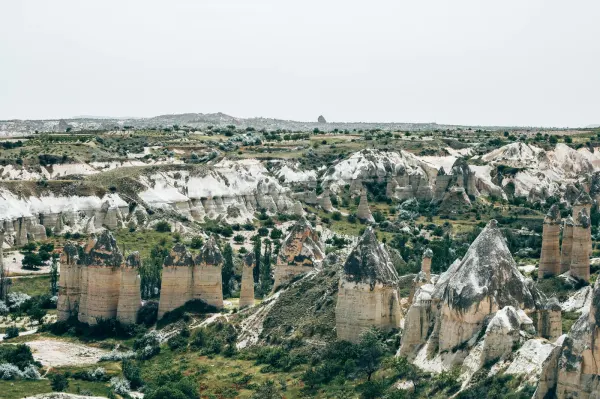
At first glance, Love Valley (Aşk Vadisi) appears to be another breathtaking Cappadocian landscape.
Towering rock formations rise dramatically from the valley floor, surrounded by beautiful volcanic scenery.
But take another look.
Notice anything unusual about those rocks?
Yes.
They look exactly like what you're thinking!
And no, your tour guide did not secretly carve them into those shapes to entertain tourists.
Nature did all the work!
Love Valley is particularly famous for its tall, slender fairy chimneys, whose distinctive shapes have made this one of Cappadocia's most recognizable landscapes.
But how exactly did they get here?
To understand the formations, we need to travel millions of years into the past.
During periods of intense volcanic activity, the region was covered by enormous quantities of volcanic material.
Mountains such as Erciyes, Hasan, and Güllüdağ played important roles in shaping the wider Cappadocian landscape.
Over immense periods of geological time, volcanic deposits and other sedimentary layers were exposed to the forces of erosion.
Rainwater, flowing streams, temperature changes, and wind gradually wore away the softer materials.
However, harder layers sometimes protected the rocks beneath them.
The result was a remarkable process called differential erosion, where some rock layers disappeared faster than others.
In Love Valley, the distinctive formations include softer lake sediments protected by harder volcanic deposits.
And after countless years of natural sculpting, these incredible pillars were left standing.
No architects.
No construction workers.
No expensive equipment.
Just nature working on a project for millions of years without ever requesting a salary!
From the viewpoint, you can admire the extraordinary rock formations and take photographs of this unforgettable landscape.
Your guide will explain the geological processes behind their creation and help you understand why Cappadocia looks so different from other destinations.
And if your imagination begins producing slightly inappropriate comparisons?
Don't worry.
You're probably not the first visitor!
After all, they didn't call it Love Valley for nothing!
After leaving Love Valley, we continue toward one of the most iconic landscapes in Cappadocia.
Welcome to Paşabağı, also known as Monks Valley!
Here, you'll encounter some of the region's most remarkable fairy chimneys.
Unlike the tall, slender formations of Love Valley, many of the fairy chimneys in Paşabağı resemble enormous stone mushrooms.
Some even have two or three caps!
No, they aren't giant mushrooms.
And please don't try to cook them.
These extraordinary formations developed as softer volcanic material eroded beneath more resistant layers, creating the distinctive capped structures visible today.
But geological beauty is only half the story.
The other half involves monks who apparently decided that ordinary houses weren't quite private enough.
During the Byzantine period, Cappadocia became an important center of Christian religious life.
Monasteries, chapels, and places of retreat were established throughout the region.
Some monks chose to live in isolation, dedicating their lives to prayer, reflection, and religious discipline.
And in Paşabağı, certain monks took isolation to an entirely different level.
They moved into the fairy chimneys!
Small chambers and chapels were carved directly into the rock formations, creating secluded spaces away from ordinary settlements.
One of the most significant examples is a chapel dedicated to Saint Simeon, located within a three-headed fairy chimney.
Saint Simeon was a famous fifth-century Christian ascetic from Syria, remembered for living atop a pillar as an extraordinary expression of religious devotion.
His example inspired similar traditions of religious seclusion.
Now imagine explaining this lifestyle to your friends today.
"Where do you live?"
"Inside a rock."
"Which floor?"
"Quite high up, actually."
"Do you have Wi-Fi?"
"My brother, I came here specifically to avoid distractions!"
Different centuries, different priorities!
Walking among these enormous formations, you'll discover how nature created their unusual shapes and how religious communities later adapted them for spiritual life.
Your guide will introduce you to the region's Christian heritage and explain the importance of the rock-cut chapels and hermit dwellings.
When permitted by site access, you may also see examples of the remarkable spaces carved into the formations.
It's one thing to read that monks once lived inside rocks.
It's something completely different to stand beneath those rocks and imagine what their everyday lives must have been like.
And that's the magic of Paşabağı!
Now we're heading somewhere truly extraordinary.
Welcome to Zelve Open-Air Museum!
Imagine walking through a village where homes, churches, storage rooms, and passageways were carved directly into volcanic rock.
No ordinary apartment buildings.
No modern construction cranes.
And certainly no complaints about your neighbors drilling holes in the wall.
Because practically everyone was drilling holes in the rocks!
Zelve is spread across three valleys and contains one of Cappadocia's remarkable collections of rock-cut architecture.
But what makes Zelve especially fascinating is that it wasn't merely a religious complex.
It was also a real settlement where people lived and worked.
Between approximately the ninth and thirteenth centuries, Zelve developed into an important center of Christian religious life.
Churches, monastic spaces, and religious buildings were established within the soft volcanic rock.
Among its notable historical churches are the Üzümlü (Grape), Balıklı (Fish), and Geyikli (Deer) Churches.
Their names refer to distinctive imagery associated with their decoration.
And yes, even centuries ago, people appreciated a little artistic creativity!
But Zelve's history didn't end with its early Christian communities.
Over time, the settlement also became home to Muslim residents, reflecting the changing cultural and religious history of Anatolia.
The presence of a mosque alongside churches offers a fascinating reminder that Cappadocia's history is not the story of just one community.
It is the story of many people, beliefs, and traditions sharing the same extraordinary landscape across different centuries.
Here's where things become particularly interesting.
The volcanic rock found throughout Cappadocia is relatively soft and workable compared with many other building materials.
This allowed local inhabitants to carve rooms and passages directly into the landscape.
Instead of constructing an entire building from the ground up, people could create usable spaces within the rock itself.
These spaces served different purposes, including homes, religious buildings, food storage areas, and working environments.
And the rock provided another practical advantage.
Its insulating properties helped create more stable indoor temperatures compared with the extremes outside.
Considering Cappadocia's hot summers and cold winters, that was rather clever!
Natural insulation, centuries before modern energy-efficient architecture became fashionable.
Not bad, ancient Cappadocians.
Not bad at all!
Now comes the rather emotional part.
Despite its long history as a settlement, Zelve eventually became unsuitable for continued habitation.
The gradual deterioration of the rock formations and associated safety concerns contributed to the relocation of its residents.
The settlement remained inhabited until 1952, when the local population was resettled.
Think about that for a moment.
While many of us associate cave settlements with distant ancient history, people were still living in Zelve during the twentieth century!
Your grandparents may have been alive while families were still calling these extraordinary rock-cut houses home.
Suddenly, history doesn't feel quite so distant, does it?
As you explore the museum's accessible paths, your guide will help you identify the different spaces carved into the valley walls.
You'll discover how communities organized their settlements, how their religious traditions changed through time, and why the region's unique geology influenced their everyday lives.
You can observe the remains of churches, communal spaces, and traditional rock-cut structures while imagining the people who once used them.
Reading that people lived inside rocks makes you aware of history. Walking through the places where they lived makes that history feel real.
And we believe there's a tremendous difference between those two experiences.
After discovering how people carved and shaped the rocks of Zelve, it's time to see what nature created without any human assistance.
Welcome to Devrent Valley!
Also known as Imagination Valley, this fascinating destination is famous for rock formations that resemble animals, people, and other recognizable objects.
But here's something important.
Unlike many other valleys in Cappadocia, Devrent is not particularly known for ancient cave churches or rock-cut settlements.
Its greatest attraction is nature itself.
And nature apparently decided to organize an outdoor sculpture exhibition!
One of the valley's most famous attractions is a natural rock formation resembling a camel.
And when we say camel, we really mean it!
From the right angle, you can recognize its characteristic shape.
But the camel is only the beginning.
Visitors have compared other rock formations to rabbits, birds, dolphins, human silhouettes, and countless imaginary creatures.
The fascinating thing is that different people see different things.
One visitor might recognize an animal.
Another might see a person.
And someone with an especially creative imagination may discover something nobody else has noticed!
If your friend sees a dinosaur where you see a rabbit, please don't argue. You're both on holiday!
The answer lies in the same geological forces responsible for Cappadocia's fairy chimneys.
Different rock layers respond differently to erosion, and over time, rainwater, wind, and other natural processes gradually create unusual shapes.
Some formations happen to resemble familiar objects.
Our brains are particularly good at recognizing patterns, even when no one intentionally created them.
This phenomenon is known as pareidolia.
Quite a complicated scientific word for something very simple:
Your brain looks at a rock and says, "That looks like a camel!"
And just like that, a geological formation becomes an imaginary animal.
Your guide will introduce you to the valley's most recognizable formations and explain how erosion has shaped the landscape.
But here's our suggestion:
Don't immediately ask your guide what every rock represents.
Take a moment to look around and decide for yourself.
Let your imagination do the work!
Because Devrent isn't simply about discovering what nature has created.
It's about discovering what your own imagination is capable of seeing.
After watching nature shape the landscape for millions of years, it's time to meet the people who learned to shape a small piece of that very landscape.
Welcome to Avanos!
This charming Cappadocian town sits along the banks of the Kızılırmak, also known as the Red River.
And before you ask, no, the river isn't filled with red wine.
Although we must admit, that would make the local geography considerably more entertaining!
The Kızılırmak is the longest river flowing entirely within Türkiye, and its sediments have played an important role in the local pottery tradition.
Avanos has a remarkably long history of ceramic production.
The region's pottery-making tradition is commonly traced back to the Hittite period, thousands of years ago.
The Hittites were one of the major civilizations of ancient Anatolia, developing sophisticated systems of administration, trade, and craftsmanship.
And apparently, they also understood something extremely important:
If you want to prepare, store, and serve food properly, you're going to need some decent pots!
Over many centuries, local craftsmen continued developing techniques for transforming clay into practical and decorative objects.
The river's red sediments, together with suitable clay deposits from the surrounding area, provided important raw materials.
After gathering and preparing the clay, potters shaped it using traditional methods, including the pottery wheel.
The finished objects were dried and fired in kilns, transforming soft clay into durable ceramics.
Water jugs, storage containers, cooking vessels, and decorative pieces became part of the region's craft heritage.
And that tradition remains alive today.
Now, here's where things get exciting.
During your visit to a traditional pottery workshop, you'll have the opportunity to observe experienced craftsmen transforming a seemingly ordinary lump of clay into a beautiful ceramic object.
First, the clay is carefully prepared.
Then it is placed on the rotating wheel.
Using controlled hand movements, the potter gradually shapes the material into the desired form.
It looks remarkably simple when a professional does it.
Almost effortless!
But don't be fooled.
Pottery requires patience, precision, coordination, and years of practice.
And if you have the chance to try the wheel yourself, you'll quickly discover something rather amusing.
Your instructor might create a beautiful vase in just a few minutes.
You?
You might invent a completely new species of bowl!
But that's absolutely fine.
Art isn't always about perfection.
Sometimes it's about enjoying the process, making mistakes, and laughing at your own creation.
You'll discover how local craftsmen continue practicing techniques connected to an ancient Anatolian tradition.
Your guide and the workshop artisans can explain the preparation of clay, the importance of the pottery wheel, and the stages of drying, firing, and decorating ceramics.
Depending on the workshop program, you may even have the opportunity to try shaping clay yourself.
And this is exactly why we love experiences like this.
Reading about pottery teaches you how ceramics are made.
But feeling the clay between your fingers, watching it spin beneath your hands, and trying to control its shape gives you a completely different understanding of the craft.
One gives you information.
The other gives you a memory.
And perhaps a slightly crooked bowl!
Now, after exploring extraordinary valleys, ancient settlements, and thousands of years of craftsmanship, we have a small situation to address.
Your stomach.
Yes, we've heard it too.
And frankly, it has been very patient!
It's time for lunch!
After all, you can't expect anyone to investigate centuries of history on an empty stomach.
During the lunch break, you'll have the opportunity to relax, recharge, and enjoy a selection of delicious Turkish flavors according to the restaurant and menu included in your tour.
Turkish cuisine has been shaped by centuries of Anatolian culinary traditions, regional ingredients, and cultural exchange.
And Cappadocia has some especially interesting local specialties.
From traditional meat dishes and savory pastries to rich vegetable recipes, the region offers plenty of delicious ways to satisfy your appetite.
Depending on the restaurant and menu, you may encounter regional dishes such as Testi Kebab (Pottery Kebab), one of Cappadocia's best-known culinary specialties.
And what makes Pottery Kebab particularly interesting?
The food can actually be cooked inside a clay vessel!
Remember what we just learned about pottery in Avanos?
Well, here's another delicious example of how local craftsmanship and cuisine can come together.
The same broader tradition of working with clay has helped create vessels used in Anatolian kitchens for generations.
Who knew a little mud could eventually contribute to such a wonderful lunch?
Now eat well.
Because we still have one rather impressive castle to discover!
Our next destination is one of the most recognizable landmarks in Cappadocia.
Welcome to Uçhisar Castle!
But before you start imagining a European-style fortress with enormous stone walls, royal bedrooms, and a beautifully decorated throne room, we should explain something.
This castle is different.
Very different!
Because much of Uçhisar Castle was not constructed by stacking building materials on top of one another.
It was carved directly into an enormous natural rock formation!
Apparently, the people of Cappadocia looked at a gigantic rock and thought:
"That's a nice mountain."
"Shall we build a fortress?"
"No, no. Let's just live inside it!"
And that's how extraordinary human creativity met Cappadocia's unusual geology.
Uçhisar occupies an elevated position overlooking much of the surrounding region.
Throughout different historical periods, its commanding location made it valuable for observation, habitation, and defense.
The rock formation contains chambers and passages that were adapted for practical purposes over time.
Its elevated position offered an important advantage: people could observe movement across the surrounding landscape.
And in periods when security was a serious concern, visibility mattered enormously.
Imagine being responsible for defending a settlement.
Would you rather stand in an ordinary building surrounded by hills?
Or occupy one of the highest and most imposing natural formations in the region?
Exactly.
Ancient strategic thinking at its finest!
Uçhisar's carved interiors reflect the practical needs of the people who used the site.
Different spaces served as living quarters, storage areas, and defensive facilities.
The wider settlement developed through many centuries, including the Byzantine, Seljuk, and Ottoman periods.
This layered history is part of what makes the castle so fascinating.
It isn't simply the monument of one ruler or one civilization.
It is a landscape shaped by nature and repeatedly adapted by human communities.
During the sightseeing stop, you'll have the opportunity to admire the remarkable rock-cut fortress and learn about its strategic importance.
Your guide will explain how its unusual architecture developed and why Cappadocia's inhabitants adapted natural rock formations into places of shelter and defense.
The surrounding viewpoints also offer magnificent panoramas of the Cappadocian landscape.
If your itinerary includes entry and summit access, you may be able to enjoy the remarkable views from above.
And when you look across the valleys, fairy chimneys, and distant volcanic mountains, you'll understand something.
Cappadocia isn't only extraordinary when you stand among its rocks. It's equally extraordinary when you look over them!
Depending on your selected tour and preferences, you may also visit a traditional Anatolian carpet workshop.
And if you think carpets are simply decorative objects placed beneath coffee tables, we have some history to share!
The art of carpet weaving has deep roots in Anatolian culture.
For centuries, communities across Türkiye developed distinctive weaving techniques, decorative patterns, and textile traditions.
Anatolian carpets became valued not only for their practical uses but also for their craftsmanship and artistic beauty.
During the Seljuk and Ottoman periods, carpet production gained considerable cultural and commercial importance.
Turkish carpets eventually traveled far beyond Anatolia.
They became admired in foreign markets and were even depicted in European Renaissance paintings.
That's right.
Before fashionable luxury brands took over the world, Anatolian carpets were already making international appearances!
Traditional carpet weaving involves a remarkable amount of preparation and patience.
Wool, cotton, or silk may be used depending on the type of carpet.
Threads are prepared, sometimes colored using natural dyes, and arranged on a loom.
The weaver then creates the design through a careful combination of knots and weaving techniques.
Some elaborate carpets require an extraordinary number of individual knots.
And each knot contributes to the finished work.
Imagine spending weeks, months, or even longer creating a single beautiful piece.
Now imagine somebody walking across it with muddy shoes.
We strongly recommend not doing that in front of the person who made it!
One of the most fascinating elements of traditional Anatolian weaving is the use of symbolic motifs.
Different patterns can represent ideas connected to fertility, protection, abundance, family, nature, and the continuity of life.
Their meanings can vary according to region and tradition.
Some commonly recognized motifs include the Tree of Life, associated with continuity and eternity, and Elibelinde, often linked with femininity and fertility.
These patterns help transform carpets from simple household objects into expressions of cultural identity.
During a carpet workshop visit, you can discover how traditional weaving techniques work and learn about the craftsmanship behind handmade textiles.
Depending on the workshop, you may observe artisans working at looms and see examples of different patterns, materials, and knotting methods.
And here's something worth remembering:
A machine can reproduce a pattern. But understanding the patience, skill, and cultural tradition behind a handmade carpet requires looking beyond the finished product.
That's what makes witnessing the craft so special.
Perhaps you're thinking:
"Okay, I've seen enough carpets. Is there something beautiful I can actually wear?"
Well, we have good news!
Depending on your chosen itinerary, you may have the opportunity to visit a leather workshop.
Leatherworking has a long history in Anatolia, where leather was traditionally used to produce practical goods such as footwear, belts, bags, and other everyday necessities.
Over time, leather processing and craftsmanship developed into sophisticated trades.
During the Ottoman period, different types of leather goods were produced for both practical and decorative purposes.
Skilled artisans worked with cutting, stitching, dyeing, and finishing techniques to create durable and attractive products.
And today, modern Turkish leather craftsmanship combines traditional knowledge with contemporary design.
At a leather workshop, you may discover examples of leather production, finishing techniques, and contemporary Turkish leather goods.
Depending on the venue, visitors may learn about materials, design, and the workmanship involved in producing leather clothing and accessories.
From elegant jackets to beautifully crafted bags, the workshop offers a different perspective on the craftsmanship associated with Türkiye.
And who knows?
You might arrive intending to discover history and leave thinking about your next winter wardrobe.
We came for the history. We stayed for the jacket!
Naturally, purchases are optional.
The purpose of the visit is to give you another opportunity to explore the variety of craftsmanship found in Turkish culture.
After a day filled with extraordinary landscapes, fascinating historical discoveries, and traditional craftsmanship, it's time to return to your hotel.
But don't worry.
Cappadocia isn't finished entertaining you yet!
Depending on the duration of your tour and the stops you've selected, you may still have time to enjoy one of the region's beautiful sunset experiences.
Perhaps you'd like to explore the valleys on an ATV adventure.
Maybe a horseback ride through the dramatic rock formations sounds more appealing.
Or perhaps you'd prefer a relaxing evening at your hotel, enjoying the scenery with a cup of Turkish tea.
All excellent decisions!
If you prefer not to include the optional workshop visits, an earlier hotel return may be possible, subject to the day's schedule.
After all, Cappadocia offers something for every kind of traveler.
Those who love history.
Those who love nature.
Those who love adventure.
And those who simply want to take magnificent photographs and make everyone back home slightly jealous!
We understand all of you.
Don't Just Read About Cappadocia. Experience It!Now, you've probably discovered quite a lot about Cappadocia.
You've learned how volcanoes and erosion created the fairy chimneys.
You've discovered why monks carved their shelters into towering rocks.
You've explored the fascinating story of communities living in rock-cut villages.
You've learned how ancient craftsmen transformed river clay into beautiful pottery.
And you've discovered how people turned giant natural rock formations into places of defense and shelter.
Wonderful!
But let us ask you something.
Do you really think reading all of this is enough?
Of course not!
Imagine reading about Love Valley without standing in front of those extraordinary formations.
Learning about the monks of Paşabağı without seeing the rock-cut chambers where their traditions took shape.
Discovering the history of Zelve without walking through the valley where generations of families lived.
Or reading about pottery without ever witnessing a skilled artisan transform a lump of clay into a beautiful vessel.
You would certainly learn something.
But you would be missing the most beautiful part.
The experience itself!
There is something we truly believe:
Reading makes you aware, but experiencing takes you far beyond awareness.
Reading teaches you what something is. Experiencing teaches you what it feels like.
You can read about history, memorize dates, and understand how civilizations lived. But when you stand where those people once stood, walk through the places they called home, and touch the materials they transformed with their own hands, history stops feeling like a collection of facts.
It becomes something personal.
And what you genuinely feel is what you never forget.
Picture yourself standing beneath the enormous fairy chimneys of Paşabağı.
For a moment, you look upward and imagine a monk living in one of those rock-cut shelters centuries ago.
No electricity.
No smartphones.
No modern comforts.
Just silence, stone, and spiritual devotion.
You can suddenly appreciate how dramatically different life once was.
Then imagine walking through Zelve.
You see the entrances to former homes and religious spaces.
You look toward the old settlement and wonder about the people who once walked through those same valleys.
What did they eat?
How did they spend their days?
What were they afraid of?
What made them happy?
Suddenly, those old caves aren't simply holes in the rocks anymore.
They were people's homes.
Places where families worked, prayed, celebrated, and experienced everyday life.
And that's when history becomes truly fascinating.
Now picture yourself in Avanos.
You sit beside a pottery wheel, ready to try a technique that has been practiced in the region for thousands of years.
Your instructor makes it look effortless.
You put your hands on the clay.
The wheel begins turning.
And within seconds, you realize that pottery is considerably harder than it looks.
Your masterpiece might end up resembling a very confused potato.
But you'll laugh.
You'll learn.
And years later, you'll remember that moment far more vividly than a paragraph you once read about pottery.
Because you were there. You experienced it. And you became part of the story.
Of course, Cappadocia offers plenty of beautiful souvenirs.
Handmade ceramics.
Traditional carpets.
Locally produced goods.
Wonderful pieces of craftsmanship.
But we believe the most valuable thing you can take home from Cappadocia is something that won't fit inside your suitcase.
A memory.
The moment you first stood beneath a towering fairy chimney.
The laughter when your friend discovered an outrageous shape in Love Valley.
The surprise of learning how recently people still lived in Zelve.
The satisfaction of watching a local craftsman work with techniques passed down through generations.
And perhaps the pride of successfully shaping your first little piece of clay.
These are the experiences that turn an ordinary holiday into an unforgettable journey.
Because years from now, you might forget the exact geological terminology.
You might forget a few historical dates.
You might even forget what you had for lunch.
Although, considering Turkish cuisine, we sincerely doubt that last one!
But you'll remember how Cappadocia made you feel.
Cappadocia has spent millions of years preparing its extraordinary landscapes.
Civilizations have spent centuries building, carving, creating, and leaving their marks upon them.
Craftsmen have passed their knowledge from one generation to another.
And all these stories are still waiting to be discovered.
The only thing missing?
You!
So put away the endless travel articles.
Stop wondering whether the fairy chimneys really look that extraordinary in person.
And don't just imagine what it might feel like to explore an ancient rock-cut village.
Come and experience it!
Walk among the fairy chimneys.
Discover the hidden stories.
Meet the local craftsmen.
Ask questions.
Take photographs.
Laugh at the strange rocks.
And most importantly, create memories that belong entirely to you.
Because at the end of the day:
Reading introduces you to Cappadocia.
Experiencing Cappadocia makes you fall in love with it.
And once you've experienced it, you'll understand why this extraordinary place has fascinated travelers for generations.
Join our Cappadocia Red Tour and turn millions of years of history into one unforgettable day!
The rocks have been waiting for millions of years.
It's about time you came to meet them!
3 guided tours include a stop at Cappadocia Red Tour | Fairy Chimneys, Zelve & Avanos.
Browse all Cappadocia attractions